Palampet pillar inscription of Recherla Rudra
A Sanskrit verse inscription of 31 March 1213 on a basalt pillar at the Ramappa temple. It praises the Kakatiya king Ganapatideva and records the temples, town and gifts of his general Recherla Rudra.
What it is
This is the founding record of the temple now called the Ramappa temple at Palampet. It was first published in 1919, edited by L. D. Barnett.1 He worked from ink impressions that G. Yazdani took in December 1916.1 Its subject is the pious works and virtues of Recherla Rudra, a general in the service of the Kakatiya king Ganapatideva.1 The Nizam’s government wrote a note in the 1919 edition.1 It said that the verses on the founding of a city and a temple to Rudreshvara “apparently refer to the old city of Palampet and the temple there”.1
The pillar
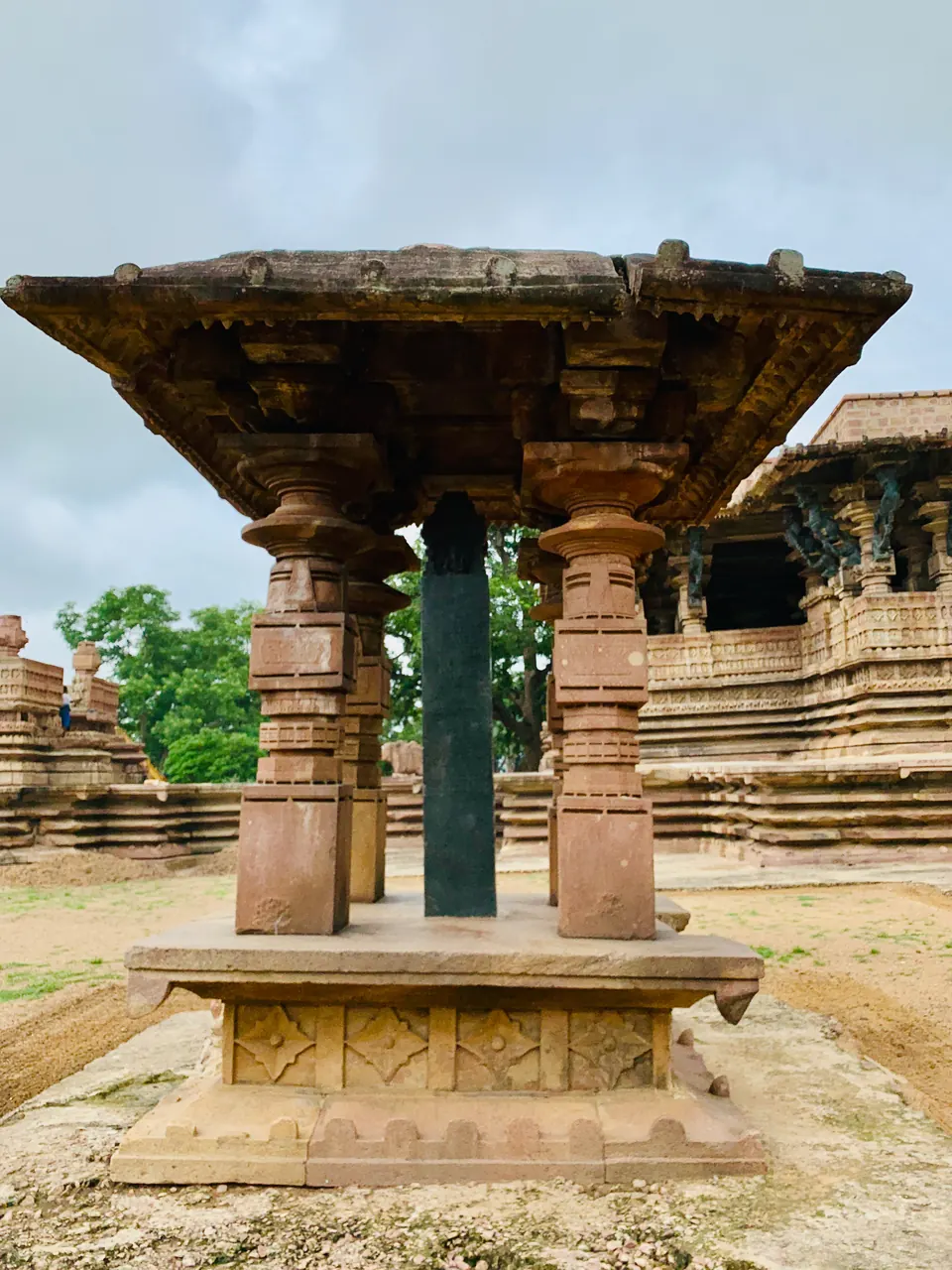
The inscription is cut on the four faces of a square pillar of polished black basalt standing north-east of the temple.2 Yazdani placed it in front of a square pavilion (chhatri) inside the temple enclosure.3 At the top of the pillar is a small truncated (cut-off) spire.2 Below it, each face has a sunken panel carved in high relief:2
The text is in Telugu characters of the period.2 The language is Sanskrit, and the whole record is in verse, in a range of classical metres.2 A 2021 evaluation for UNESCO describes it as running to 204 lines.4
Date
The grant in verses 47–48 is dated Saka 1135 (Saka is an Indian way of counting years), the cyclic year Srimukha.5 The day was the eighth of the bright half of Chaitra, a Sunday, under the asterism (star) Pushya.5 Barnett calculated this as Sunday, 31 March 1213.5 He thanked Robert Sewell for help in checking it.5
Contents
After prayers to Ganesha, Sarada, Shiva and Vishnu, four verses praise Ganapatideva.2 The poet then traces Rudra’s family:26
- A general named Brahma took Kanchi for a Kakatiya king.26
- Kataya followed in the same family.26
- Then came Kama, who as commander of king Prola’s army killed Manthanya-Gunda.26
- Kama’s son Kataya and his wife Kamamba were Rudra’s parents.26
Several verses refer to the troubled years around 1200. When “king Rudra” (apparently the Kakatiya Rudradeva) died, the enemies he had beaten rose up together. The general Rudra made a king named Nagati flee.7 At a time of crisis he restored the Kakatiya kingdom.7 Barnett translated the verse: “when the Fortune of the Kakati Monarch through error had set her foot among many sharp thorns … himself by the might of his arm forcibly crushed and removed those”.7
Rudra consecrated a Rudreshvara at Orugallu (Warangal) and gave it the village of Nekkonda.8 He also built a city with tall buildings, beside a pond that the poet compares to the ocean.8 The city was full of the sounds of elephants, horses, music, Vedic recitation and debate.8
In this city Rudra consecrated another Rudreshvara, whose temple had a golden cupola.5 In 1213 he gave the god the villages of Upparlapalli and Borlapalli.5 A last gift granted the village of Nradkude to Rudreshvara, Kateshvara and Kameshvara at Atukuru. Barnett noted that the last two names honour Rudra’s father and grandfather.56
Significance
The record is the main evidence for the date and founder of the Ramappa temple.1 Parabrahma Sastry read its account of a crisis as a reference to the years after Ganapatideva’s father Mahadeva was killed fighting the Yadavas.910 In those years the young Ganapati was held captive at Devagiri, and Recherla Rudra kept the kingdom together.910
Parabrahma Sastry also connected the great lake beside the temple with Recherla Rudra’s work in 1213.11 He describes this Recherla family as Reddis, distinct from the Velama family of the same name.12 A Telugu inscription of Saka 1157 at Uparpalli, published with this one, gives Rudra’s parents differently, as Kata-reddi Bejjama and Bejjamamba.13
Editions
The inscription was first published by Barnett in Inscriptions at Palampet and Uparpalli (Hyderabad Archaeological Series No. 3, 1919), with text, translation and notes.1 Yazdani identified the places it names on a map.14 Among them were Recherla in Karimnagar district and Nradkude, which he took to be Nuddakuda in Parkal taluk.14
Footnotes
-
L. D. Barnett (ed.), Inscriptions at Palampet and Uparpalli (1919), p. v (archive.org (opens in a new tab)). ↩ ↩2 ↩3 ↩4 ↩5 ↩6 ↩7
-
Barnett, Inscriptions at Palampet and Uparpalli (1919), p. 1 (archive.org (opens in a new tab)). ↩ ↩2 ↩3 ↩4 ↩5 ↩6 ↩7 ↩8 ↩9 ↩10 ↩11 ↩12 ↩13 ↩14 ↩15
-
G. Yazdani, The Temples at Palampet, Memoirs of the Archaeological Survey of India 6 (1922), p. 177. ↩
-
ICOMOS, Rudreshwara (Ramappa) Temple (India), No 1570: Evaluation (2021), p. 40 (whc.unesco.org (opens in a new tab)). ↩
-
Barnett, Inscriptions at Palampet and Uparpalli (1919), p. 2 (archive.org (opens in a new tab)). ↩ ↩2 ↩3 ↩4 ↩5 ↩6 ↩7
-
Barnett, Inscriptions at Palampet and Uparpalli (1919), p. 8 (archive.org (opens in a new tab)). ↩ ↩2 ↩3 ↩4 ↩5 ↩6
-
Barnett, Inscriptions at Palampet and Uparpalli (1919), p. 9, verses 21–24 (archive.org (opens in a new tab)). ↩ ↩2 ↩3
-
Barnett, Inscriptions at Palampet and Uparpalli (1919), pp. 10–11, verses 33–46 (archive.org (opens in a new tab)). ↩ ↩2 ↩3
-
P. V. Parabrahma Sastry, The Kakatiyas of Warangal (1978), p. 106. ↩ ↩2
-
Parabrahma Sastry, The Kakatiyas of Warangal (1978), p. 116. ↩ ↩2
-
Parabrahma Sastry, The Kakatiyas of Warangal (1978), p. 205. ↩
-
Parabrahma Sastry, The Kakatiyas of Warangal (1978), p. 143. ↩
-
Barnett, Inscriptions at Palampet and Uparpalli (1919), p. 14 (archive.org (opens in a new tab)). ↩
-
Barnett, Inscriptions at Palampet and Uparpalli (1919), p. vi (archive.org (opens in a new tab)). ↩ ↩2
Photos
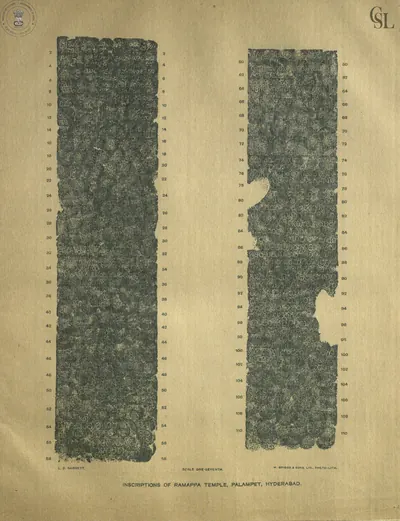 Inscriptions of Ramappa temple, Palampet (pillar inscription, first two faces) (Barnett 1919)Inscription rubbing · 1919
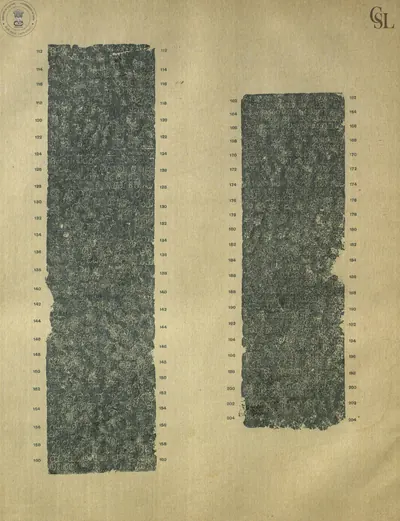 Inscriptions of Ramappa temple, Palampet (pillar inscription, remaining faces) (Barnett 1919)Inscription rubbing · 1919
 Pavilion of the Ramappa foundation inscription pillarPhotograph · 2019
References
Notes (0)
Sources (3)
Spotted an error on this page? Tell us
Last updated: