Chebrolu inscription of Jaya
Sanskrit and Telugu inscription on a pillar of the Nagesvara temple at Chebrolu. It records that the Kakatiya king Ganapatideva gave the town to his general Jaya in Saka 1135 (1213–14), the earliest proved date of his reign, and it lists the lands of the town's temples. It marks the Kakatiya takeover of Velanadu, the country of the Velanati Chodas.
What it is
The inscription is engraved on the four faces of a pillar at the Nagesvara temple at Chebrolu.1 It is the right-hand one of two pillars in front of the gopura (gate tower).1 Chebrolu was in the Bapatla taluk of the old Krishna (then Kistna) district.1 E. Hultzsch edited the inscription in Epigraphia Indica in 1899.1 He worked from an inked estampage (ink copy) made by H. Krishna Sastri in 1897.1
Hultzsch found it so well preserved that its letters “can be read as easily as print”.1 It is in the Telugu alphabet, in Sanskrit verse with a long passage of Telugu prose.1
Contents
After invocations, the verses give the family line of the Kakatiya king Ganapatideva, from Durjaya through Beta, Prola, Rudra, Mahadeva and Ganapati.1 Verses 13–27 concern Jaya, or Jayana, whose family line is given in the Ganapesvaram inscription.2 He was chief of the elephant troops of King Ganapati.2 In the month of Chaitra of Saka 1135 (Saka is an Indian way of counting years), the year Srimukha, he received from his sovereign the city of Chebrolu.2
The verses call the town the city of Shanmukha, after its temple of Kumarasvamin, the present Nagesvara.2 They also call it Tamrapuri.2 Hultzsch took both names for Sanskrit renderings of the Telugu Chembrolu.2 The verses credit Jaya with building a wall round Chebrolu and repairing its temples.2
The temple lists
The Telugu portion lists the villages and shares belonging to the temples of Chebrolu.2 It also lists the persons who had given lamps.2 Hultzsch thought the list was compiled from the temple records at Jaya’s order.2
Among the temples named is one of Ananta-Jina.2 It perhaps stood on the site of a Siva temple in whose courtyard Krishna Sastri found three carved Jaina figures.2 The list of shares names the temple’s servants.3 Among them are three hundred dancing-girls, a dancing-master, drummers, singers, an astrologer, a doctor and an accountant.3
Date and significance
Hultzsch called Saka 1135 (1213–14) “the earliest authenticated date of Ganapati’s reign”.2 He thought the inscription itself might have been engraved some years later, since Jaya’s buildings would have taken time.2
A postscript to the edition prints part of another inscription of Jaya.3 It stands on a pillar now built into the roof of the Lingodbhavasvamin temple at Tsandavolu, “the capital of the chiefs of Velanandu”.3 See Chandavolu and the Velanati Chodas.
The Godavari District Gazetteer (1907) called this Chebrolu record the first undoubted Kakatiya inscription in the Vengi country.4 It read the Tsandavolu inscription as showing that Ganapati overcame the Velanandu chiefs.4
P. V. Parabrahma Sastry took the date as the time when Ganapati made Jaya governor of the Velanadu country.5 In his view this came after the defeat of the Velanati king Prithvisvara.5 He noted that the same inscription says Ganapati gave Jaya the lordship of the region on his return from his southern expedition.6
Older records at Chebrolu
Hultzsch noted that an older inscription at Chebrolu, of the Velanati chief Gonka, is dated in Saka 998 (1076).2 Gordon Mackenzie (1883) recorded inscriptions of Prataparudra’s reign at the Nagesvara temple.7 He also recorded a local tradition about the old temples of Chebrolu.7 According to it, treasure-seekers under the zamindar (landholder) Vasireddi Venkatadri Nayudu damaged them early in the 19th century.7
Footnotes
-
E. Hultzsch, “Chebrolu Inscription of Jaya; after Saka-Samvat 1135”, Epigraphia Indica V (1899), p. 142 (archive.org (opens in a new tab)). ↩ ↩2 ↩3 ↩4 ↩5 ↩6 ↩7 ↩8
-
Hultzsch, “Chebrolu Inscription of Jaya” (1899), p. 143 and notes (archive.org (opens in a new tab)). ↩ ↩2 ↩3 ↩4 ↩5 ↩6 ↩7 ↩8 ↩9 ↩10 ↩11 ↩12 ↩13 ↩14 ↩15
-
Hultzsch, “Chebrolu Inscription of Jaya” (1899), p. 150 and postscript (archive.org (opens in a new tab)). ↩ ↩2 ↩3 ↩4
-
F. R. Hemingway, Madras District Gazetteers: Godavari, Vol. I (1907), p. 24 (archive.org (opens in a new tab)). ↩ ↩2
-
P. V. Parabrahma Sastry, The Kakatiyas of Warangal (1978), p. 108. ↩ ↩2
-
Parabrahma Sastry, The Kakatiyas of Warangal (1978), p. 109. ↩
-
Gordon Mackenzie, A Manual of the Kistna District (1883), p. 203 (archive.org (opens in a new tab)). ↩ ↩2 ↩3
Photos
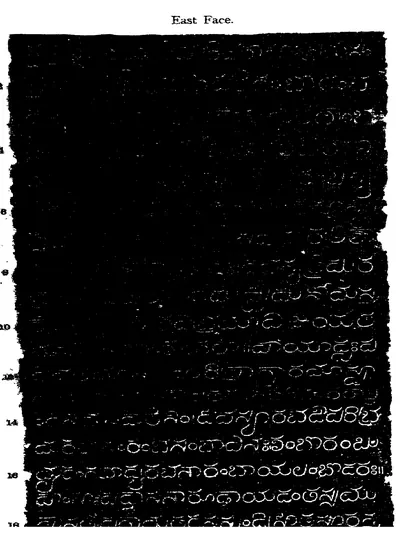 "Chebrolu Pillar Inscription of Jaya; after Saka-Samvat 1135", east face, opening lines (numbered 2 to 18) (Epigraphia Indica V, plate between pp. 146 and 147 (PDF p. 204))Inscription rubbing · 1899
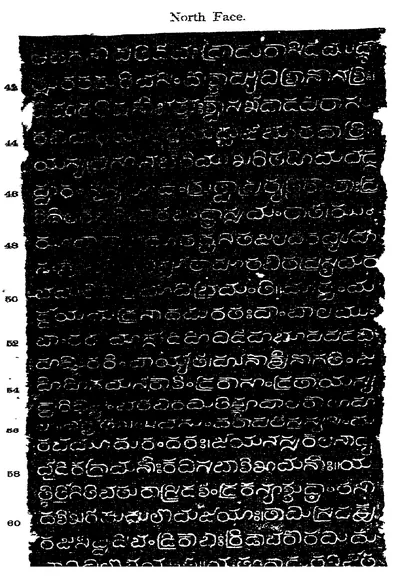 "Chebrolu Pillar Inscription of Jaya; after Saka-Samvat 1135", north face, part (lines numbered 43 to 60) (Epigraphia Indica V, plate between pp. 146 and 147 (PDF p. 204))Inscription rubbing · 1899
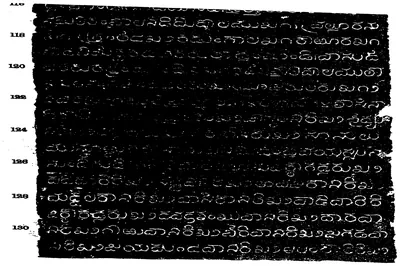 "Chebrolu Pillar Inscription of Jaya; after Saka-Samvat 1135", second page of the plate, lines 116-131 (Epigraphia Indica V, plate between pp. 146 and 147 (PDF p. 205))Inscription rubbing · 1899
References
Notes (0)
Sources (4)
Spotted an error on this page? Tell us
Last updated: