Pikira grant of Simhavarman
A Sanskrit copper-plate grant issued from the camp at Menmatura in the fifth year of the Pallava king Simhavarman, son of the crown prince Vishnugopa. It gives the village of Pikira in Mundarashtra to the Brahman Vilasasarman. The village munsiff (headman) of Nelatur in the Ongole taluk sent in the plates, which had been the unclaimed property of a dead ascetic. E. Hultzsch edited the grant in 1906.
The Pikira grant is one of four surviving grants of the Pallava king Simhavarman, son of the crown prince Vishnugopa.12 E. Hultzsch edited it in 1906.23 He used it to argue that the Uruvupalli grant too belonged to this king’s reign.23
Discovery and description
V. Venkayya obtained the plates on loan from the Madras Museum, to which the Collector of Nellore had sent them.12 They had been sent originally “by the village Munsiff of Nelatur, Ongole taluka, now part of the Guntur district, to the Deputy Tahsildar of Addanki”.12 They had formed part of the unclaimed property of a dead Bairagi, a wandering ascetic.12
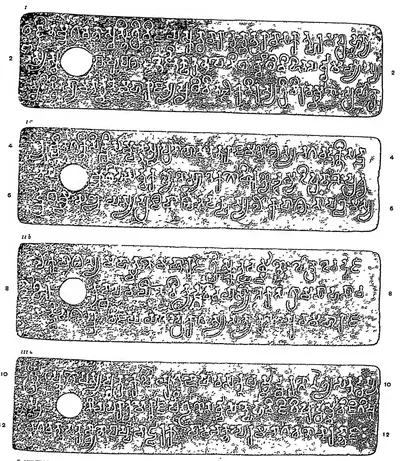
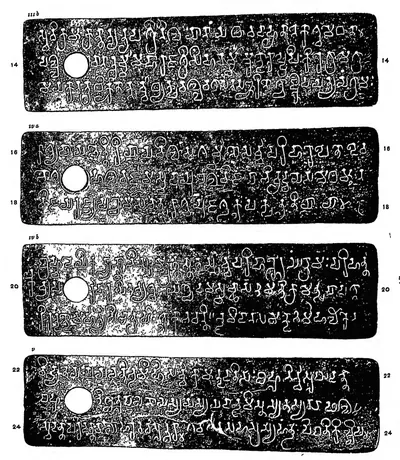
There are five plates on a ring, weighing together 70 tolas.2 The worn seal shows an animal with open mouth, sitting on a line.2 It is very like the animal on the seal of the Uruvupalli grant.2 Plates i, iib and ivb are numbered with the old numerical symbols 1, 2 and 4.2
Script and language
The language is Sanskrit prose, with three Sanskrit verses at the end.2 The alphabet closely resembles that of the Uruvupalli and Mangalur grants.2 Hultzsch noted one difference.2 The Uruvupalli grant gives ta a loop, as in Tamil, and na none, while this grant uses both forms for both letters.2
Content
The grant opens with the invocation jitam bhagavata, “victory has been achieved by Bhagavat (Vishnu)”, as in the Uruvupalli and Mangalur grants.24
It was issued from “the prosperous camp of victory pitched at Menmatura”.34 Its issuer was the fervent Bhagavata (devotee of Vishnu) Simhavarman, rightful Maharaja of the Pallavas.34 He was the son of the crown prince Vishnugopa, grandson of the Maharaja Skandavarman and great-grandson of the Maharaja Viravarman.34 He addressed the villagers of Pikira in Mundarashtra and the officers of the district.34
He told them that the village had been made a Brahman’s grant to Vilasasarman of the Kasyapa gotra (clan) and the Taittiriya school.4 The grant carried all immunities, excepting the land enjoyed by temples.4 It was made on the third day of the bright fortnight of Asvayuja in the fifth year of his reign.4
The places
Hultzsch could not identify Menmatura or Pikira.3 He noted Venkayya’s view that Menmatura, Dasanapura and Palakkada should be looked for in the Nellore district.3 R. Gopalan placed Menmatura in the Nellore district on the same authority.5
C. R. Krishnamacharlu identified Mundarashtra, the district of Pikira and of the Vilavatti grant, with the later Munda-nadu of the Nellore inscriptions.6 He placed Munda-nadu in the Kovur taluk and the south of the Kandukur taluk.6 D. C. Sircar recorded the findspot as Nelatur in the Ongole taluk.7
Date
Hultzsch dated the Pikira grant to the fifth year of Simhavarman.23 He dated the Mangalur grant to the eighth year and the Uruvupalli grant to the eleventh year of the same king.23 Sewell’s chronology dated the Pikira grant about 500.8 For the dispute over the date of this king, see Simhavarman II.9
Footnotes
-
E. Hultzsch, “Pikira Grant of Simhavarman”, Epigraphia Indica VIII (1905–06), p. 159 (archive.org (opens in a new tab)). ↩ ↩2 ↩3 ↩4
-
Hultzsch, “Pikira Grant of Simhavarman” (1906), p. 160 (archive.org (opens in a new tab)). ↩ ↩2 ↩3 ↩4 ↩5 ↩6 ↩7 ↩8 ↩9 ↩10 ↩11 ↩12 ↩13 ↩14 ↩15 ↩16 ↩17
-
Hultzsch, “Pikira Grant of Simhavarman” (1906), p. 161 (archive.org (opens in a new tab)). ↩ ↩2 ↩3 ↩4 ↩5 ↩6 ↩7 ↩8 ↩9 ↩10
-
Hultzsch, “Pikira Grant of Simhavarman” (1906), pp. 162–163, translation (archive.org (opens in a new tab)). ↩ ↩2 ↩3 ↩4 ↩5 ↩6 ↩7 ↩8
-
R. Gopalan, History of the Pallavas of Kanchi (1928), p. 62 (archive.org (opens in a new tab)). ↩
-
C. R. Krishnamacharlu, “Vilavatti Grant of Pallava Simhavarman”, Epigraphia Indica XXIV (1937–38), p. 301 and note (archive.org (opens in a new tab)). ↩ ↩2
-
Sircar, Successors of the Satavahanas (1939), p. 210 (archive.org (opens in a new tab)). ↩
-
Robert Sewell and S. Krishnaswami Aiyangar, The Historical Inscriptions of Southern India (1932), p. 20 (archive.org (opens in a new tab)). ↩
-
D. C. Sircar, The Successors of the Satavahanas in Lower Deccan (1939), p. 170 (archive.org (opens in a new tab)). ↩
Photos
References
Notes (0)
Sources (5)
Spotted an error on this page? Tell us
Last updated: