Omgodu grant of Skandavarman II (No. 1)
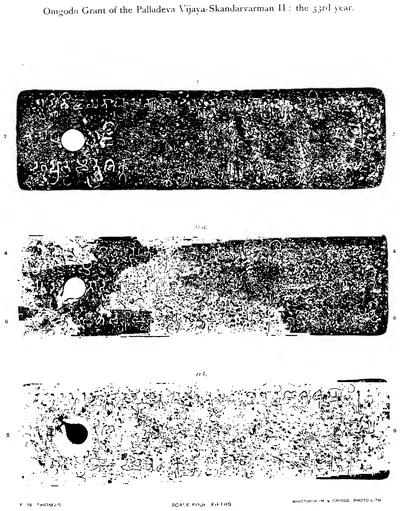
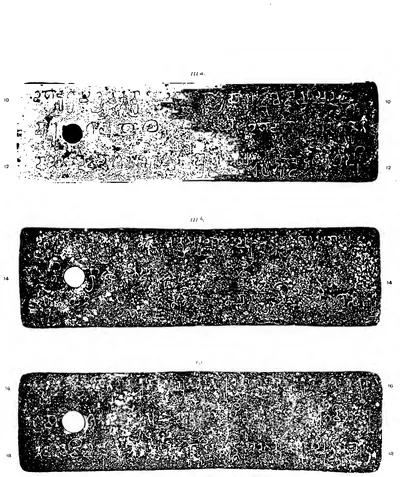
Sanskrit copper-plate grant of the Pallava king Vijaya-Skandavarman (Skandavarman II), issued from Tambrapa in the 33rd year of his reign. It gives the village of Omgodu in Karmarashtra to the Brahman Golasarman. H. Krishna Sastri edited it in 1920. It gave the earliest known members of the Pallava line of the Nellore–Guntur country and is dated in the old seasonal manner of the Prakrit charters.
The first Omgodu grant is the only record of the Pallava king Skandavarman II.1 H. Krishna Sastri published it with a later grant of the same village.1 He wrote that it “supplies a missing link in the study of Pallava history”.1 See also the second Omgodu grant.
Discovery
Both Omgodu grants were said to have been discovered in the Narasaraopet taluk of the Guntur district.1 Their owner was the village munsiff (village officer) of Santaravuru in the Bapatla taluk.1 He had held them for a long time, so the history of their discovery was not known.1 He gave them to the Madras Museum.1
G. Jouveau-Dubreuil thought the plates had been found at Santaravuru.2 So he supposed the village of Omgodu to have been near it.2 The grant was first noticed in the Madras epigraphy report for 1916, as a discovery of C. R. Krishnamacharlu.13
Description
There are four thin copper plates without raised rims, on a ring whose seal is worn smooth.45 Each side carries three lines.45 The first and last plates are written on the inner side only.45 The first three plates are numbered with a crescent-like stroke repeated once, twice and three times.45
The language is Sanskrit.56 Krishna Sastri found its letters close to those of the Uruvupalli, Mangalur and Pikira grants.56 He noted that complete words are separated by spaces, as in some Satavahana inscriptions.56
Content
The grant was issued from “the victorious Tambrapa-sthana”.56 It names four kings:56
- the Maharaja Kumaravishnu, a Pallava of the Bharadvaja gotra (clan) and performer of the horse sacrifice56
- his son the Maharaja Skandavarman, who won his kingdom by his own prowess56
- Skandavarman’s son Viravarman56
- Viravarman’s son the Maharaja Vijaya-Skandavarman, the donor56
By his order the officers and ayuktakas (local officials) of Karmarashtra and the villagers of Omgodu were told of the gift.57 The village had been given to Golasarman of the Kasyapa gotra, a student of two Vedas.57 It was given with the eighteen kinds of exemptions, except fields already ploughed as temple land.57 The grant was written on the 13th day of the third fortnight of winter in the 33rd year.57
The places
None of the camps of these kings has been identified, and Tambrapa was a new one.5 Krishna Sastri thought it, like Palakkada, Menmatura and Dasanapura, should be looked for in the north of the Nellore district.5 The Nellore gazetteer of 1942 suggested Chebrolu in the Bapatla taluk.8
Krishna Sastri identified Karmarashtra with the Kamma-nadu of later Telugu inscriptions.59 This was the north of the Nellore district and part of the Guntur district.59 He suggested that Omgodu might be the town of Ongole.59
Date
Krishna Sastri took the seasonal date, the numerals and the spaces between words as signs that the grant was close in time to the Satavahana period.6 R. Gopalan concluded that it was the oldest of the Sanskrit charters of the Pallavas.10 D. C. Sircar placed it, with the Darsi plate, between about the middle of the 4th century and the beginning of the 5th.11
Footnotes
-
H. Krishna Sastri, “Two Pallava Copper-plate Grants”, Epigraphia Indica XV (1919–20), p. 246 (archive.org (opens in a new tab)). ↩ ↩2 ↩3 ↩4 ↩5 ↩6 ↩7 ↩8
-
G. Jouveau-Dubreuil, The Pallavas (1917), p. 16 (archive.org (opens in a new tab)). ↩ ↩2
-
G. Jouveau-Dubreuil, Ancient History of the Deccan (1920), p. 67 (archive.org (opens in a new tab)). ↩
-
Krishna Sastri, “Two Pallava Copper-plate Grants” (1920), p. 249 (archive.org (opens in a new tab)). ↩ ↩2 ↩3 ↩4
-
Krishna Sastri, “Two Pallava Copper-plate Grants” (1920), p. 250 (archive.org (opens in a new tab)). ↩ ↩2 ↩3 ↩4 ↩5 ↩6 ↩7 ↩8 ↩9 ↩10 ↩11 ↩12 ↩13 ↩14 ↩15 ↩16 ↩17 ↩18 ↩19 ↩20 ↩21 ↩22
-
Krishna Sastri, “Two Pallava Copper-plate Grants” (1920), p. 251 (archive.org (opens in a new tab)). ↩ ↩2 ↩3 ↩4 ↩5 ↩6 ↩7 ↩8 ↩9 ↩10
-
Krishna Sastri, “Two Pallava Copper-plate Grants” (1920), pp. 251–252, text (archive.org (opens in a new tab)). ↩ ↩2 ↩3 ↩4
-
Gazetteer of the Nellore District, brought up to 1938, Vol. A (1942), p. 30 (archive.org (opens in a new tab)). ↩
-
Krishna Sastri, “Two Pallava Copper-plate Grants” (1920), p. 254 (archive.org (opens in a new tab)). ↩ ↩2 ↩3
-
R. Gopalan, History of the Pallavas of Kanchi (1928), p. 56 (archive.org (opens in a new tab)). ↩
-
D. C. Sircar, The Successors of the Satavahanas in Lower Deccan (1939), p. 171 (archive.org (opens in a new tab)). ↩
Photos
References
Notes (0)
Sources (6)
Spotted an error on this page? Tell us
Last updated: