Potavaram grant of Purushottama (1489)
A copper-plate grant known only from lithographs (printed copies) and a translation by Ram Raz, published in Madras in 1827, and edited again by L. D. Barnett in 1916. By it the Gajapati Purushottama gave the village of Potavaram, in the district of Ammanabrolu, to the god Siva of Chadaluvada, in the present Ongole country. The gift was made in Kartika of Saka 1412 (1489). Barnett read it as evidence that by 1489 Purushottama had won back much of the Telugu country lost to the Bahmani sultan Muhammad Shah.
By this copper-plate grant, the Gajapati king Purushottama gave the village of Potavaram to the god of Chadaluvada.12 It is dated in Kartika of Saka 1412 (1489; Saka is an Indian way of counting years).12 Barnett read it as evidence that Purushottama had won back much of the Telugu territory lost to the Bahmani sultan Muhammad Shah.3
The plates and their publication
The grant is known only from print.45 In 1827 the Transactions of the Literary Society of Madras published lithographs of its six faces.45 With them came “A Translation, by Ram Raz, Head English Master in the College of Fort St. George, of an Ancient Grant in the Carnataca Language”.45
L. D. Barnett found that the record had been left out of Kielhorn’s list of southern inscriptions.6 He edited it again from the lithographs in Epigraphia Indica XIII (1916).6 He did this “so that the document may not be altogether lost sight of”.6 He wrote that “nothing is known of its provenance or of its present whereabouts”.6
From the lithographs, Barnett described three copper plates, about 4¾ by 7¾ inches.63 They had angular projections on the left for the ring-hole.63 The first and last plates were written on one side only.63 Two faces carry emblems: the sun on the left, the moon on the right, and the bull Nandi lying below.63 The bull’s haunch is marked by a linga (stone emblem of Siva) on a stand.63
The characters are Telugu, “somewhat irregular in shape”.3 The language is Telugu as far as line 20.3 Three Sanskrit verses follow, cursing anyone who breaks the grant.3
Contents
The grant is dated in Saka 1412, the cyclic year Saumya, on the fifteenth day of the bright half of Kartika, with the moon in Krittika.12 It names the king as Vira-sri-Gajapati, lord of Gauda, lord of the nine crores of Karnata and of Kalubariga (Gulbarga), Pratapa-Purushottama-deva.12
It records that “with pouring water” he gave the village of Potavaram, in the district of Ammanambolu.12 The gift went to the god Lingodbhava Mahadeva of Chadaluvada, on the bank of the river Brahmagundi.12 It was “for the purpose of the personal enjoyment, stage-entertainment, and (other) splendours of the god”.12 The grant ends with the usual blessings and curses.12
Ram Raz, in 1827, had taken the king’s name for a word of praise.4 He translated it as “equal to Purushottama in glory”.4
Barnett pointed out that the year is called the “third” of the reign in the anka count of Orissa.31 This count skips certain numbers.31 But Purushottama’s other inscriptions put his third anka in 1470–71.31 So Kartika of Saka 1412 must have fallen in his twenty-third anka.31
J. F. Fleet showed him that the other details fit Saturday, 7 November 1489, if the shortened weekday stands for Manda-vara.31 Barnett thought it more likely that it means Tuesday, as Ram Raz had read it.31 He also thought that the date is irregular.31
Place
Barnett found all three places on the Indian Atlas: Potavaram, Ammanabrolu and Chadaluvada.1 All are in the Ongole taluk (sub-district) of the Guntur district.1 He read the grant as evidence that by 1489 Purushottama had won back much of the Telugu territory lost to the Bahmani sultan Muhammad Shah.3
R. D. Banerji drew the same conclusion.7 He wrote that the grant shows Purushottama in “undisputed possession” of the Godavari–Krishna doab (the land between the two rivers).7 It also shows him holding the country as far as Vijayawada (then Bezwada).7 See Purushottama, Ongole and the Gajapatis.
Footnotes
-
Barnett, “Potavaram Grant”, Epigraphia Indica XIII (1915–16), p. 157 (archive.org (opens in a new tab)). ↩ ↩2 ↩3 ↩4 ↩5 ↩6 ↩7 ↩8 ↩9 ↩10 ↩11 ↩12 ↩13 ↩14 ↩15 ↩16 ↩17
-
Barnett, “Potavaram Grant”, Epigraphia Indica XIII (1915–16), p. 158 (archive.org (opens in a new tab)). ↩ ↩2 ↩3 ↩4 ↩5 ↩6 ↩7 ↩8
-
Barnett, “Potavaram Grant”, Epigraphia Indica XIII (1915–16), p. 156 (archive.org (opens in a new tab)). ↩ ↩2 ↩3 ↩4 ↩5 ↩6 ↩7 ↩8 ↩9 ↩10 ↩11 ↩12 ↩13 ↩14 ↩15 ↩16 ↩17
-
Ram Raz, “A Translation … of an Ancient Grant in the Carnataca Language”, Transactions of the Literary Society of Madras, Part I (1827), p. 119 (archive.org (opens in a new tab)). ↩ ↩2 ↩3 ↩4 ↩5
-
Transactions of the Literary Society of Madras, Part I (1827), plates of the grant following p. 120 (archive.org (opens in a new tab)). ↩ ↩2 ↩3
-
L. D. Barnett, “Potavaram Grant of Pratapa-Purushottama-deva: Saka 1412”, Epigraphia Indica XIII (1915–16), p. 155 (archive.org (opens in a new tab)). ↩ ↩2 ↩3 ↩4 ↩5 ↩6 ↩7 ↩8 ↩9
-
R. D. Banerji, History of Orissa from the Earliest Times to the British Period, Vol. I (1930), p. 316 (archive.org (opens in a new tab)). ↩ ↩2 ↩3
Photos
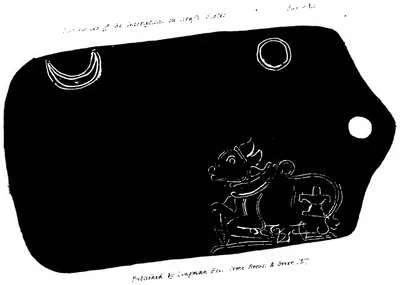 Lithograph of an emblem face of the Potavaram copper-plate grant of the Gajapati Purushottama: crescent moon, sun and the bull Nandi with a linga (Transactions of the Literary Society of Madras, Part I, 1827)Inscription rubbing · 1827
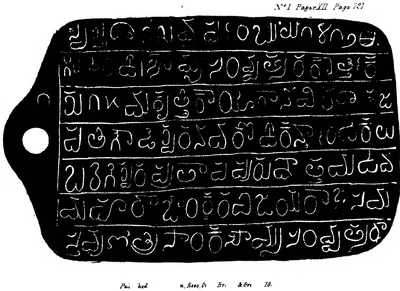 Lithograph of the first inscribed face of the Potavaram copper-plate grant of the Gajapati Purushottama, Saka 1412 (Transactions of the Literary Society of Madras, Part I, 1827)Inscription rubbing · 1827
References
Notes (0)
Sources (3)
Spotted an error on this page? Tell us
Last updated: