Warangal pillar inscription of Shitab Khan (1504)
A Sanskrit verse inscription, with two lines of Telugu prose, on a four-faced red sandstone pillar in front of the Sambhuni-gudi in Warangal fort. In 143 lines and 36 verses it records that the chief Chittapa Khan (Shitab Khan, or Sitapati) of the Bhogi family took Warangal from the Muslims. This happened on Sunday, the fifth day of the bright half of Magha, Saka 1425, which Hirananda Sastri reckoned as 21 January 1504. The record gives his ancestors, wives and sons, and says that he restored the images of Krishna and of the Kakatiya family goddess. It was composed by Madhava, son of Annarya, and edited by Sastri in 1932.
The inscription stands in Warangal Fort.1 It is on “a red sandstone pillar standing in front of the Sambhulinga temple, which is popularly known as Sambhuni-gudi”.1 It is the chief evidence for Shitab Khan, whose name the nearby hall in the fort also bears.2
Hirananda Sastri describes the pillar as four-faced, “each face being marked by Telugu numerals”.1 The inscribed part measures 3 feet 10 inches.1 Some letters have worn away, but they “can be restored with confidence”.1 See Shitab Khan of Warangal.
Edition
In September 1921 the Telugu scholar K. V. Lakshmana Rao offered to edit the inscription for the Hyderabad Archaeological Series.345 He planned to add a history of Shitab Khan “collected from various contemporary documents”.345 The Director of Archaeology gave him inked estampages (ink copies on paper).345 He died before his memoir could be printed.345
Hirananda Sastri, the Government Epigraphist for India, recast the memoir.345 The Nizam’s government published it in 1932 as No. 9 of the series.345 It has the text, a translation and four plates of the estampages.345
Robert Sewell’s list of inscriptions (1932) records it as No. 108 of 1902 in the Madras epigraphical collection.6 It notes that E. Hultzsch had commented on it in the epigraphical report for 1902.6
Script and language
The record “is written in the Telugu script of the fifteenth century”.17 This script “in several respects, differs from the modern alphabet and marks the period of transition”.17 Sastri wrote: “The language of the record is Sanskrit, but the lines 5 and 6 are written in Telugu prose”.17
The Sanskrit is verse, in “high flown Sanskrit, though not of any great merit”.17 It spells the hero’s name in different ways, such as Sittapa-khana.17 It runs to 143 lines and 36 verses, mostly in the sragdhara and sardulavikridita metres.78
Contents
In Sastri’s words, “Its main object is to record the capture of Warangal and the restoration of the temples of a god and a goddess there by Chittapa-khana (Shitab Khan).”7 The first verse and the Telugu lines give the date.79 It is Sunday, the fifth day of the bright fortnight of Magha, in the Saka year 1425, the cyclic year Rudhirodgarin.79 Sastri reckoned this as 21 January 1504.79
On that day, the record says, “Bhoge-Chittapa-khana, the ornament of the kings of the earth, who was equal to Vikramaditya”, took Warangal.79 He “captured the beautiful capital called Ekopala, (i.e., Warangal) which had been taken by the Yavanas” (Muslims).79
Next come prayers to Vishnu as the Boar, Siva and Ganesa.710 Verses 5 to 8 give his ancestors.710 His grandfather was Naga, a leader of the Bhoga family.710 His father was Mana, a fine archer, and his mother was Gauramba.710
Most of the rest is praise of his bravery and his gifts.11 It says that he took “the important and impregnable hill forts of Rajadri and others”.11
Verses 23 to 26 name his wives, Devambika and Anumamba, and his five sons.12 Verse 27 says that he “captured for the worship of the gods and the Brahmans the beautiful city of Ekasilapuri”.12 This city “was formerly ruled by a number of virtuous kings belonging to the family of Kakati”.12
Verse 33 says that he restored to its throne the image of Krishna as Panchalaraya.13 Verse 34 says that he set up again the goddess who “was the Lakshmi of the throne of the Kakati kingdom”.13 She “had been removed from her place by the wicked Turushkas” (Turks).13 The last verse names the composer, “Madhava, the son of Annarya, belonging to the Apastamba-(sutra) and Bharadvaja-(gotra)”.13 See the Kakatiyas.
Interpretation
Sastri concluded from the inscription that Shitab Khan “was a Hindu and not a Musalman”, whatever his title.8 He also concluded that Shitab Khan took Warangal “from the Musalmans” while it belonged to Sultan Quli.8 This was before Sultan Quli declared himself king.8
The record speaks of the Kakatiyas with respect.2148 Sastri took this to mean that some member of their house “was alive and was, possibly, recognised to be the de jure owner of Warangal” (its lawful owner).2148 He took the family name Bhogi to be perhaps a Sanskrit form of Boya, the caste that the kaifiyats (village records) give him.2148 See Sultan Quli.
Footnotes
-
Hirananda Sastri, Shitab Khan of Warangal (Hyderabad Archaeological Series No. 9, 1932), p. 12 (archive.org (opens in a new tab)). ↩ ↩2 ↩3 ↩4 ↩5 ↩6 ↩7 ↩8 ↩9 ↩10
-
Sastri, Shitab Khan of Warangal (1932), p. 2 (archive.org (opens in a new tab)). ↩ ↩2 ↩3 ↩4
-
Sastri, Shitab Khan of Warangal (1932), p. v, Government resolution of 7 November 1931 (archive.org (opens in a new tab)). ↩ ↩2 ↩3 ↩4 ↩5 ↩6 ↩7
-
Sastri, Shitab Khan of Warangal (1932), p. vi (archive.org (opens in a new tab)). ↩ ↩2 ↩3 ↩4 ↩5 ↩6 ↩7
-
Sastri, Shitab Khan of Warangal (1932), preface (archive.org (opens in a new tab)). ↩ ↩2 ↩3 ↩4 ↩5 ↩6 ↩7
-
Robert Sewell, The Historical Inscriptions of Southern India (1932), p. 234 (archive.org (opens in a new tab)). ↩ ↩2
-
Sastri, Shitab Khan of Warangal (1932), p. 13 (archive.org (opens in a new tab)). ↩ ↩2 ↩3 ↩4 ↩5 ↩6 ↩7 ↩8 ↩9 ↩10 ↩11 ↩12 ↩13 ↩14 ↩15 ↩16
-
Sastri, Shitab Khan of Warangal (1932), p. 15, with the list of metres (archive.org (opens in a new tab)). ↩ ↩2 ↩3 ↩4 ↩5 ↩6 ↩7
-
Sastri, Shitab Khan of Warangal (1932), p. 20, translation of verse 1 and lines 5–6 (archive.org (opens in a new tab)). ↩ ↩2 ↩3 ↩4 ↩5
-
Sastri, Shitab Khan of Warangal (1932), p. 21, translation of verses 5–8 (archive.org (opens in a new tab)). ↩ ↩2 ↩3 ↩4
-
Sastri, Shitab Khan of Warangal (1932), p. 22, translation of verse 19 (archive.org (opens in a new tab)). ↩ ↩2
-
Sastri, Shitab Khan of Warangal (1932), p. 23, translation of verses 23–27 (archive.org (opens in a new tab)). ↩ ↩2 ↩3
-
Sastri, Shitab Khan of Warangal (1932), p. 24, translation of verses 33–36 (archive.org (opens in a new tab)). ↩ ↩2 ↩3 ↩4
-
Sastri, Shitab Khan of Warangal (1932), p. 14 (archive.org (opens in a new tab)). ↩ ↩2 ↩3
Photos
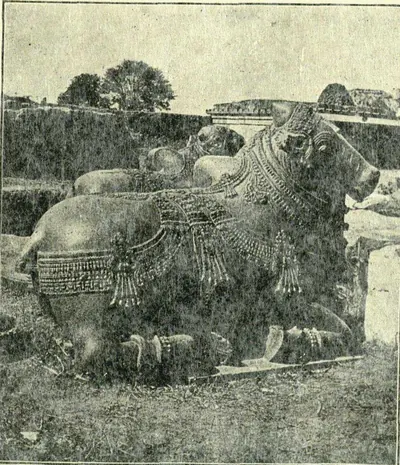 "Carved Stone Bulls in front of the Sambhuni-gudi Temple" (Sastri 1932, Pl. I (b))Book plate · 1932
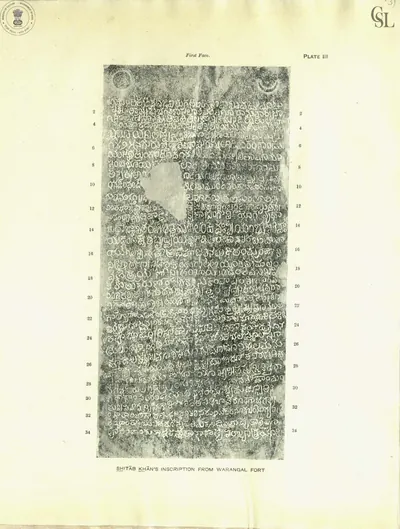 Shitab Khan's inscription from Warangal Fort: first face (Sastri 1932, Pl. III)Inscription rubbing · 1932
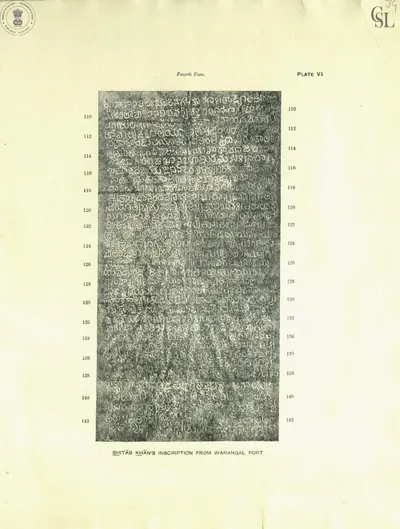 Shitab Khan's inscription from Warangal Fort: fourth face (Sastri 1932, Pl. VI)Inscription rubbing · 1932
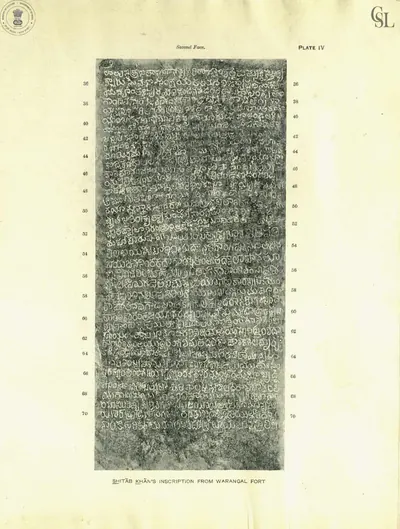 Shitab Khan's inscription from Warangal Fort: second face (Sastri 1932, Pl. IV)Inscription rubbing · 1932
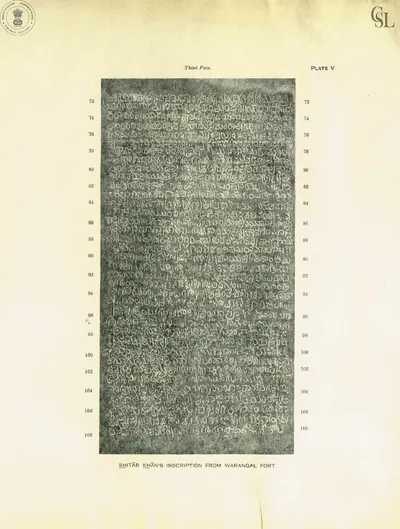 Shitab Khan's inscription from Warangal Fort: third face (Sastri 1932, Pl. V)Inscription rubbing · 1932
References
Notes (0)
Sources (2)
Spotted an error on this page? Tell us
Last updated: