Ongole
Town on the Gundlakamma in the old Guntur district, now the headquarters of Prakasam district. H. Krishna Sastri suggested that it was the Omgodu given away in two Pallava copper-plate grants. The country round it was the Karmarashtra (later Kammanadu) of the Pallava and Eastern Chalukya charters. In the eighteenth century Ongole belonged to the Nawabs of the Carnatic (Arcot). The Company took over its management in 1790 and its government in 1801, when it was joined to the Nellore district.
Ongole was the headquarters of the Ongole taluk of the Guntur district when H. Krishna Sastri wrote about it in 1920.1 Two early copper-plate grants came from the old Ongole taluk.23 The Chendalur plates of the Pallava Kumaravishnu II were found at Chendalur.2 The village munsiff (headman) of Nelatur sent in the Pikira grant of Simhavarman.3
Omgodu
Two Pallava grants, of Skandavarman II and of Simhavarman, give a village called Omgodu in Karmarashtra.1 Krishna Sastri wrote that it “has to be looked for in the northern part of the Nellore district”.1 He added that “perhaps it has to be identified with the town of Ongole itself”.1 He identified Kodikim, one of the boundary villages in the second grant, with Kodiki, near Ongole.1
G. Jouveau-Dubreuil thought instead that Omgodu lay near Santaravuru in the Bapatla taluk.4 He believed that the plates had been found there.4
Karmarashtra
Krishna Sastri identified Karmarashtra with the Kamma-nadu of later Telugu inscriptions.51 It covered the north of the Nellore district and part of the Guntur district.51 Jouveau-Dubreuil concluded that “the environs of the present town of Ongole watered by the river Gundlakamma” formed Karmarashtra under the early Pallavas.4 P. B. Desai and the Nellore gazetteer of 1942 took Karmarashtra to cover roughly the Ongole and Bapatla taluks.67
The Nawabs of Arcot
In the eighteenth century Ongole lay in the northern districts of the Nawabs of the Carnatic. French and Hyderabad armies passed through it on the road south.89 In 1758 the French general Bussy “proceeded through Ongole to Nellore”.8 In 1759 the Nizam’s brother Basalat Jang, “passing through Ongole, attacked the fort of Pellur”.9
In 1780 the English gave the Guntur Circar back to the Nizam.10 The troops stationed there refused to go by sea, “and were obliged to be left at Ongole”.10 See the Nawabs of the Carnatic (Arcot).
The Company
The Company took over the Nawab’s revenues in 1790, and Erskine was made Collector of “Ongole and the Palnaud”.11 He reported that Ongole “was rated in the Nawab’s books at a lakh of pagodas, but he was informed that he never received more than 85,000 pagodas for it”.12 It had been let to “one head renter with two assistants under him”.12 He also reported that “the Nawab had never had any sibbandies in the district” (sibbandies were local armed police).12 In his settlement he set aside 3,000 pagodas “for the Rajah of Ongole’s allowance”.13
The Board of Revenue thought its rent of 1,08,852 pagodas “the full value of the district in its present state”.14 It noted that Nellore and Ongole “entirely escaped the effects of the two last wars”.14
Ongole was named with Nellore in the schedule of districts pledged by the treaty of 1792.15 The Nellore manual’s map shows “the District of Nellore and Ongole at the date of the assumption in 1801”.16 See Nellore.
Footnotes
-
Krishna Sastri, “Two Pallava Copper-plate Grants” (1920), p. 254 (archive.org (opens in a new tab)). ↩ ↩2 ↩3 ↩4 ↩5 ↩6 ↩7
-
E. Hultzsch, “Chendalur Plates of Kumaravishnu II”, Epigraphia Indica VIII (1905–06), p. 233 (archive.org (opens in a new tab)). ↩ ↩2
-
E. Hultzsch, “Pikira Grant of Simhavarman”, Epigraphia Indica VIII (1905–06), p. 160 (archive.org (opens in a new tab)). ↩ ↩2
-
G. Jouveau-Dubreuil, The Pallavas (1917), p. 16 (archive.org (opens in a new tab)). ↩ ↩2 ↩3
-
H. Krishna Sastri, “Two Pallava Copper-plate Grants”, Epigraphia Indica XV (1919–20), p. 250 (archive.org (opens in a new tab)). ↩ ↩2
-
P. B. Desai, “Reyuru Grant of Pallava Narasimhavarman; Year 12”, Epigraphia Indica XXIX (1951–52), p. 94 (archive.org (opens in a new tab)). ↩
-
Gazetteer of the Nellore District, brought up to 1938, Vol. A (1942), p. 30 (archive.org (opens in a new tab)). ↩
-
John A. C. Boswell, A Manual of the Nellore District (1873), p. 456 (archive.org (opens in a new tab)). ↩ ↩2
-
Boswell, Nellore District (1873), p. 457 (archive.org (opens in a new tab)). ↩ ↩2
-
Boswell, Nellore District (1873), p. 461 (archive.org (opens in a new tab)). ↩ ↩2
-
Boswell, Nellore District (1873), p. 464 (archive.org (opens in a new tab)). ↩
-
Boswell, Nellore District (1873), p. 466, quoting Erskine’s report for fasli 1200 (archive.org (opens in a new tab)). ↩ ↩2 ↩3
-
Boswell, Nellore District (1873), p. 468 (archive.org (opens in a new tab)). ↩
-
Boswell, Nellore District (1873), p. 471, quoting the Board of Revenue’s report of 1791 (archive.org (opens in a new tab)). ↩ ↩2
-
Boswell, Nellore District (1873), p. 472 (archive.org (opens in a new tab)). ↩
-
Boswell, Nellore District (1873), p. 474, and the map facing it (archive.org (opens in a new tab)). ↩
Photos
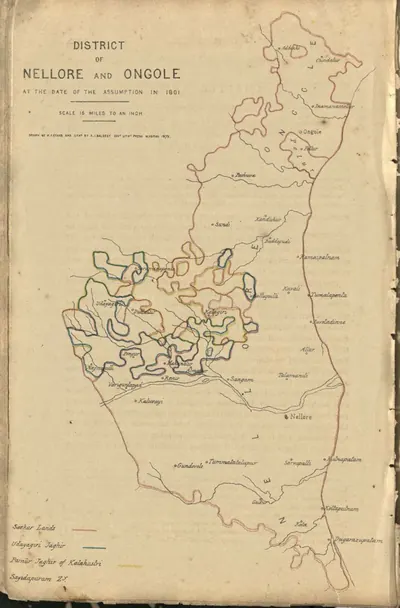 "District of Nellore and Ongole at the date of the assumption in 1801" (coloured lithograph) (Boswell 1873, PDF p. 496)Map · 1873
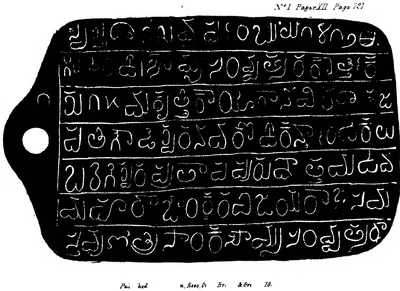 Lithograph of the first inscribed face of the Potavaram copper-plate grant of the Gajapati Purushottama, Saka 1412 (Transactions of the Literary Society of Madras, Part I, 1827)Inscription rubbing · 1827
References
Notes (0)
Sources (6)
Spotted an error on this page? Tell us
Last updated: