Purushottama (Gajapati)
Gajapati king of Orissa from 1469–70 to 1496–97, son of Kapilendra. Early in his reign the Bahmanis took Rajahmundry and Kondapalli or Kondavidu, after a disputed succession in which he may have bought their help. His attempt to recover the Godavari country in the 1470s ended with Muhammad Shah III's invasion of Orissa. But by 1489 his grants and inscriptions reach the Krishna and the Ongole country again. Orissan tradition credits him with an expedition to Kanchi and a romantic marriage.
Purushottama was the son and successor of Kapilendra, the founder of the Gajapati dynasty of Orissa. Soon after Kapilendra’s death, the Bahmani general Nizam-ul-Mulk Bahri took Rajahmundry and Kondavidu.1 By 1489 Purushottama was again making grants in the Ongole country.23
His reign is dated in different ways:
- his first year in 1469–70 and his death in 1496–97, by Monmohan Chakravarti, reckoning from the regnal (anka) years of his inscriptions4
- 1470–97, by R. D. Banerji5
- 1479–1504, in W. W. Hunter’s version of the temple chronicle of Puri6
- 1461–1496, in the Kondavidu chronicle summarised by Robert Sewell7
See the Gajapatis.
Family
The Velicherla grant of Prataparudra names Purushottama as the son of Kapilesvara and the father of Prataparudra.8 D. C. Sircar and K. H. V. Sarma knew only two of Kapilendra’s sons from the inscriptions.9 They give Purushottama’s mother as Parvati.9 According to the introduction of the Sarasvativilasa, as Banerji reports it, Purushottama’s queen was a princess of Karnata named Rupambika.10
Oriya tradition, as recorded by Tarini Charan Rath, made Purushottama the youngest son of Kapilendra.1110 The same tradition gave his queen the name Padmavati.1110 The temple chronicle tells how he carried off a princess of Kanchipuram (then Conjeveram) whose father had refused her to him.6 See Kapilendra, Hamvira and Prataparudra.
The succession
How Purushottama came to the throne is disputed. Ferishta tells of a usurper, “Mungul Ray, a bramin” (Brahmin), who was the adopted son of the late king.12 With Bahmani help, his cousin “Ambur Ray” displaced him.12
Chakravarti read the temple chronicle in another way.413 He wrote that Kapilendra’s sons fought over the throne.413 Purushottama won it with the help of the Bahmani sultan, and ceded (gave up) Kondapalli and Rajahmundry to him.413 Chakravarti took “Ambur Rai” for a title of Purushottama.413
The Godavari gazetteer says that in 1470 he “applied to the Bahmani king of Kulbarga, for help against a rival claimant”.14 It says that he “was forced to cede to that ruler, as the price of his assistance, the districts of Rajahmundry and Kondapalle”.14 L. D. Barnett held the same view.15
Banerji rejected these accounts.1617 An inscription at Puri dated in Purushottama’s second anka, 12 April 1470, shows him reigning.1617 The Burhan-i Ma’asir says nothing of a disputed succession.1617 Sircar and Sarma cited a tradition that he was chosen over his elder brother Hamvira.9
The loss and recovery of the Telugu country
The Burhan-i Ma’asir says that soon after Kapilendra’s death the Bahmani general Nizam-ul-Mulk Bahri took Rajahmundry and Kondavidu.1 A few years later, Ferishta says, the garrison of Kondapalli rebelled.181920 They invited the Ray (king) of Orissa to recover his “hereditary dominions in Tulingana” (the Telugu country).181920
The Ray came with ten thousand horsemen and eight thousand foot soldiers and besieged Rajahmundry.181920 He retreated when the sultan Muhammad Shah III came in person.181920 The sultan then raided Orissa in AH 882 (a year of the Islamic calendar), and the raid ended only when he received twenty-five elephants.181920
Banerji compared this with the Burhan-i Ma’asir.21 He concluded that Purushottama drove the Bahmanis from the lower Godavari for a time before Muhammad Shah came.21 He also concluded that Rajahmundry was besieged and capitulated (surrendered).21 See the Bahmanis and Muhammad Shah III.
The Godavari gazetteer says that the kings of Orissa recovered the district after the Bahmani kingdom broke up.22 The Kondavidu chronicle records an inscription of Saka 1411 (a year of the Saka era), by which Purushottama exempted the people of Kondavidu from taxes.7
By his copper-plate grant of 1489 he gave the village of Potavaram in the Ongole country to the god Lingodbhava Mahadeva of Chadaluvada.23 Barnett translated the purpose of the gift as “for the purpose of the personal enjoyment, stage-entertainment, and (other) splendours of the god”.23 A damaged record on a slab north of the road from Kavuluru to Kondapalli names Mogalaraju-Mahapatra as his governor there.23 See the Potavaram grant and Kondapalli.
At Srikurmam a series of his inscriptions runs from Saka 1392 (1470) to Saka 1417 (1495).242526 They record gifts of land, silver vessels and offerings by merchants and others.242526 One at Simhachalam is dated Saka 1394 (1472–73).27
V. Rangacharya took the Srikurmam record of Saka 1393 as Purushottama’s seventh year.24 So he placed Purushottama’s accession in 1464–65.24 See the Gajapati inscriptions at Srikurmam.
Kanchi and Vijayanagara
The temple chronicle, as Hunter gave it, says that “the King of Conjevaram refused to marry his daughter to this prince”.6 He refused her “on the ground of the Orissa Dynasty holding the office of Sweeper to Jagannath”.6 So Purushottama invaded the south and carried her off.6 His minister was ordered to marry her to a sweeper.6 The minister presented her to the king himself, as he swept before the god at the festival.6
The Bengali Chaitanya-charitamrita says that Purushottama conquered Vijayanagara.1328 It says that he brought back a jewelled throne and the image of Sakshi-gopala.1328
S. Krishnaswami Aiyangar wrote that Purushottama’s records “assert that he penetrated as far south as Kanchi”.29 He also wrote that the Vijayanagara usurper Saluva Narasimha failed to recover Udayagiri from him.29
Other works
The chronicle credits Purushottama with building the hall of offerings, the Bhoga-mandapa, of the Jagannatha temple.11 Banerji noted that his grant of 1483, found at Balasore, is engraved on a copper axe-head.1110 He noted that it is the first grant written in the cursive Oriya script.1110 The Velicherla grant of his son praises him as a poet.30
Footnotes
-
J. S. King, The History of the Bahmani Dynasty, founded on the Burhan-i Ma’asir (1900), p. 104 (archive.org (opens in a new tab)). ↩ ↩2
-
Barnett, “Potavaram Grant”, Epigraphia Indica XIII (1915–16), p. 157 (archive.org (opens in a new tab)). ↩ ↩2 ↩3
-
Barnett, “Potavaram Grant”, Epigraphia Indica XIII (1915–16), p. 158 (archive.org (opens in a new tab)). ↩ ↩2 ↩3
-
Monmohan Chakravarti, “The last Hindu Kings of Orissa”, Journal of the Asiatic Society of Bengal, Vol. LXIX, Part I (1900), p. 183 (archive.org (opens in a new tab)). ↩ ↩2 ↩3 ↩4 ↩5
-
R. D. Banerji, History of Orissa from the Earliest Times to the British Period, Vol. I (1930), p. 305 (archive.org (opens in a new tab)). ↩
-
W. W. Hunter, Orissa, Vol. II (1872), Appendix VII, p. 188 (archive.org (opens in a new tab)). ↩ ↩2 ↩3 ↩4 ↩5 ↩6 ↩7
-
Robert Sewell, Lists of Inscriptions, and Sketch of the Dynasties of Southern India (1884), p. 188 (archive.org (opens in a new tab)). ↩ ↩2
-
G. Ramadas, “Velicherla Grant of Prataparudra Gajapati: Saka 1432”, Epigraphia Indica XXVIII (1949–50), p. 206 (archive.org (opens in a new tab)). Paraphrased. ↩
-
D. C. Sircar and K. H. V. Sarma, “Chiruvroli Grant of Hambira, Saka 1383”, Epigraphia Indica XXXIV (1961–62), p. 181 (archive.org (opens in a new tab)). Paraphrased. ↩ ↩2 ↩3
-
Banerji, History of Orissa, Vol. I (1930), p. 320 (archive.org (opens in a new tab)). ↩ ↩2 ↩3 ↩4 ↩5
-
Banerji, History of Orissa, Vol. I (1930), p. 319 (archive.org (opens in a new tab)). ↩ ↩2 ↩3 ↩4 ↩5
-
Muhammad Qasim Ferishta, tr. John Briggs, History of the Rise of the Mahomedan Power in India, Vol. II (1829), p. 487 (archive.org (opens in a new tab)). ↩ ↩2
-
Chakravarti, “The last Hindu Kings of Orissa”, JASB LXIX, Part I (1900), p. 184 (archive.org (opens in a new tab)). ↩ ↩2 ↩3 ↩4 ↩5 ↩6
-
F. R. Hemingway, Madras District Gazetteers: Godavari, Vol. I (1907), p. 26 (archive.org (opens in a new tab)). ↩ ↩2
-
L. D. Barnett, “Potavaram Grant of Pratapa-Purushottama-deva: Saka 1412”, Epigraphia Indica XIII (1915–16), p. 156 (archive.org (opens in a new tab)). ↩
-
Banerji, History of Orissa, Vol. I (1930), p. 306 (archive.org (opens in a new tab)). ↩ ↩2 ↩3
-
Banerji, History of Orissa, Vol. I (1930), p. 307 (archive.org (opens in a new tab)). ↩ ↩2 ↩3
-
Ferishta, tr. Briggs, Vol. II (1829), p. 494 (archive.org (opens in a new tab)). ↩ ↩2 ↩3 ↩4 ↩5
-
Ferishta, tr. Briggs, Vol. II (1829), p. 495 (archive.org (opens in a new tab)). ↩ ↩2 ↩3 ↩4 ↩5
-
Ferishta, tr. Briggs, Vol. II (1829), p. 496 (archive.org (opens in a new tab)). ↩ ↩2 ↩3 ↩4 ↩5
-
Banerji, History of Orissa, Vol. I (1930), p. 312 (archive.org (opens in a new tab)). ↩ ↩2 ↩3
-
Hemingway, Godavari Gazetteer, Vol. I (1907), p. 27 (archive.org (opens in a new tab)). ↩
-
Rangacharya, Topographical List, Vol. II (1919), p. 885, Kistna No. 95 (archive.org (opens in a new tab)). ↩
-
V. Rangacharya, A Topographical List of the Inscriptions of the Madras Presidency, Vol. I (1919), p. 686, Ganjam No. 152 (archive.org (opens in a new tab)). ↩ ↩2 ↩3 ↩4
-
Rangacharya, Topographical List, Vol. I (1919), p. 691, Ganjam No. 225 (archive.org (opens in a new tab)). ↩ ↩2
-
Rangacharya, Topographical List, Vol. I (1919), p. 693, Ganjam Nos. 243–244 (archive.org (opens in a new tab)). ↩ ↩2
-
Rangacharya, Topographical List, Vol. III (1919), p. 1679, Vizagapatam No. 113 (archive.org (opens in a new tab)). ↩
-
Banerji, History of Orissa, Vol. I (1930), p. 316 (archive.org (opens in a new tab)). ↩ ↩2
-
S. Krishnaswami Ayyangar, “Hindu States in Southern India, A.D. 1000–1565”, in Wolseley Haig (ed.), The Cambridge History of India, Vol. III (1928), p. 494 (archive.org (opens in a new tab)). ↩ ↩2
-
Ramadas, “Velicherla Grant of Prataparudra Gajapati”, Epigraphia Indica XXVIII (1949–50), p. 208 (archive.org (opens in a new tab)). Paraphrased. ↩
Photos
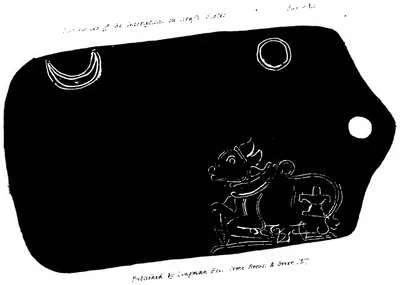 Lithograph of an emblem face of the Potavaram copper-plate grant of the Gajapati Purushottama: crescent moon, sun and the bull Nandi with a linga (Transactions of the Literary Society of Madras, Part I, 1827)Inscription rubbing · 1827
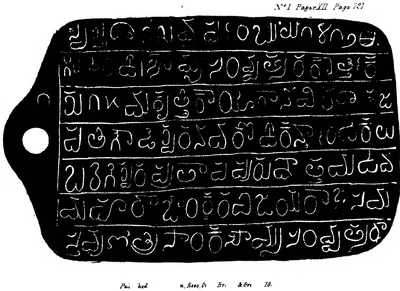 Lithograph of the first inscribed face of the Potavaram copper-plate grant of the Gajapati Purushottama, Saka 1412 (Transactions of the Literary Society of Madras, Part I, 1827)Inscription rubbing · 1827
References
Notes (0)
Sources (14)
Spotted an error on this page? Tell us
Last updated: