Bhattiprolu relic-casket inscriptions
Ten short Prakrit inscriptions on three stone relic caskets and a crystal from the Bhattiprolu stupa, found by A. Rea in 1892. Bühler dated them no later than about 200 BCE. Their unusual variety of Brahmi is among the earliest writing found in the region.
Discovery
In early 1892 Alexander Rea of the Archaeological Survey excavated the brick stupa (relic mound) at Bhattiprolu in the Krishna delta. Much of the mound had already been pulled down, and its bricks used for road-making.1 Rea cut down the old shaft at its centre and found three inscribed stone relic caskets set into the brickwork at different depths. They lay at these depths below the top of the mound:2345
The caskets and their contents went to the Madras Museum.67
The objects
Each “casket” was a pair of heavy black stones: a lower block with a hollow cut into it, and a lid that fitted over it. The first was about 2 ft 3 in by 1 ft 10 in. Its inscription runs in two lines around the hollow. Inside stood a round stone casket, and inside that a cylindrical crystal phial (small bottle) with a small piece of bone. With them lay gold flowers, pearls and beads, and twenty-four small silver coins laid out in the shape of a svastika.38
The second casket has a nineteen-line inscription inside a circle on the underside of its lid.4 There are more lines around the lid and around the rim of the lower stone.4 The third has eight lines under the lid and one line around the rim. Its inner casket, cut from beryl, held three small pieces of bone.45 The letters were filled in with white.4 A six-sided crystal from the first casket has an inscription lightly scratched on its faces. It has a hole through it, perhaps so that it could be worn as an amulet (charm).3
G. Bühler numbered the texts I to X. Nos. I–IX are on the three caskets, on the lids and on the rims of the lower stones, and No. X is on the crystal. Most are well preserved, but No. IV is rubbed away.9
Script and language
The script is a form of Brahmi, the script of Asoka’s edicts, which Bühler called the “Southern Maurya” alphabet. He found that twenty-three letters agree exactly with the “Southern Maurya” alphabet of Asoka’s edicts. Five letters (gh, j, m, l and a sign for sh) are “entirely abnormal”, and there is an extra letter for a retroflex ḷ. The vowel marks also work differently.910 The stroke that marks a long ā in Asoka’s script marks the short a here.910 He described the language as Prakrit of the Pali type. It differs from Pali mainly in its use of a retroflex sibilant (an s sound made with the tongue curled back).11
Content
The inscriptions are short gift records. Bühler reads two of them as stating that the caskets were made for relics of the Buddha.11 No. I records a casket and a crystal box given by a man named Kura with his father, his mother and one Siva. No. III is a long list of the members of a committee (goṭhi).1213 No. VIII lists the members of a guild (negama).1213
No. VI says that “another casket, a box of crystal and a box of stone” was given by the members of a guild.1314 The guild was headed by “King Khubiraka”, chief of the Shiba (Simha) committee.1314 No. IX credits the committee of Arahadina with a casket and a box.1314 In Bühler’s tentative translation, it adds that the work was by the same man through whom King Kubiraka had the carving done.1314 Bühler could not interpret No. X with certainty.14
Date and debate
The inscriptions contain no date or historical event. Bühler noted that King Kubiraka and the other names cannot be traced in any other source. So the date rests on comparing the letter forms with inscriptions that can be dated. On that evidence the Bhattiprolu texts fall between Asoka’s edicts and inscriptions of about the mid-2nd century BCE, and are much closer to the former. They “cannot be placed later than 200 B.C., but may be somewhat earlier”. He warned that this kind of evidence “may mislead”.15
He took the system of writing as proof that several regional varieties of Brahmi already existed in the 3rd century BCE.1516 He used it to argue that writing in India was older than the Mauryas.1516 Later reports of the Archaeological Survey repeated a date of about 200 BCE.17 Who Kubiraka was, and over what territory he ruled, remains unknown from these sources.
Editions
Bühler first announced the inscriptions in letters to The Academy (28 May 1892) and the Journal of the Royal Asiatic Society (1892). His full edition, with transcripts, translations and plates, appeared in Epigraphia Indica II (1894). Rea’s 1894 report shows the caskets and the crystal in pictures.39
Footnotes
-
Alexander Rea, South Indian Buddhist Antiquities (1894), p. 7 (archive.org (opens in a new tab)). ↩
-
Rea, South Indian Buddhist Antiquities (1894), p. 9 (archive.org (opens in a new tab)). ↩ ↩2 ↩3 ↩4
-
Rea, South Indian Buddhist Antiquities (1894), p. 11 (archive.org (opens in a new tab)). ↩ ↩2 ↩3 ↩4 ↩5 ↩6 ↩7
-
Rea, South Indian Buddhist Antiquities (1894), p. 13 (archive.org (opens in a new tab)). ↩ ↩2 ↩3 ↩4 ↩5 ↩6 ↩7 ↩8
-
Rea, South Indian Buddhist Antiquities (1894), p. 14 (archive.org (opens in a new tab)). ↩ ↩2 ↩3 ↩4 ↩5
-
Rea, South Indian Buddhist Antiquities (1894), p. 10 (archive.org (opens in a new tab)). ↩
-
Imperial Gazetteer of India: Madras, Vol. I (1908), p. 334 (archive.org (opens in a new tab)). ↩
-
Rea, South Indian Buddhist Antiquities (1894), p. 12 (archive.org (opens in a new tab)). ↩
-
G. Bühler, “The Bhattiprolu Inscriptions”, Epigraphia Indica II (1894), p. 323 (archive.org (opens in a new tab)). ↩ ↩2 ↩3 ↩4
-
Bühler, Epigraphia Indica II (1894), p. 324 (archive.org (opens in a new tab)). ↩ ↩2
-
Bühler, Epigraphia Indica II (1894), p. 326 (archive.org (opens in a new tab)). ↩ ↩2
-
Bühler, Epigraphia Indica II (1894), p. 327 (archive.org (opens in a new tab)). ↩ ↩2
-
Bühler, Epigraphia Indica II (1894), p. 328 (archive.org (opens in a new tab)). ↩ ↩2 ↩3 ↩4 ↩5 ↩6
-
Bühler, Epigraphia Indica II (1894), p. 329 (archive.org (opens in a new tab)). ↩ ↩2 ↩3 ↩4 ↩5
-
Bühler, Epigraphia Indica II (1894), p. 325 (archive.org (opens in a new tab)). ↩ ↩2 ↩3
-
Rea, South Indian Buddhist Antiquities (1894), Preface, p. iv, quoting Bühler (archive.org (opens in a new tab)). ↩ ↩2
-
H. Hargreaves (ed.), Annual Report of the Archaeological Survey of India, 1927–28 (1931), p. 115 (archive.org (opens in a new tab)). ↩
Photos
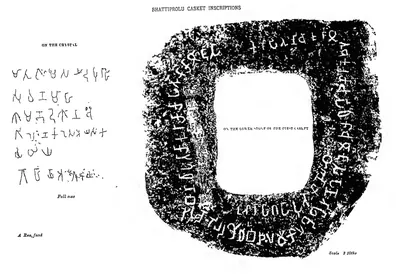 Bhattiprolu casket inscriptions: on the crystal, and on the lower stone of the first casket (Epigraphia Indica II)Inscription rubbing · 1894
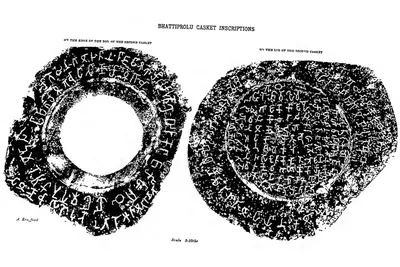 Bhattiprolu casket inscriptions: on the edge of the box and on the lid of the second casket (Epigraphia Indica II)Inscription rubbing · 1894
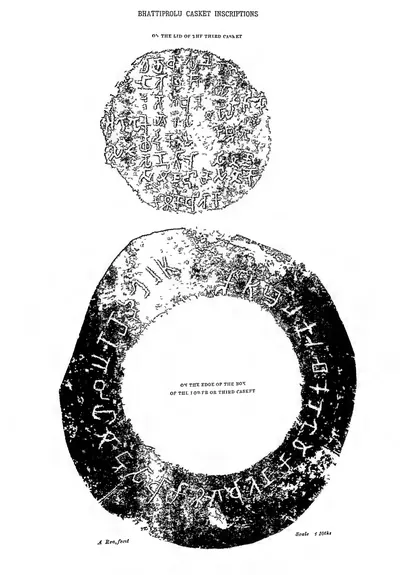 Bhattiprolu casket inscriptions: on the lid of the third casket, and on the edge of the box of the lower or third casket (Epigraphia Indica II)Inscription rubbing · 1894
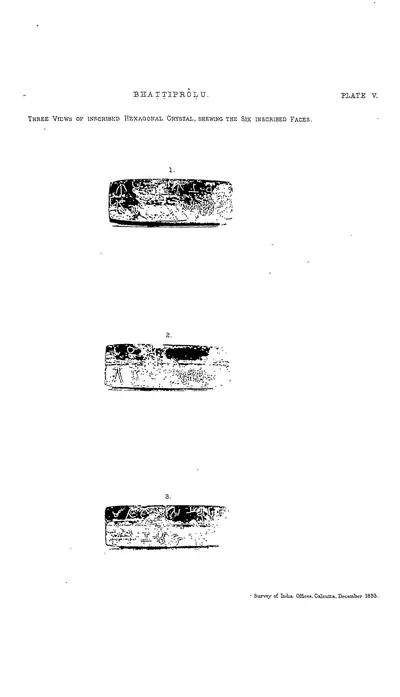 Bhattiprolu: inscribed crystal hexagon ("Three views of inscribed hexagonal crystal, shewing the six inscribed faces") (Rea 1894, Pl. V)Drawing · 1894
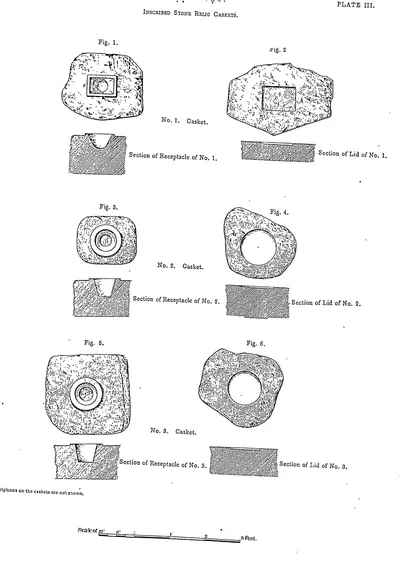 Bhattiprolu: large stone caskets (Rea 1894, Pl. III)Drawing · 1894
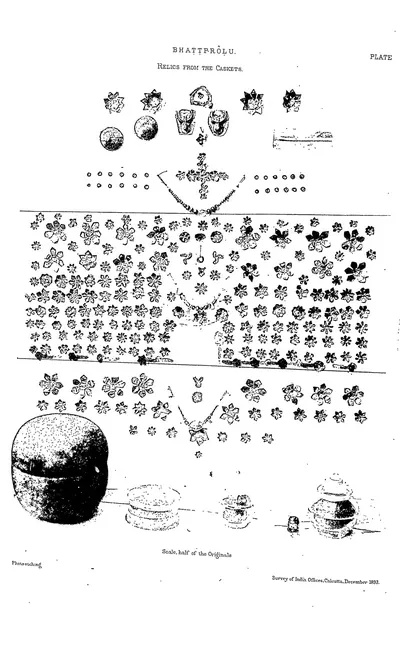 Bhattiprolu: relics and crystal caskets ("Relics from the caskets") (Rea 1894, Pl. I)Drawing · 1894
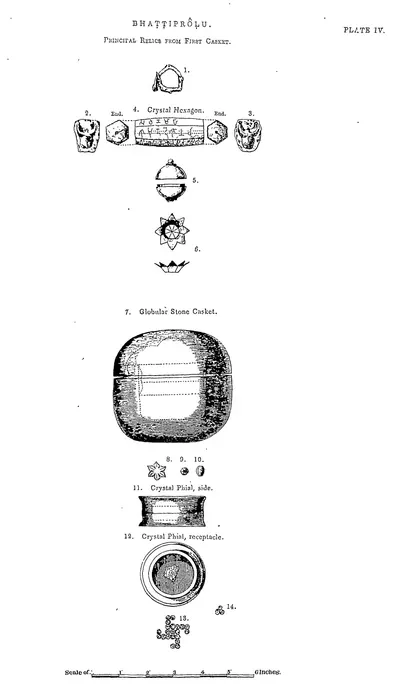 Bhattiprolu: relics of first casket (Rea 1894, Pl. IV)Drawing · 1894
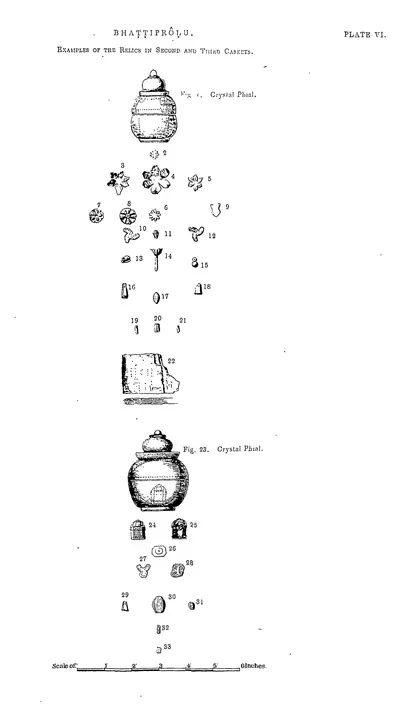 Bhattiprolu: relics of second and third caskets (Rea 1894, Pl. VI)Drawing · 1894
References
Notes (0)
Sources (4)
Spotted an error on this page? Tell us
Last updated: