Narasimhavarman II
Pallava king of Kanchi about 700, son of Paramesvaravarman I, also called Rajasimha, builder of the Kailasanatha temple at Kanchipuram. His Reyuru grant, kept in the archives of the Raja of Kalahasti, gives a village in Mel-Mundarashtra, which P. B. Desai placed in the Atmakur taluk of Nellore. Desai suggested that he or his father had won back part of the Nellore country from the Eastern Chalukyas.
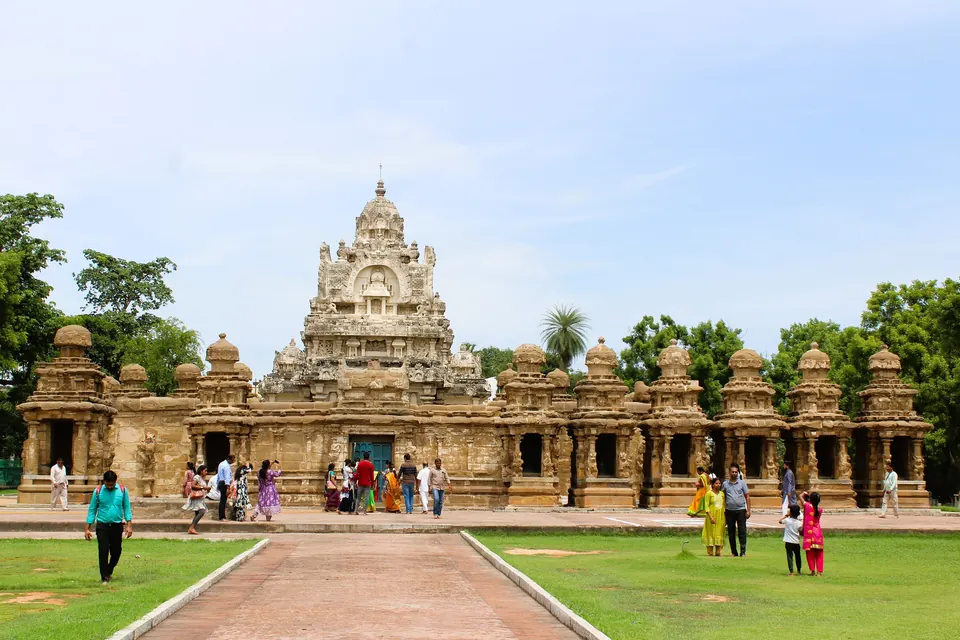
Narasimhavarman II, better known by his surname Rajasimha, is remembered chiefly as the builder of the Kailasanatha temple at Kanchipuram.12 For the Telugu country his importance lies in a single charter, the Reyuru grant.34 It shows a Pallava king giving a village in the Nellore country about 700.34
Family
Narasimhavarman II was the son of Paramesvaravarman I. The Reyuru grant names his father Paramesvaravarman and his grandfather Mahendravikramavarman, whom P. B. Desai identified with Mahendravarman II.53 See Paramesvaravarman I.
R. Gopalan wrote that he succeeded his father towards the close of the 7th century, and that his reign seems to have been peaceful.1
The Reyuru grant
The plates were kept in the archives of the Raja of Kalahasti.6 Veturi Prabhakara Sastri first edited them in Telugu, and Desai edited them again.6 The king issued the grant from his capital Kanchipura, in the 12th year of his reign, on a full-moon day of Vaisakha with a lunar eclipse.37 He gave the village of Reyuru in Mel-Mundarashtra to the Brahman Kumaramandasarman, a student of two Vedas, who lived at Kuravasri.37
Desai placed Mel-Mundarashtra, “western Mundarashtra”, in the Atmakur taluk of Nellore, west of the Kovur country of the older Mundarashtra.74 He identified Reyuru with Revuru in that taluk.74
Desai suggested that Narasimhavarman II or his father had won back from the Eastern Chalukyas a part of Karmarashtra, which Pulakesin II had taken before 630.4 In his view they made it a new district, but he admitted that there was no direct evidence for such a conquest.4
The executor of the grant was the chief of Nandakurra, a place Desai identified with Nandavaram in the Udayagiri taluk.748 Desai named the chief Isvara, son of Somaditya.74 D. C. Sircar read the verse instead as naming Rajaditya, son of Somaditya.8
Date
The grant is the only dated record of Narasimhavarman II, but its date is not complete.3 Desai found lunar eclipses on the full moon of Vaisakha in 701, 702, 711 and 720.3 He preferred 711, which would make the reign begin about 700.3
Sircar dated his father’s Vunna Guravayapalem plates, and after that he concluded that Narasimhavarman II came to the throne about 690–691 or 700.89 G. Jouveau-Dubreuil gave him 690–715.10
Desai noted two outer limits:3
- the identification of this king with the Pallava ruler who exchanged embassies with China in 7203
- an inscription found at Ulchala near Kurnool that dates the first year of his son Paramesvaravarman II to 728–7293
Footnotes
-
R. Gopalan, History of the Pallavas of Kanchi (1928), p. 108 (archive.org (opens in a new tab)). ↩ ↩2
-
Gopalan, History of the Pallavas of Kanchi (1928), p. 109 (archive.org (opens in a new tab)). ↩
-
Desai, “Reyuru Grant” (EI XXIX), p. 92 (archive.org (opens in a new tab)). ↩ ↩2 ↩3 ↩4 ↩5 ↩6 ↩7 ↩8 ↩9 ↩10 ↩11
-
Desai, “Reyuru Grant” (EI XXIX), p. 94 (archive.org (opens in a new tab)). ↩ ↩2 ↩3 ↩4 ↩5 ↩6 ↩7 ↩8
-
Desai, “Reyuru Grant” (EI XXIX), p. 91 (archive.org (opens in a new tab)). ↩
-
P. B. Desai, “Reyuru Grant of Pallava Narasimhavarman; Year 12”, Epigraphia Indica XXIX (1951–52), p. 89 (archive.org (opens in a new tab)). ↩ ↩2
-
Desai, “Reyuru Grant” (EI XXIX), p. 93 (archive.org (opens in a new tab)). ↩ ↩2 ↩3 ↩4 ↩5 ↩6
-
D. C. Sircar and P. Seshadri Sastri, “Vunna Guravayapalem Plates of Paramesvaravarman I, Year 19”, Epigraphia Indica XXXII (1957–58), p. 95 (archive.org (opens in a new tab)). ↩ ↩2 ↩3
-
Sircar and Seshadri Sastri, “Vunna Guravayapalem Plates” (EI XXXII), p. 96 (archive.org (opens in a new tab)). ↩
-
G. Jouveau-Dubreuil, Ancient History of the Deccan (1920), p. 70, genealogical table (archive.org (opens in a new tab)). ↩
Photos
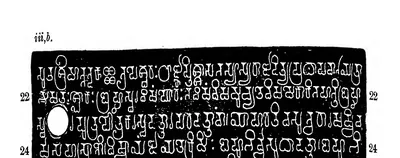 "Reyuru Grant of Pallava Narasimhavarman; Year 12", plate iii b (Epigraphia Indica XXIX, plate with No. 11 (PDF p. 199))Inscription rubbing · 1952
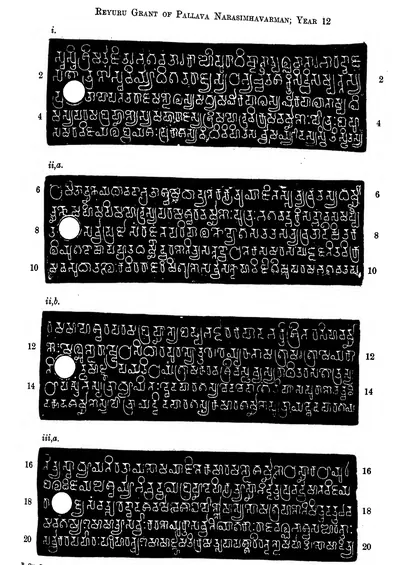 "Reyuru Grant of Pallava Narasimhavarman; Year 12", plates i, ii a, ii b and iii a (Epigraphia Indica XXIX, plate with No. 11 (PDF p. 198))Inscription rubbing · 1952
 Kailasanatha temple, KanchipuramPhotograph · 2025
Related
Dynasties

References
Notes (0)
Sources (4)
Spotted an error on this page? Tell us
Last updated: