Ipur plates of Vishnuvardhana III
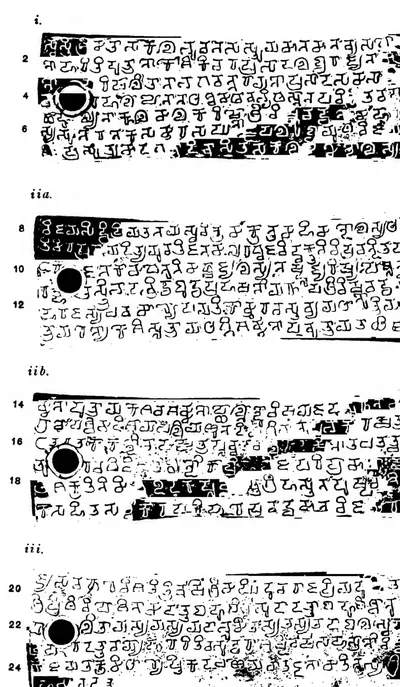
Sanskrit copper-plate grant of the Eastern Chalukya king Vishnuvardhana III (reigned about 709–746), dated in his 23rd year. It records a gift of a field in Jalayuru, in the Plolnandu district near Pithapuram, and a house site with a flower garden. Prithivipothi, daughter of Maghinduvaraja, made the gift. The plates were kept at Ipur in Tenali taluk with two Vishnukundin grants. E. Hultzsch edited them in 1926, and he took the lady for a queen and her father for the Pallava king Mahendravarman III.
These plates are a grant of the reign of Vishnuvardhana III, the Eastern Chalukya king whom J. F. Fleet dated 709–746.123 The king himself did not make the gift.123 A woman named Prithivipothi made it, and the grant’s interest lies in her and in her father’s name.123 They should not be confused with the two Vishnukundin sets from the same collection, the Ipur plates (set I) and set II.
Discovery and description
E. Hultzsch wrote in 1926 that the plates “were found while digging in an unspecified village of the Kistna District”.1 By then they belonged to the collection of Brindavanam Gopalacharlu at Ipur, a village in the Tenali taluk of Guntur district.1
The epigraphical report for 1919–20 registered them as No. 10 of Appendix A.4 It registered with them a grant of Jayasimha I (No. 9) from the same collection.4 It called both “valuable old documents of the Eastern Chalukya kings”.4 The same collection had yielded the two Vishnukundin grants, which Hultzsch edited in 1924.5
There are three oblong plates, and the second is inscribed on both sides.14 They have slightly raised rims and a slight inward curve in the middle of the long edges.14 They measure 6½ by 2¼ inches and hang on a ring about 3 inches across.14 The set weighs 35 tolas.14
The round seal bears, on a sunken surface, the legend Sri-Vishamasiddhi “in Telugu characters”.14 Below it is a seven-petalled lotus.14 Above it is a crescent enclosing a star, or perhaps the sun.14
Script and language
The writing is well preserved.1 Hultzsch found the alphabet like that of other Eastern Chalukya grants of the period.1 He was harsh about the text: “The language is barbarous Sanskrit prose”.1 He added that “owing to the dense ignorance of the drafting clerk, orthography, Sandhi rules, and grammar are disregarded in every line”.1 Still, he judged it “an interesting historical document” that “can be made out almost completely”.1 Two verses are quoted at the end.1
Content
The order is issued by Vishnuvardhana-Maharaja, son of Vijayasiddhi and grandson of Vishnuvardhana of the Chalukya family.1 Hultzsch reasoned that “as Vijayasiddhi is known to have been a surname of Mangi-yuvaraja, his father has to be identified with Vishnuvardhana II, and his son with Vishnuvardhana III”.1 The epigraphist of 1920 had read the family line in the same way.4
On the occasion of a samkranti (the sun’s entry into a new sign), in the twenty-third year of the king’s reign, a gift was made.6 A field and a house site with a flower garden were given to Kesavasarman of the Atreya gotra (clan) and the Hiranyakesi sutra.6 He lived at Kommara and was the son of Talisarman and grandson of Agnisarman.6
The field lay in the western part of the village of Jalayuru in the Plolnandu district.6 It needed twenty khandikas of paddy as seed.6 Its boundaries were:6
- the Eliyeru river on the east6
- the field of Prabhakara on the south6
- the fields of Kakandivada on the west6
- an anthill on the north6
Hultzsch could identify none of these places.1 But he thought the Plolnandu district was “evidently the same as Prolnandu or Prolunandu near Pithapuram”.1 See Pithapuram.
The executor (ajnapti) was “the chief of the camp, Vatatta (?) by name”.6 He himself gave the house site to the donee.6 The 1920 report read the executor’s title as Kadaereya and took it for Katakaraja.7
Prithivipothi and her father
The gift was made by Prithivipothi, “the beloved daughter of Maghinduvaraja”.16 Hultzsch thought she “seems to have been one of the queens of Vishnuvardhana III”.16 He took the second part of her name for a misspelling of poti, a feminine form of pota.16 This word occurs in the names of Pallava kings.16
He went further: “I hope I am not considered too bold if I further propose to identify the name of Prithivipothi’s father, Maghinduvaraja, with Mahendravarman III, the Pallava king of Kanchi.”12 The reign of Vishnuvardhana III would suit this.12 He found support in the way the praise of kings in Eastern Chalukya grants recalls that of some Pallava grants.12 See the Pallavas.
The epigraphist of 1920 read her name as Prithivipori and called her a princess.47 He wrote that her relationship to Vishnuvardhana III “is not made clear by the wording of the inscription”.47 He suggested that she might be the same person as Vijaya-Mahadevi, the queen named in another grant of the king.47 Hultzsch rejected the reading pori, arguing that the letter cannot be r.6
The seal and the king’s surname
The two editors drew different conclusions from the seal. Hultzsch held that it showed Vishnuvardhana III bearing the surname Vishamasiddhi, like his ancestors Vishnuvardhana I and II.1 The 1920 report was more cautious.7 It said that Vishnuvardhana III was “not known to have possessed this title from any of his own inscriptions”.7 So it suggested that the seal might, as with his Musinikunda grant, be one of Kubja Vishnuvardhana I, who bore that surname.7 Fleet had recorded Vishamasiddhi on the seals of both grants of Vishnuvardhana II.8
Footnotes
-
E. Hultzsch, “Ipur Plates of Vishnuvardhana III”, Epigraphia Indica XVIII (1925–26), p. 58 (archive.org (opens in a new tab)). ↩ ↩2 ↩3 ↩4 ↩5 ↩6 ↩7 ↩8 ↩9 ↩10 ↩11 ↩12 ↩13 ↩14 ↩15 ↩16 ↩17 ↩18 ↩19 ↩20 ↩21 ↩22 ↩23 ↩24 ↩25 ↩26 ↩27 ↩28 ↩29 ↩30
-
Hultzsch, “Ipur Plates of Vishnuvardhana III” (1926), p. 59 (archive.org (opens in a new tab)). ↩ ↩2 ↩3 ↩4 ↩5 ↩6
-
Fleet, “The Chronology of the Eastern Chalukya Kings” (1891), p. 99 (archive.org (opens in a new tab)). ↩ ↩2 ↩3
-
Annual Report on Epigraphy, Madras, for 1919–20 (G.O. No. 985, Home (Education), 31 August 1920), Part II, paras. 11–12, p. 99 (archive.org (opens in a new tab)). ↩ ↩2 ↩3 ↩4 ↩5 ↩6 ↩7 ↩8 ↩9 ↩10 ↩11 ↩12 ↩13 ↩14
-
E. Hultzsch, “Ipur Plates of Govindavarman’s Son Madhavavarman”, Epigraphia Indica XVII (1924), p. 334 (archive.org (opens in a new tab)). ↩
-
Hultzsch, “Ipur Plates of Vishnuvardhana III” (1926), p. 60, text, abstract of contents and note 2 (archive.org (opens in a new tab)). ↩ ↩2 ↩3 ↩4 ↩5 ↩6 ↩7 ↩8 ↩9 ↩10 ↩11 ↩12 ↩13 ↩14 ↩15 ↩16 ↩17
-
Annual Report on Epigraphy, Madras, for 1919–20 (1920), Part II, para. 12, p. 100 (archive.org (opens in a new tab)). ↩ ↩2 ↩3 ↩4 ↩5 ↩6 ↩7
-
J. F. Fleet, “The Chronology of the Eastern Chalukya Kings”, Indian Antiquary XX (1891), p. 98 (archive.org (opens in a new tab)). ↩
Photos
References
Notes (0)
Sources (4)
Spotted an error on this page? Tell us
Last updated: