Epitaph of Sultan Quli, Golconda (1543)
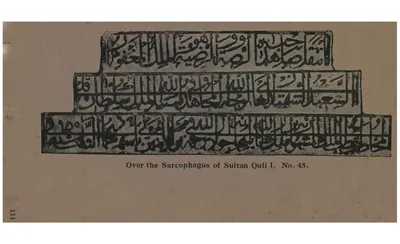
Inscriptions in three bands on the black basalt tomb-chest of Sultan Quli, in the Qutb Shahi burial ground at Golconda. An epitaph at its foot calls him 'the Martyr' and 'Bara Malik'. It dates his death to Monday, 2 Jumada II AH 950 (3 September 1543 in T. W. Haig's conversion). Haig noted that the epitaph gives him no royal title. Bilgrami read the word 'Martyr' as confirming that he was murdered at prayer.
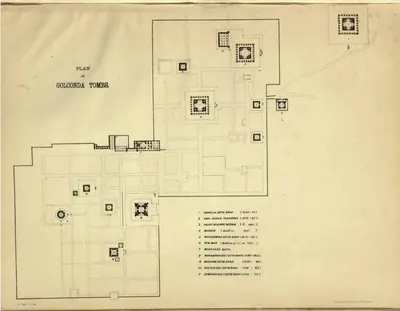
Sultan Quli founded the Qutb Shahi line.12 He built his own domed tomb in his lifetime, on a square terrace in the burial ground north of Golconda, “according to the prevalent custom”.12 His sarcophagus (stone coffin) is of highly polished black basalt.12 See Qutb Shahi Tombs.
The inscriptions
Syed Ali Asgar Bilgrami describes the inscriptions as “engraved in three bands”, “in Naskh style and Tauqi script of the finest quality”.23 The bands are these:23
- the first band praises God and the Prophet23
- the second is a Shia prayer of blessing on the Prophet, Ali, Fatima and the twelve Imams down to “the victorious Muhammad Mahdi, the Lord of the time”, ending “In the year 950 (A.H.)”23
- the third is the Throne Verse of the Quran23
At the foot of the grave is the epitaph:3
“The occupant of this chosen shrine, is the blessed monarch, the felicitous, the Martyr, the warrior for God’s sake and the striver in God’s path, the King Sultan Quli, entitled Qutbul Mulk, known as Bar (great) Malik, May God illumine his argument; marched to the neighbourhood of God’s mercy on Monday, the 2nd of Jamadi II, 950 (A.H.).”3
T. W. Haig first published the epitaph in Epigraphia Indo-Moslemica for 1907–08.4 He translated the same words with small differences (“the prince Sultan Quli, entitled Qutb-ul-Mulk and known as Bare Malik”), and he converted the date to 3 September 1543.4
Bilgrami published a plate of the inscription, and he noted where he differed from Yazdani’s reading in Epigraphia Indo-Moslemica for 1915–16.52
What the epitaph shows
Two scholars drew different points from it.61 Haig, in the Cambridge History of India (1928), observed that Sultan Quli never used the royal title, “as is evident from the epitaph on his tomb”.6 The epitaph calls him only Qutb-ul-Mulk.6
Bilgrami read the word “Martyr” as confirming a story about his death.1 In this story, he was killed in the congregational mosque of the fort, at the urging of his son Jamshid.1 Bilgrami also took the name “Bara Malik”, which the epitaph uses, to be the pet name by which all the people of the Deccan called him.1 Yazdani had written that this name was not found in any writing of the time.1 See the Jami Masjid inscription for the mosque where he died.
Bilgrami’s own account dates the murder to “Sunday, the 2nd Jamadi Sani 950 A.H.”.31 This is a day earlier in the week than the Monday of the epitaph.31 Bilgrami says, from the Tarikh-i Qutbshahi, that Sultan Quli died in his ninety-ninth year.31
Footnotes
-
Bilgrami, Landmarks of the Deccan (1927), p. 115 and note (archive.org (opens in a new tab)). ↩ ↩2 ↩3 ↩4 ↩5 ↩6 ↩7 ↩8 ↩9 ↩10 ↩11
-
Bilgrami, Landmarks of the Deccan (1927), p. 112 and notes (archive.org (opens in a new tab)). ↩ ↩2 ↩3 ↩4 ↩5 ↩6 ↩7 ↩8 ↩9
-
Bilgrami, Landmarks of the Deccan (1927), p. 113 (archive.org (opens in a new tab)). ↩ ↩2 ↩3 ↩4 ↩5 ↩6 ↩7 ↩8 ↩9 ↩10
-
T. W. Haig, “Inscriptions in Hyderabad and Golconda”, Epigraphia Indo-Moslemica 1907–08 (1909), p. 24 (archive.org (opens in a new tab)). ↩ ↩2
-
Syed Ali Asgar Bilgrami, Landmarks of the Deccan (1927), p. 111 and plate (archive.org (opens in a new tab)). ↩
-
Wolseley Haig (ed.), The Cambridge History of India, Vol. III (1928), p. 430 (archive.org (opens in a new tab)). ↩ ↩2 ↩3
Photos
References
Notes (0)
Sources (3)
Spotted an error on this page? Tell us
Last updated: