Lepakshi temple inscriptions of Achyuta Raya's reign (1533–1538)
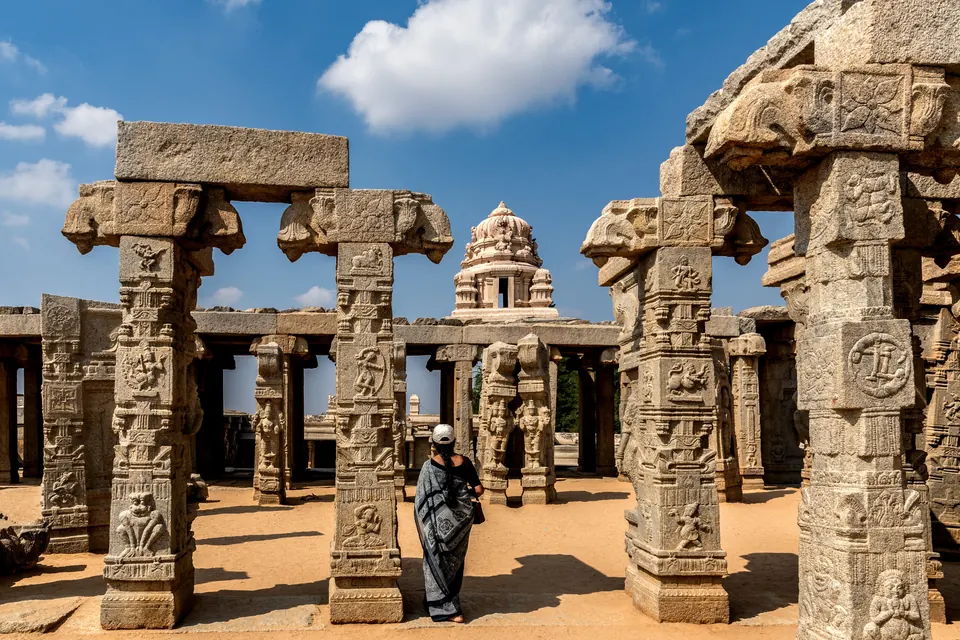
Some fifteen Sanskrit and Kannada inscriptions on the walls of the Virabhadra temple at Lepakshi in the Anantapur district. They were copied in 1912 and are dated between Saka 1455 and 1460 (1533–1538), in the reign of Achyuta Raya. They record gifts of villages, tolls and lands to the shrines of Virabhadra (Viresvara), Papavinasa and Raghunatha. The givers were Virupanna (Virappannayya) of Penukonda and his brother Virana Nayaka, sons of Nandi Lakkisetti of Lepakshi, and the king himself. Local tradition makes Virupanna a treasurer of Krishnadeva Raya.
The records
The Government Epigraphist’s office copied the inscriptions of the Virabhadra temple at Lepakshi in 1912.12 V. Rangacharya summarised them in 1919, and most are in Sanskrit and Kannada on the east wall of the second enclosure.12 One of them is a preface to the rest.12 It says that the inscriptions on the east wall, “which record gifts made to the shrines of Virabhadra, Papanasesvara and Rama at Lepakshi”, were engraved by two men.12
They were “engraved by Basavana Somayajin of Chatakuru and Timmapa of Gorantla”.12 Timmapa “was the senabova (clerk or shroff) of Virapannayya”, and the work was done “under orders from Virapanna”.12 The dates of the records run from Saka 1455 (1533; Saka is an Indian way of counting years) to Saka 1460 (1538).32 All are in the reign of “the Vijayanagara king Virapratapa Achyutadeva-Maharaya”.32 See Achyuta Raya and the Lepakshi temple.
Virupanna and Virana Nayaka
In Saka 1460, Vilambi (1538–39), “Virappannayya of Penugonde” made a gift to the temple of “Viresvara on the Kurmasaila hill at Lepakshipura”.31 He gave two villages near Depparu, with their copper-plate deeds.31 He had bought them from Brahmans to whom king Praudhadeva-Maharaya had given them.31 He also gave lands at Nagaragere, also called Krishnarayasamudra, in Rodda-nadu, “a subdivision of Penugonde-rajya”.31
A record of Saka 1456 (1534) grants the tolls of the Sunday market at the hamlet of Viresvaradevarapura, which belonged to Lepakshi.1 It also grants other income for offerings in the three shrines.1 The grant was made “at the instance of Virana Nayaka, brother of Virapannaya of Penugonde”.1
Another record, of February 1538, names “Virabhupa, the brother of Penugonde Virappanna, who was the son of Nandi-Lakiseti of Lepakshi”.1 The Epigraphist’s report of 1912 describes the brothers’ gifts to a Lakshmi temple near Hindupur.4 It calls them “Virappannayya of Penugonda and his younger brother Virana-Nayaka, sons of Nandi-Lakkisetti and Muddamamba of Lepakshi”.4
The king’s gifts
Several of the records are grants of the king.125 In Saka 1455 (1533), three villages were given to the shrine of Virabhadra.125 All three were renamed Venkatadri-samudra “after prince Kumara-Venkatadri, the son of Achyuta Raya”.125
A record of October 1537 refers to a grant of two villages.125 The grant was made “by the king in the presence of Vithalesvara on the banks of the Tungabhadra river”.125
One record on the north wall is a copy of a copper-plate document of the god Viresvara.125 It has the same long praise of the king as the Unamanjeri plates of Achyuta.125 It records that the king “weighed himself against pearls at Kanchi in the Saka year 1455”.125 He made the gift called Kanchanameru in Saka 1456.125
Other records place Lepakshi in “Sadali-vente which belonged to Rodda-nadu, a subdivision of Penugonde-rajya”.12 They trace a village given to the temple back to grants of Deva Raya II and his son Virupaksha in the fifteenth century.12 See Deva Raya II and Penukonda.
The builder and the tradition
The Anantapur gazetteer of 1905 names the builder of the temple.6 It says that “an inscription on the inside of the outer wall to the left of the main entrance records that it was constructed in A. D. 1538 by a ‘shroff’ named Virupanna”.6
The gazetteer then gives the local story.6 In this story, Virupanna “was treasurer at Penukonda to king Krishna Deva Raya of Vijayanagar”.6 He built the temple out of the public money while the king was away.6 The king ordered his eyes to be put out, and Virupanna carried out the sentence himself.6 This left two dark stains on the wall near the unfinished kalyana-mantapam (marriage hall).6
The dated records do not name Krishnadeva Raya as the reigning king.32 They belong to the reign of his brother and successor Achyuta.32 See Krishnadeva Raya.
Later records in the village include Telugu grants of 1680–81 to a temple at old Lepakshi.5 One of them was made “for the merit of” the Golconda king Abul Hasan.5 There is also an unfinished Kannada record of Sadasiva of 1549, for the merit of Rama Raja Vitthala.5 See Lepakshi.
Footnotes
-
Rangacharya, Topographical List, Vol. I (1919), p. 13, Anantapur Nos. 75–79 (archive.org (opens in a new tab)). ↩ ↩2 ↩3 ↩4 ↩5 ↩6 ↩7 ↩8 ↩9 ↩10 ↩11 ↩12 ↩13 ↩14 ↩15 ↩16 ↩17 ↩18 ↩19 ↩20 ↩21 ↩22 ↩23 ↩24 ↩25
-
Rangacharya, Topographical List, Vol. I (1919), p. 14, Anantapur Nos. 80–86 (archive.org (opens in a new tab)). ↩ ↩2 ↩3 ↩4 ↩5 ↩6 ↩7 ↩8 ↩9 ↩10 ↩11 ↩12 ↩13 ↩14 ↩15 ↩16 ↩17 ↩18 ↩19 ↩20 ↩21
-
V. Rangacharya, A Topographical List of the Inscriptions of the Madras Presidency, Vol. I (1919), p. 12, Anantapur Nos. 73–75 (archive.org (opens in a new tab)). ↩ ↩2 ↩3 ↩4 ↩5 ↩6 ↩7 ↩8
-
Annual Report on Epigraphy, Madras (G.O. No. 919, Public, 29 July 1912), Part II, para. 56, p. 81 (archive.org (opens in a new tab)). ↩ ↩2
-
Rangacharya, Topographical List, Vol. I (1919), p. 15, Anantapur Nos. 86–90 (archive.org (opens in a new tab)). ↩ ↩2 ↩3 ↩4 ↩5 ↩6 ↩7 ↩8 ↩9 ↩10 ↩11 ↩12
-
W. Francis, Madras District Gazetteers: Anantapur (1905), p. 172 (archive.org (opens in a new tab)). ↩ ↩2 ↩3 ↩4 ↩5 ↩6 ↩7
Photos
References
Notes (0)
Sources (3)
Spotted an error on this page? Tell us
Last updated: