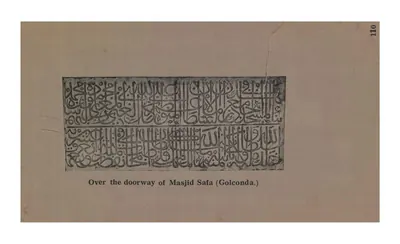
Jami Masjid inscription, Golconda fort
An inscription of AH 924 (1518) over the doorway of the congregational mosque (Masjid Safa) in Golconda fort. It records that Sultan Quli Qutb-ul-Mulk built the mosque in the reign of the Bahmani king Mahmud Shah, son of Muhammad Shah. Syed Ali Asgar Bilgrami used it to argue that Sultan Quli stayed loyal to the Bahmanis until 1518, and became independent only after Mahmud Shah's death.
The congregational mosque (Jami Masjid) of Golconda fort, which Syed Ali Asgar Bilgrami calls the Masjid Safa, stands near the entrance gate of the Bala Hisar, the citadel.1 Over its gateway is an inscription dated AH 924 (1518; AH is the Islamic way of counting years).1 It records that the mosque was built by Sultan Quli, Qutb-ul-Mulk, while he still named the Bahmani king Mahmud Shah as his sovereign.12 It was cut in the year in which Mahmud Shah died.3
The inscription
Bilgrami, an officer of the Hyderabad Archaeological Department, published it in 1927 in his guide to the monuments of Hyderabad and its suburbs, with a plate of a rubbing. He describes it as cut on a slab of black basalt fixed over the gateway of the mosque.1
His translation begins: “This Assembly mosque was built during the reign of the great King, trusting in the Independent God, Abil Maghazi Mahmood Shah son of Muhammad Shah Bahmani”.2 The text goes on: “May God perpetuate his Kingdom and sovereignty”.2 It names “its builder the humble suppliant of God, the Lord of The Universe is, Sultan Quli, entitled Qutbul Mulk”.2 It ends: “In the year 924 (A.H.).”2 He converts the date to 1518.2
Bilgrami records two later inscriptions in the same mosque:2
- Over the first is a line in Persian enamel signed by the calligrapher Abdul Karim and dated AH 927 (1520).2
- In the prayer niche are two verses of the Qur’an (chapter III, verses 33 and 34). He took them to express the founder’s hope that his descendants would be “honourable, chaste and righteous”.2
He noted that G. Yazdani had left these two out when he published the inscriptions of Golconda in Epigraphia Indo-Moslemica for 1915–16.2
The mosque
Bilgrami says Sultan Quli built the mosque “when he resided at Golconda in the capacity of a Bahmani Governor of Telingana”.2 It has a large prayer hall divided into four aisles by five arches, and a courtyard paved with granite slabs.2 He credits Sultan Quli with the boundary wall of the fort, this mosque and a royal palace.4 He says Sultan Quli renamed the fort Muhammadnagar.4 See Golconda Fort.
Sultan Quli’s independence
The inscription is the main evidence for the latest of the dates proposed for the beginning of the Qutb Shahi kingdom. Bilgrami wrote that Sultan Quli, “who had remained staunch until 924 A.H. (1518 A.D.)”, declared his independence only after his master’s death in that year.5
The other sources say this:
- Ferishta’s history, as translated by Briggs, says Sultan Quli was made governor of Telingana in AH 901 (1495–96), with Golconda and Warangal added to his estate.6
- The Burhan-i Ma’asir says he settled at Golconda after a settlement among the nobles some years later.7
- Gribble dates his independence to 1510.8
- T. W. Haig gives 1512, and notes that Sultan Quli never used the royal title, “as is evident from the epitaph on his tomb”.8910
Mahmud Shah died on 7 December 1518.3
Footnotes
-
Bilgrami, Landmarks of the Deccan (1927), p. 110 and plate (archive.org (opens in a new tab)). ↩ ↩2 ↩3 ↩4
-
Bilgrami, Landmarks of the Deccan (1927), p. 111 and note (archive.org (opens in a new tab)). ↩ ↩2 ↩3 ↩4 ↩5 ↩6 ↩7 ↩8 ↩9 ↩10 ↩11 ↩12
-
Haig, Cambridge History of India, Vol. III (1928), p. 431 (archive.org (opens in a new tab)). ↩ ↩2
-
Syed Ali Asgar Bilgrami, Landmarks of the Deccan (1927), p. 108 (archive.org (opens in a new tab)). ↩ ↩2
-
Bilgrami, Landmarks of the Deccan (1927), p. 192 (archive.org (opens in a new tab)). ↩
-
Muhammad Qasim Ferishta, tr. John Briggs, History of the Rise of the Mahomedan Power in India, Vol. II (1829), p. 544 (archive.org (opens in a new tab)). ↩
-
J. S. King, The History of the Bahmani Dynasty, founded on the Burhan-i Ma’asir (1900), p. 137 (archive.org (opens in a new tab)). ↩
-
J. D. B. Gribble, A History of the Deccan, Vol. I (1896), p. 129 (archive.org (opens in a new tab)). ↩ ↩2
-
Wolseley Haig (ed.), The Cambridge History of India, Vol. III (1928), p. 425, note (archive.org (opens in a new tab)). ↩
-
Haig, Cambridge History of India, Vol. III (1928), p. 430 (archive.org (opens in a new tab)). ↩
Photos
References
Notes (0)
Sources (5)
Spotted an error on this page? Tell us
Last updated: