Tiruvalangadu plates of Rajendra I
The largest known set of Chola copper plates, thirty-one sheets on a massive ring and seal, recording a grant of the sixth year of Rajendra I (about 1018) to the Siva temple at Tiruvalangadu in the Tamil country. Its Sanskrit verses, added later, give the Chola view of the Telugu country: Rajaraja I's killing of 'the Andhra king Bhima', and Rajendra's wait on the Godavari while his general carried the war through Orissa and Bengal to the Ganges and brought back its water.
The Tiruvalangadu plates are the largest known set of Chola copper plates.1 They record a grant of the sixth year of Rajendra I to a temple in the Tamil country.2 Their Sanskrit verses tell of Chola wars in the Telugu country: Rajaraja I’s killing of an Andhra king, and Rajendra’s march to the Godavari.34
The plates
H. Krishna Sastri published the plates in 1920, in South-Indian Inscriptions III.1 They had been found in September 1905.1 There are thirty-one copper sheets, against twenty-one in the Larger Leiden plates.1 K. V. Subrahmanya Aiyer later wrote that he had found the plates himself in 1906.5
The grant has two parts.2 The Tamil part, 524 lines, records an order of Rajendra’s sixth year.26 The Sanskrit part, 137 verses, praises the Chola family.2 Krishna Sastri thought it was written at least ten years after the Tamil part.2 He noted that it includes conquests which Rajendra’s Tamil inscriptions record only from his 13th year.7 He placed the grant in 1018.2
Rajaraja I and the Andhra king
The verses on Rajaraja I tell how he killed an Andhra king.3 In Krishna Sastri’s translation, Rajaraja vowed to “kill that Andhra (king) called Bhima”, and killed him with a mace.3 Krishna Sastri took this to mean that Rajaraja “unnecessarily interfered in the politics of the Andhra country”.8 He added that this Bhima had not been identified.9 See Rajaraja I.
The next verse lists the kings Rajaraja subdued.10 Krishna Sastri’s text reads Vanga (Bengal) among them.11 Subrahmanya Aiyer, summing up the same verse, wrote Vengi.12
Rajendra I on the Godavari
The verses then describe Rajendra’s northern expedition.13 He ordered his army commander to conquer the kings on the banks of the Ganges.13 The general reached the Ganges and sent its water to his master.13 “(Meantime) Rajendra-Chola (himself) … reached the river Godavari”, where the general brought him the water.4 There the king “killed in battle (the lord of) Odda”, with his younger brother and army.4 At home Rajendra built a tank, “composed of the waters of the Ganges”, as a pillar of victory.4
Krishna Sastri summed it up: Rajendra “reached the river Godavari to meet his able General who had just brought the water of the Ganges”.9 See the Mahendragiri inscriptions.
Kollippakkai
The Tamil part names Kollippakkai among Rajendra’s conquests.14 Krishna Sastri wrote that “Kollippakkai has been identified by Mr. Lewis Rice with Kulpak in the Nizam’s Dominions”, the modern Kolanupaka.15
Footnotes
-
H. Krishna Sastri, “The Tiruvalangadu Copper-plates of the Sixth Year of Rajendra-Chola I”, South-Indian Inscriptions, Vol. III, pt. III (1920), p. 383 (archive.org (opens in a new tab)). ↩ ↩2 ↩3 ↩4
-
Krishna Sastri, “Tiruvalangadu Copper-plates” (1920), p. 384 and notes (archive.org (opens in a new tab)). ↩ ↩2 ↩3 ↩4 ↩5 ↩6
-
Krishna Sastri, “Tiruvalangadu Copper-plates” (1920), p. 421, vv. 81–82 (archive.org (opens in a new tab)). ↩ ↩2 ↩3
-
Krishna Sastri, “Tiruvalangadu Copper-plates” (1920), p. 425, vv. 118–125 (archive.org (opens in a new tab)). ↩ ↩2 ↩3 ↩4
-
K. V. Subrahmanya Aiyer, “The Larger Leiden Plates (of Rajaraja I)”, Epigraphia Indica XXII (1933–34, publ. 1938), p. 214 (archive.org (opens in a new tab)). Paraphrased. ↩
-
Krishna Sastri, “Tiruvalangadu Copper-plates” (1920), p. 427, translation of the Tamil portion (archive.org (opens in a new tab)). ↩
-
Krishna Sastri, “Tiruvalangadu Copper-plates” (1920), p. 389 (archive.org (opens in a new tab)). ↩
-
Krishna Sastri, “Tiruvalangadu Copper-plates” (1920), p. 387 (archive.org (opens in a new tab)). ↩
-
Krishna Sastri, “Tiruvalangadu Copper-plates” (1920), p. 388 and note 6 (archive.org (opens in a new tab)). ↩ ↩2
-
Krishna Sastri, “Tiruvalangadu Copper-plates” (1920), p. 422, v. 84 (archive.org (opens in a new tab)). ↩
-
Krishna Sastri, “Tiruvalangadu Copper-plates” (1920), p. 398, text, l. 169 (archive.org (opens in a new tab)). ↩
-
Subrahmanya Aiyer, “Larger Leiden Plates”, Epigraphia Indica XXII, p. 221 (archive.org (opens in a new tab)). Paraphrased. ↩
-
Krishna Sastri, “Tiruvalangadu Copper-plates” (1920), p. 424, vv. 104–117 (archive.org (opens in a new tab)). ↩ ↩2 ↩3
-
Krishna Sastri, “Tiruvalangadu Copper-plates” (1920), p. 430, translation of ll. 131–142 (archive.org (opens in a new tab)). ↩
-
Krishna Sastri, “Tiruvalangadu Copper-plates” (1920), p. 390 (archive.org (opens in a new tab)). ↩
Photos
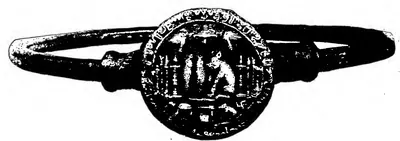 "Ring and Seal" of the Tiruvalangadu copper plates of the Chola king Rajendra I (South-Indian Inscriptions III, pt. III, 1920, Plate XIX)Book plate · 1920
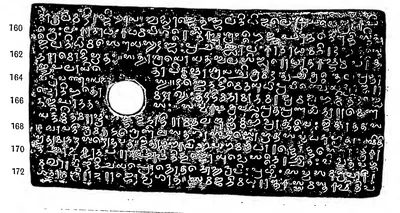 Tiruvalangadu plates of Rajendra I, plate vi, second side: lines 160-172 of the Sanskrit portion (South-Indian Inscriptions III, pt. III, 1920, Plate XIV)Book plate · 1920
References
Notes (0)
Sources (2)
Spotted an error on this page? Tell us
Last updated: