Rajaraja I (Chola)
Chola king of Tanjore (Thanjavur) from 985, the founder of the Chola empire, whose inscriptions claim the conquest of Vengai-nadu, the Eastern Chalukya country of Vengi. About 999 he helped the Eastern Chalukya prince Saktivarman I back to the throne of Vengi, and he married his daughter Kundavadevi to Saktivarman's brother Vimaladitya. This began the alliance that made the Eastern Chalukyas Chola vassals and, two generations later, Chola emperors. Inscriptions of his reign are found at Kalahasti, and a Vaidumba chief ruled under him in the Nellore country.
Rajaraja I was the Chola king of Tanjore whose conquests made the Cholas the leading power of the south.12 E. Hultzsch, using F. Kielhorn’s calculations, placed the start of his reign between 25 June and 25 July 985.1 In the Telugu country he is remembered for his part in Vengi and for the marriage that bound the Eastern Chalukyas to his family.34 See the Cholas of Tanjore.
Family
In Hultzsch’s pedigree of 1903, Rajaraja I was the son of the Chola king Parantaka II.5 His son Rajendra I succeeded him, and his daughter Kundavadevi married the Eastern Chalukya king Vimaladitya.56 The Tiruvalangadu plates, written in his son’s reign, call him Arunmolivarman.7 Robert Sewell’s table gives him the titles Mummadi-Chola and Nurmadi-Chola.8
Vengai-nadu
Rajaraja’s Tamil inscriptions open with a list of his conquests.9 The great Tanjore inscription of his 26th year names “Vengai-nadu, Ganga-padi, Tadigai-padi, Nulamba-padi”, Kalingam and other lands.9 Hultzsch explained in 1890 that “Vengai-nadu is the well-known country of Vengi”.4
When this conquest happened is disputed.10111213
- Sewell found the claim in a record of Rajaraja’s 14th year, 998–99.10
- K. V. Subrahmanya Aiyer (1933–34) dated the first mention of the Eastern Chalukyas to records of the 12th to 14th years, about 997–98.11
- S. Krishnaswami Aiyangar (1911) wrote that within two years after his twelfth year he had conquered Vengai-nadu.12
- J. F. Fleet (1891), who then dated Rajaraja to 1003 or 1004, thought the claim to Vengi “merely an honorary one”.13
The restoration of Saktivarman
The Eastern Chalukya grants say that Vengi had no ruler for twenty-seven years before Danarnava’s son Saktivarman I took the throne.6 The Godavari District Gazetteer (1907) wrote that Rajaraja “conquered the Eastern Chalukya country”.3 It thought he made Saktivarman (999–1011) king, or perhaps a vassal, in Vengi.3 The Imperial Gazetteer of Madras (1908) says that by 999 the Cholas had won “the whole of the coast possessions of the Eastern Chalukyas”.2
Subrahmanya Aiyer thought the invasion was made on behalf of Danarnava’s line, to put Saktivarman on the throne.14 Sewell read a record of 998–99 in the same way.10 See the Eastern Chalukyas.
Bhima and Satyasraya
The Tiruvalangadu plates say that Rajaraja killed “that Andhra (king) called Bhima” with a mace.7 H. Krishna Sastri (1920) concluded that Rajaraja “unnecessarily interfered in the politics of the Andhra country”.15 He added that this Bhima had not been identified.16
Rajaraja also fought the Western Chalukya king Satyasraya.17 Fleet wrote in 1896 that each side claimed the victory.17 Sewell put this war in 1005–06.18 He noted an inscription of Satyasraya dated 1006 at Chebrolu, in the Guntur district.18 See the Western Chalukyas of Kalyani.
Kundavadevi and Vimaladitya
Hultzsch thought in 1890 that Kundavadevi’s marriage to Vimaladitya “was probably a forced one”.4 V. Venkayya (1901) linked it with Vimaladitya’s defeat by Rajaraja’s son Rajendra.19 He thought Vimaladitya was taken prisoner to Thanjavur (then Tanjore) and married Kundava there.19 The Vizagapatam District Gazetteer (1907) gave the victory over Vimaladitya at Mahendragiri to Rajaraja himself, in 999–1000.20 See Kundavadevi and the Mahendragiri inscriptions.
The southern Telugu districts
V. Rangacharya (1919) wrote of Kalahasti that “in the time of Rajaraja I it came to be called Mummudicholapuram”.21 Among the records in its temple is one of Rajaraja’s 27th year, recording the gift of a diadem.22
Sewell cited a record of Rajaraja’s 8th year, 992, in the Gudur taluk of Nellore.23 It names a Vaidumba chief as the local ruler.23 The Cuddapah District Gazetteer (1915) adds that a Vaidumba chief was Rajaraja’s vassal in the Kadapa (then Cuddapah) country.24 See the Vaidumbas.
Where the sources disagree
- Accession. 985, from Kielhorn’s calculations (Hultzsch, Sewell, Aiyangar).123 The Cuddapah gazetteer gives 982.24 Fleet in 1891 gave 1003 or 1004.13
- The Mahendragiri victory. Rajendra, in his father’s lifetime (Venkayya), or Rajaraja himself in 999–1000 (the Vizagapatam gazetteer).1920
Footnotes
-
E. Hultzsch, South-Indian Inscriptions, Vol. III, pt. II (1903), p. 126 (archive.org (opens in a new tab)). ↩ ↩2 ↩3
-
Imperial Gazetteer of India, Provincial Series: Madras, Vol. I (1908), p. 16 (archive.org (opens in a new tab)). ↩ ↩2
-
F. R. Hemingway, Madras District Gazetteers: Godavari, Vol. I (1907), p. 20 (archive.org (opens in a new tab)). ↩ ↩2 ↩3
-
Hultzsch, South-Indian Inscriptions I (1890), p. 63 (archive.org (opens in a new tab)). ↩ ↩2 ↩3
-
Hultzsch, South-Indian Inscriptions III, pt. II (1903), p. 196, “Pedigree of the Chola Dynasty” (archive.org (opens in a new tab)). ↩ ↩2
-
E. Hultzsch, South-Indian Inscriptions, Vol. I (1890), p. 51 (archive.org (opens in a new tab)). ↩ ↩2
-
H. Krishna Sastri, “The Tiruvalangadu Copper-plates of the Sixth Year of Rajendra-Chola I”, South-Indian Inscriptions, Vol. III, pt. III (1920), p. 421, vv. 81–82 (archive.org (opens in a new tab)). ↩ ↩2
-
Sewell and Aiyangar, Historical Inscriptions of Southern India (1932), p. 341, table of the Chola kings (archive.org (opens in a new tab)). Paraphrased. ↩
-
E. Hultzsch, South-Indian Inscriptions, Vol. II, pt. I (1891), p. 8, translation of No. 1 (archive.org (opens in a new tab)). ↩ ↩2
-
Sewell and Aiyangar, Historical Inscriptions of Southern India (1932), p. 56 (archive.org (opens in a new tab)). Paraphrased. ↩ ↩2 ↩3
-
K. V. Subrahmanya Aiyer, “The Larger Leiden Plates (of Rajaraja I)”, Epigraphia Indica XXII (1933–34, publ. 1938), p. 225 (archive.org (opens in a new tab)). Paraphrased. ↩ ↩2
-
S. Krishnaswami Aiyangar, Ancient India (1911), p. 104 (archive.org (opens in a new tab)). ↩ ↩2
-
J. F. Fleet, “The Chronology of the Eastern Chalukya Kings”, Indian Antiquary XX (1891), p. 272 (archive.org (opens in a new tab)). ↩ ↩2 ↩3
-
Subrahmanya Aiyer, “Larger Leiden Plates”, Epigraphia Indica XXII, pp. 227–228 (archive.org (opens in a new tab)). Paraphrased. ↩
-
Krishna Sastri, “Tiruvalangadu Copper-plates” (1920), p. 387 (archive.org (opens in a new tab)). ↩
-
Krishna Sastri, “Tiruvalangadu Copper-plates” (1920), p. 388 (archive.org (opens in a new tab)). ↩
-
J. F. Fleet, “Dynasties of the Kanarese Districts”, Gazetteer of the Bombay Presidency I, pt. II (1896), p. 433 (archive.org (opens in a new tab)). ↩ ↩2
-
Sewell and Aiyangar, Historical Inscriptions of Southern India (1932), pp. 57–58 (archive.org (opens in a new tab)). Paraphrased. ↩ ↩2
-
V. Venkayya, “Ranastipundi Grant of Vimaladitya”, Epigraphia Indica VI (1900–01), p. 350 (archive.org (opens in a new tab)). ↩ ↩2 ↩3
-
W. Francis, Madras District Gazetteers: Vizagapatam, Vol. I (1907), p. 26 (archive.org (opens in a new tab)). ↩ ↩2
-
V. Rangacharya, A Topographical List of the Inscriptions of the Madras Presidency, Vol. I (1919), p. 480 (archive.org (opens in a new tab)). ↩
-
Rangacharya, Topographical List I (1919), p. 482, Chittoor No. 80 (archive.org (opens in a new tab)). ↩
-
Robert Sewell and S. Krishnaswami Aiyangar, The Historical Inscriptions of Southern India (1932), p. 54 (archive.org (opens in a new tab)). Paraphrased. ↩ ↩2 ↩3
-
C. F. Brackenbury, Madras District Gazetteers: Cuddapah (1915), p. 29 (archive.org (opens in a new tab)). ↩ ↩2
Photos
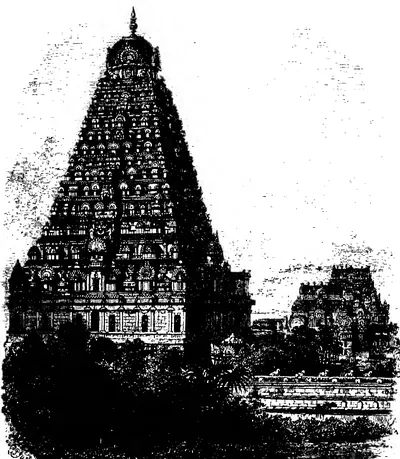 "View of the Great Temple at Tanjor": the Rajarajesvara temple of Rajaraja I at Thanjavur (Fergusson and Burgess 1910, woodcut 213)Drawing · 1910
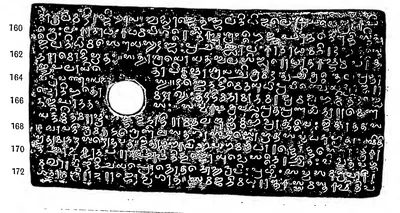 Tiruvalangadu plates of Rajendra I, plate vi, second side: lines 160-172 of the Sanskrit portion (South-Indian Inscriptions III, pt. III, 1920, Plate XIV)Book plate · 1920
References
Notes (0)
Sources (15)
Spotted an error on this page? Tell us
Last updated: