Toli Masjid inscription (1671)
A Persian verse inscription in the prayer niche of the Toli Masjid, Hyderabad. It records that Musa Khan built the mosque and that it was completed in the reign of Abdullah Qutb Shah. Its chronogram (a phrase whose letters give the date) gives AH 1082 (1671). G. Yazdani edited it in 1921, in Epigraphia Indo-Moslemica for 1917–18, and Bilgrami again in 1927. A second slab in the courtyard, of AH 1043 (1633), belongs to another mosque.
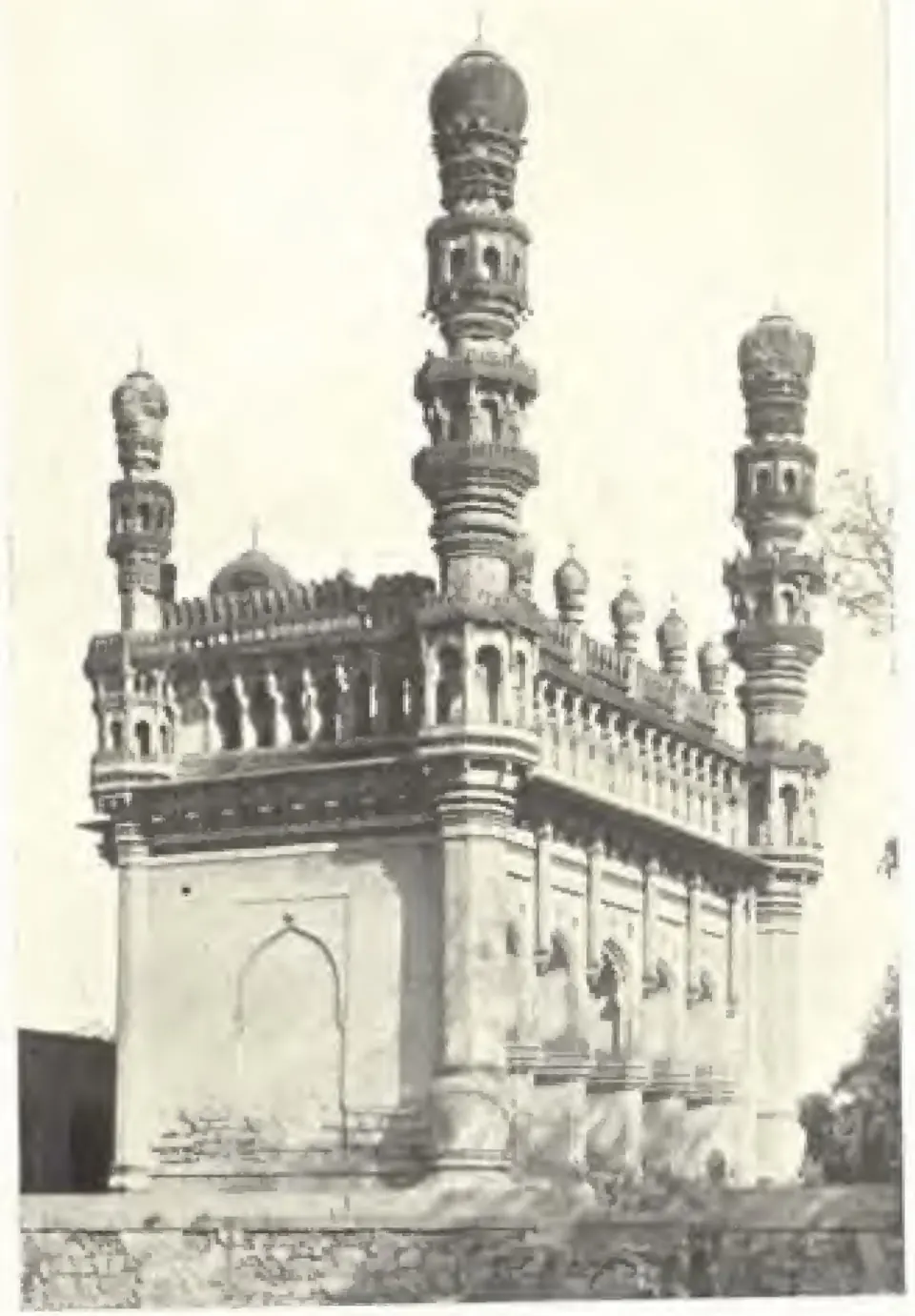
The Toli Masjid stands on the road from the Purana Pul to Golconda, and its building record is in the prayer niche.1 G. Yazdani published the record in 1921 with a plate.1 It was one of thirteen inscriptions of the Qutb Shahi kings in Hyderabad city and its suburbs that he published together.1 He described it as Persian verse in two lines, in Naskh script.1
The text
Yazdani translated it:
“For whom is the Kingdom today? For God, the One, the All-powerful. Musa Khan built this mosque of his Which was completed in the reign of Shah Abdullah, As a chronogram of the mosque this was heard (from the Invisible Speaker): ‘Built the mosque in the name of God.’ 1082 A.H. = 1671 A.D.”1
Syed Ali Asgar Bilgrami, writing in 1927, gives the same reading and the same year in nearly the same words.2 Bilgrami identifies the builder as Musa Khan, the mahaldar (chamberlain) of Abdullah Qutb Shah.3 He calls him both a minister and a general of the king.3 According to Bilgrami, the same man built the Musa Burj of Golconda fort.34 There a Persian and Telugu inscription names him as the commander who held the fort against the Mughals in 1656.34 Bilgrami adds that he took part in the choice of Abul Hasan as Abdullah’s successor.34 See the Musa Burj inscription.
The second slab
Two loose tablets of black basalt lie in the courtyard near a grave.51 Each measures 3 ft 2 in by 1 ft 3 in.51 Their Persian verse says that in the reign of King Abdullah “This building was completed through the efforts of the Shaikh, the leader”.51 It gives the chronogram “This mosque was built by the order of King Abdullah”, that is AH 1043 (1633; AH is the Islamic way of counting years).51 The calligrapher was Lutfullah al-Husaini of Tabriz.51
Yazdani pointed out that this record “records the erection of a mosque in 1043 A.H.”5 He added that this mosque “is different from the Toli Masjid, which, according to the inscription set up in the niche, was built by Musa Khan in 1082 A.H.”5
Bilgrami agreed, and he identified the Shaikh as Shaikh Muhammad Ibn Khatun, Abdullah’s peshwa (chief minister).62 Yazdani had already given the text of the 1043 slab in the department’s report for 1916–17.7
What the record settles
The inscription dates the mosque to Abdullah’s reign.81 A. Claude Campbell had written in 1898 that the mosque was built in 1604 by order of Muhammad Quli.81 Neither Yazdani nor Bilgrami mentions that date, and the niche record contradicts it.81
Footnotes
-
Yazdani, Epigraphia Indo-Moslemica 1917–18 (1921), p. 50 and pls. XIX (a), XX (a) (archive.org (opens in a new tab)). ↩ ↩2 ↩3 ↩4 ↩5 ↩6 ↩7 ↩8 ↩9 ↩10 ↩11 ↩12 ↩13
-
Bilgrami, Landmarks of the Deccan (1927), p. 66 and plates (archive.org (opens in a new tab)). ↩ ↩2
-
Bilgrami, Landmarks of the Deccan (1927), p. 67 (archive.org (opens in a new tab)). ↩ ↩2 ↩3 ↩4 ↩5
-
Bilgrami, Landmarks of the Deccan (1927), p. 165 (archive.org (opens in a new tab)). ↩ ↩2 ↩3
-
G. Yazdani, “Inscriptions of the Qutb Shahi Kings in Hyderabad City and Suburbs”, Epigraphia Indo-Moslemica 1917–18 (1921), p. 49 (archive.org (opens in a new tab)). ↩ ↩2 ↩3 ↩4 ↩5 ↩6 ↩7
-
Syed Ali Asgar Bilgrami, Landmarks of the Deccan (1927), p. 65 (archive.org (opens in a new tab)). ↩
-
Annual Report of the Archaeological Department of H.E.H. the Nizam’s Dominions, 1326 F. (1916–17) (1917), p. 4 (archive.org (opens in a new tab)). ↩
-
A. Claude Campbell, Glimpses of the Nizam’s Dominions (1898), p. 211 (archive.org (opens in a new tab)). ↩ ↩2 ↩3
Photos
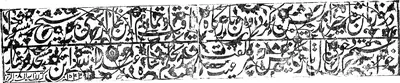 "Inscription on two loose slabs lying in the Toli Masjid, Hyderabad" (Epigraphia Indo-Moslemica 1917-18, Pl. XIX (a) (PDF p. 81))Inscription rubbing · 1921
 "Inscription slab in the court-yard of Toli Masjid" (Bilgrami 1927, p. 66)Inscription rubbing · 1927
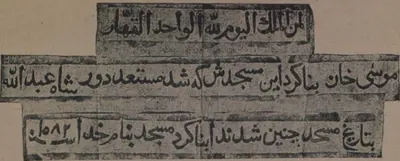 "Inscriptions of Toli Masjid (Prayer-Niche)" (Bilgrami 1927, p. 66)Inscription rubbing · 1927
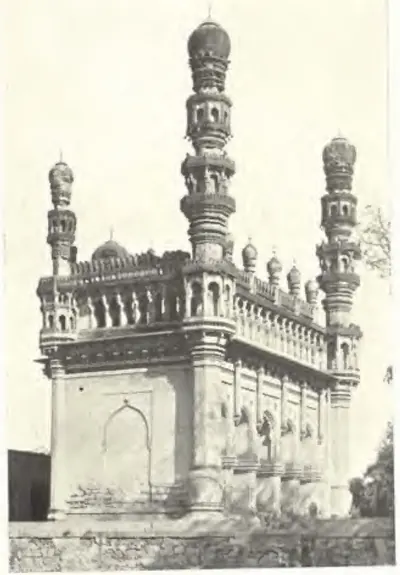 "Toli Masjid, Hydrabad, view from S. E." (Annual Report of the Archaeological Department, Hyderabad, 1916-17, Pl. II (b) (PDF p. 71 of the IGNCA scan))Historic photograph · 1917
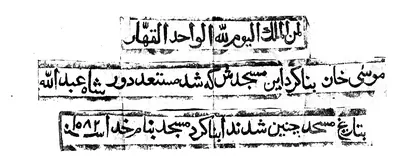 Toli Masjid, Hyderabad: Persian inscription of Musa Khan with the chronogram "Built the mosque in the name of God", 1082 AH (1671) (Epigraphia Indo-Moslemica 1917-18, Pl. XX (a))Inscription rubbing · 1921
References
Notes (0)
Sources (4)
Spotted an error on this page? Tell us
Last updated: