Abdullah Qutb Shah
Seventh Qutb Shahi sultan of Golconda (1626–1672). He was crowned as a boy and left the government to his mother Hayat Bakhsh Begum and his ministers. In 1636 he accepted the Mughal emperor Shah Jahan as his overlord. His minister Mir Jumla conquered the Karnatak and its diamond mines. In 1656 Mir Jumla's quarrel with him brought Aurangzeb to besiege Golconda. An inscription in Persian and Telugu records the siege. He died without a son in 1672.
Abdullah Qutb Shah was the seventh king of the Qutb Shahi dynasty of Golconda.12 He reigned for forty-six years, the longest reign of his line.12 He was the only son of Sultan Muhammad Qutb Shah and Hayat Bakhsh Begum, the daughter of Muhammad Quli.12 Sha Rocco, writing for the Hyderabad government press in 1929, gives his birth as 2 December 1614.3 His reign saw Golconda become a tributary of the Mughal empire, the conquest of the Karnatak by his minister Mir Jumla, and the first Mughal siege of Golconda in 1656.
A king and his mother
Bilgrami says Abdullah was crowned in the Muhammadi Mahal on 14 Jumada I AH 1035 (1626; AH is the Islamic way of counting years), the day after his father’s death.1 Jadunath Sarkar, writing in 1930, called him “a mere puppet on the throne” for the whole of his reign.2 Sarkar wrote: “The actual administration was conducted for more than 40 years by his mother, Hayat Bakhsh Begam, a lady of strong character”.2 She died on 12 February 1667, and after that he was swayed by his eldest son-in-law, Sayyid Ahmad.2
The French traveller Jean de Thevenot was at Golconda in 1666.4 He wrote that “next to the Queen-mother, he trusts no body but Sidy Mezafer (his favourite) and the Bramens”.4 This was “because that Queen is of the Bramen Caste, and continually surrounded by them”.4
Thevenot also heard that the king was “the Son of a Bramen Lady”.56 He heard that an elder brother had been imprisoned so that Abdullah could reign.56 Rocco found no other evidence that Hayat Bakhsh Begum was a Brahmin.56 But he agreed that Brahmins came into power at court in her time.56
The Mughal overlordship
In the ninth year of his reign (AH 1045, 1635–36) the emperor Shah Jahan was campaigning in the Deccan.7 He sent Abdullah a farman (royal order).7 In the words of the editors of the official Badshah-nama, it called “for the allegiance of Kutbu-l Mulk to the Imperial throne”.7 It also called “for the khutba being read in the name of the Emperor, and for the payment of tribute”.7
The imperial envoy Abdul Latif came near Golconda, and the king came out five kos to meet him.8 He had the khutba (the Friday sermon) read in the emperor’s name and attended its reading several times.8 He also “had coins struck in the Emperor’s name, and sent specimens of them to Court”.8
Another court history of Shah Jahan’s reign gives the agreed yearly tribute as two lakhs of huns (pagodas).910 Tavernier visited Golconda several times.910 He says that neither Jahangir nor Shah Jahan made war on the king of Golconda, “on the condition that he should pay to the Moguls an annual tribute of 200,000 pagodas”.910
Mir Jumla and the siege of 1656
Abdullah’s chief minister for many years was Mir Muhammad Said of Ardistan, known by his office of Mir Jumla.11 He conquered a large territory in the Karnatak, south of the Krishna, with its diamond mines.11 He kept five thousand horse of his own.11
His enemies at court turned the king against him, and he asked the Mughal prince Aurangzeb for protection.1213 Abdullah imprisoned his son and seized his property.1213 Aurangzeb sent his own son Muhammad Sultan to Hyderabad.1213 Abdullah fled to the fort of Golconda, where the Mughals besieged him early in 1656.1213 See Mir Jumla.
The French doctor François Bernier, writing from Delhi, tells of a plan to seize the king by a trick.1415 Aurangzeb was to come disguised as the escort of an ambassador from Shah Jahan.1415 He would seize Abdullah when the king came out to receive the envoy in his garden at Bhagnagar.1415 A noble in the plot warned the king at the last moment, and he “rode at full speed to the fortress of Golkonda”.1415
Tavernier records that a gunner on the walls offered to kill Aurangzeb with a cannon shot.16 The king, “seizing him by the arm, told him to do nothing of the sort, and that the lives of Princes should be respected”.16
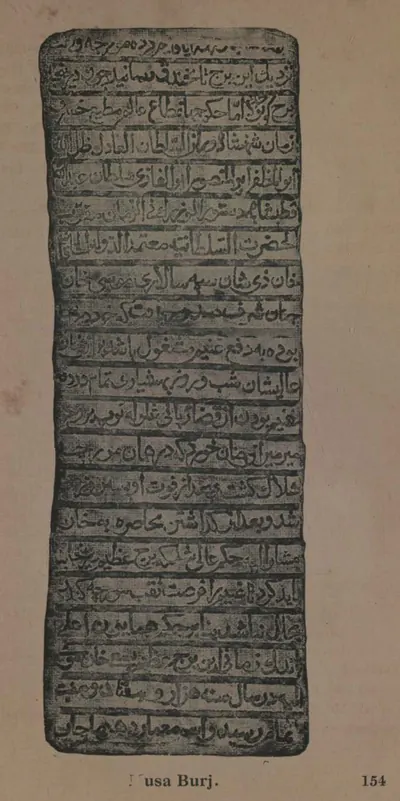
A bastion of the fort, the Musa Burj, carries an inscription in Persian and a version in Telugu script that record the siege.17 Bilgrami printed a translation of the Persian text.17 It says that Abdullah ordered his commander-in-chief Musa Khan to hold the place “day and night”.17 A gun shot killed Aurangzeb’s officer Mir Miran in his trench, and “three days after his death peace was concluded”.17 The bastion was then built in AH 1077 (1666–67) by an architect named Dharmachar.17
H. Krishna Sastri read the Telugu text.1819 It dates the siege to Wednesday, the seventh day of the bright half of Magha in the Saka year 1578.1819 Sastri worked this out as 23 January 1656.1819
Peace came through Abdullah’s mother, who came out to talk with the Mughal prince.20 Abdullah paid a war payment and unpaid tribute, and married his daughter to Muhammad Sultan.212223 Haig adds that he gave her the district of Ramgir as her dowry.212223 He also agreed to put the emperor’s name on his silver coins.212223 Bernier says the young prince was promised the succession to Golconda.24 See Golconda Fort.
The later years
Bernier was at Golconda in 1667.2526 He described a king who had “lost all mental energy” since the siege.2526 The king never appeared in public to give justice and never left the fortress, while his nobles “exercise a disgusting tyranny”.2526 The Mughal ambassador at his court acted “with the uncontrolled authority of an absolute sovereign”.2526
Sarkar says that in 1665–66 Abdullah still sent troops to help Bijapur against the Mughals.27 He also helped Shivaji with money after Shivaji’s flight from Agra in 1666.27
The kingdom kept growing in the south.28 The Kistna district manual says that Mir Jumla had greatly added to his wealth “by successful war against the Hindu Rajas of the Carnatic”.28 Robert Sewell’s list of inscriptions, published in 1932, records that one of Abdullah’s generals took Udayagiri in 1642.2930 By 1646 Golconda ruled the Kadapa (then Cuddapah) district and took Chandragiri, the home of the last Vijayanagara king.2930
The English moved their factory (trading post) from Machilipatnam (then Masulipatam) to Armagaon in 1628, because the king’s officers put obstacles in their way.331 They came back in 1632 when they received the “Golden Firman” from Abdullah.331 Rocco quotes its promise: “Under Me the King, they shall sit down at rest and in safety”.331 See Machilipatnam.
Court and buildings
Bilgrami records that two works were compiled in his reign: the Persian dictionary Burhan-i Qati, and the Hadiqat-us-Salatin, a book of Qutb Shahi history.32 Rocco calls him “a just and liberal prince, but weak”.33 He was “an enthusiastic patron of learning and architecture” who founded colleges and built mosques, palaces, baths and gardens.33
Haig read an inscription on black basalt in the citadel of Golconda in 1907.34 It records that a store-house (ambar-khana) was completed by Khairat Khan, “the faithful servant of the glorious King Abdullah Qutb Shah”, in Rajab 1642.34 Haig’s text prints the Hijri (Islamic) year as 1252.34 But Hijri 1252 began in April 1836, according to the conversion tables of Sewell and Dikshit.35 Bilgrami’s 1927 guide reads the year on the same stone as 1052, which he gives as October 1642.36 Rocco adds that the eastern extension of the fort, the Naya Qila, was built in his reign to take in a small hill that overlooked the fortress.33
Death and succession
Abdullah had no son but three daughters, and their marriages decided who would rule next.103738 According to Tavernier:103738
- the eldest daughter married Sayyid Ahmad, a relative of the Grand Sheikh of Mecca, who rose to be prime minister
- the second married Aurangzeb’s son Muhammad Sultan
- the third married Abul Hasan, a cousin of the king103738
Bernier calls the princess who married Muhammad Sultan the king’s eldest daughter.24 Sarkar says the third daughter was to have married Sayyid Sultan, a follower of Sayyid Ahmad.3940 But the two men quarrelled on the wedding day, and she was married in haste to Abul Hasan.3940
The sources give different dates for Abdullah’s death:414243
- Sarkar: 21 April 1672, in the Old Style calendar he used throughout his book414243
- Rocco: 1 May 1672414243
- the Imperial Gazetteer: 1674444546
- Bernier’s editor: 1674444546
- the Kistna manual: 1669444546
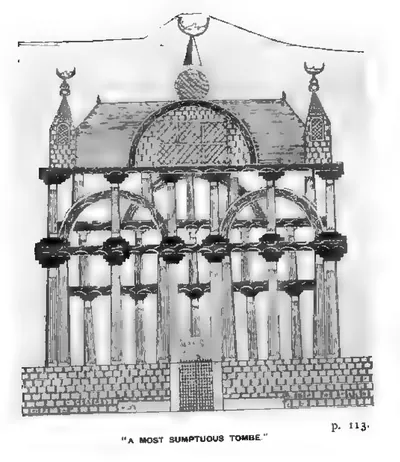
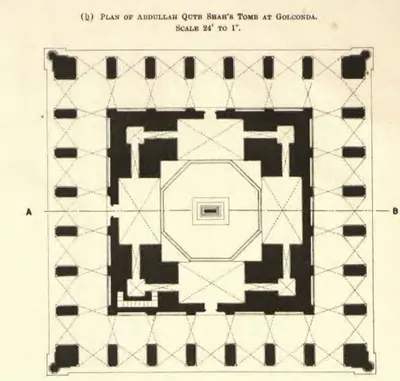
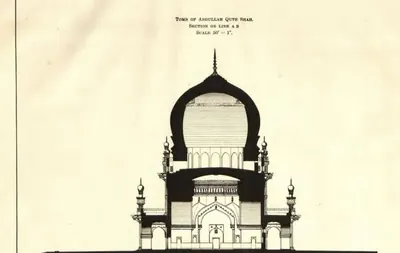
His eldest son-in-law Sayyid Ahmad claimed the throne, but the courtiers made Abul Hasan king.41 Abdullah’s domed tomb stands among the Qutb Shahi tombs, and Rocco’s book shows a photograph of it.47
Footnotes
-
Bilgrami, Landmarks of the Deccan (1927), p. 201 (archive.org (opens in a new tab)). ↩ ↩2 ↩3 ↩4
-
Jadunath Sarkar, History of Aurangzib, Vol. IV (2nd ed., 1930), p. 395 (archive.org (opens in a new tab)). ↩ ↩2 ↩3 ↩4 ↩5 ↩6
-
Sha Rocco, Golconda and the Qutb Shahs (1929), p. 17 (archive.org (opens in a new tab)). ↩ ↩2 ↩3 ↩4
-
Thevenot, Travels into the Levant, Part III (1687), p. 101 (archive.org (opens in a new tab)). ↩ ↩2 ↩3
-
Jean de Thevenot, The Travels of Monsieur de Thevenot into the Levant, Part III (English tr., 1687), p. 100 (archive.org (opens in a new tab)). ↩ ↩2 ↩3 ↩4
-
Rocco, Golconda and the Qutb Shahs (1929), pp. 26–27 (archive.org (opens in a new tab)). ↩ ↩2 ↩3 ↩4
-
Badshah-nama of Abdul Hamid Lahori, in H. M. Elliot and John Dowson (eds.), The History of India as Told by Its Own Historians, Vol. VII (1877), p. 51 (archive.org (opens in a new tab)). ↩ ↩2 ↩3 ↩4
-
Badshah-nama, in Elliot and Dowson, History of India, Vol. VII (1877), p. 53 (archive.org (opens in a new tab)). ↩ ↩2 ↩3
-
Inayat Khan, Shah Jahan-nama, in Elliot and Dowson, History of India, Vol. VII (1877), p. 84 (archive.org (opens in a new tab)). ↩ ↩2 ↩3
-
Jean-Baptiste Tavernier, tr. V. Ball, Travels in India, Vol. I (1889), p. 161 (archive.org (opens in a new tab)). ↩ ↩2 ↩3 ↩4 ↩5 ↩6
-
Inayat Khan, Shah Jahan-nama, in Elliot and Dowson, History of India, Vol. VII (1877), p. 108 (archive.org (opens in a new tab)). ↩ ↩2 ↩3
-
Elliot and Dowson, History of India, Vol. VII (1877), pp. 109–110 (archive.org (opens in a new tab)). ↩ ↩2 ↩3 ↩4
-
Elliot and Dowson, History of India, Vol. VII (1877), pp. 111–113 (archive.org (opens in a new tab)). ↩ ↩2 ↩3 ↩4
-
Bernier, Travels in the Mogul Empire (1891), p. 19 (archive.org (opens in a new tab)). ↩ ↩2 ↩3 ↩4
-
Bernier, Travels in the Mogul Empire (1891), pp. 20–21 (archive.org (opens in a new tab)). ↩ ↩2 ↩3 ↩4
-
Tavernier, Travels in India, Vol. I (1889), p. 167 (archive.org (opens in a new tab)). ↩ ↩2
-
Syed Ali Asgar Bilgrami, Landmarks of the Deccan (1927), pp. 153, 155 (archive.org (opens in a new tab)). ↩ ↩2 ↩3 ↩4 ↩5
-
Bilgrami, Landmarks of the Deccan (1927), p. 156 (archive.org (opens in a new tab)). ↩ ↩2 ↩3
-
Bilgrami, Landmarks of the Deccan (1927), p. 157 (archive.org (opens in a new tab)). ↩ ↩2 ↩3
-
Elliot and Dowson, History of India, Vol. VII (1877), p. 116 (archive.org (opens in a new tab)). ↩
-
Elliot and Dowson, History of India, Vol. VII (1877), pp. 115–116 (archive.org (opens in a new tab)). ↩ ↩2 ↩3
-
Elliot and Dowson, History of India, Vol. VII (1877), pp. 118–119 (archive.org (opens in a new tab)). ↩ ↩2 ↩3
-
Haig, Historic Landmarks of the Deccan (1907), pp. 183–184 (archive.org (opens in a new tab)). ↩ ↩2 ↩3
-
Bernier, Travels in the Mogul Empire (1891), pp. 21–22 (archive.org (opens in a new tab)). ↩ ↩2
-
Bernier, Travels in the Mogul Empire (1891), p. 194 (archive.org (opens in a new tab)). ↩ ↩2 ↩3 ↩4
-
Bernier, Travels in the Mogul Empire (1891), p. 195 (archive.org (opens in a new tab)). ↩ ↩2 ↩3 ↩4
-
Sarkar, History of Aurangzib, Vol. IV (1930), p. 406 (archive.org (opens in a new tab)). ↩ ↩2
-
Mackenzie, Kistna District (1883), p. 35 (archive.org (opens in a new tab)). ↩ ↩2
-
Robert Sewell, The Historical Inscriptions of Southern India (1932), p. 278 (archive.org (opens in a new tab)). ↩ ↩2
-
Sewell, Historical Inscriptions (1932), p. 279 (archive.org (opens in a new tab)). ↩ ↩2
-
Gordon Mackenzie, A Manual of the Kistna District (1883), p. 34 (archive.org (opens in a new tab)). ↩ ↩2 ↩3
-
Bilgrami, Landmarks of the Deccan (1927), p. 202 (archive.org (opens in a new tab)). ↩
-
Rocco, Golconda and the Qutb Shahs (1929), p. 28 (archive.org (opens in a new tab)). ↩ ↩2 ↩3
-
T. W. Haig, Historic Landmarks of the Deccan (1907), pp. 181–182 (archive.org (opens in a new tab)). ↩ ↩2 ↩3
-
Robert Sewell and S. B. Dikshit, The Indian Calendar (1896), Table XVI, p. cxxxvi (archive.org (opens in a new tab)). ↩
-
Bilgrami, Landmarks of the Deccan (1927), p. 149 (archive.org (opens in a new tab)). ↩
-
Tavernier, Travels in India, Vol. I (1889), pp. 164–165 (archive.org (opens in a new tab)). ↩ ↩2 ↩3
-
Tavernier, Travels in India, Vol. I (1889), pp. 170–171 (archive.org (opens in a new tab)). ↩ ↩2 ↩3
-
Sarkar, History of Aurangzib, Vol. IV (1930), p. 396 (archive.org (opens in a new tab)). ↩ ↩2
-
Sarkar, History of Aurangzib, Vol. IV (1930), p. 397 (archive.org (opens in a new tab)). ↩ ↩2
-
Sarkar, History of Aurangzib, Vol. IV (1930), p. 398 (archive.org (opens in a new tab)). ↩ ↩2 ↩3 ↩4
-
Sarkar, History of Aurangzib, Vol. IV (1930), preface (archive.org (opens in a new tab)). ↩ ↩2 ↩3
-
Rocco, Golconda and the Qutb Shahs (1929), p. 29 (archive.org (opens in a new tab)). ↩ ↩2 ↩3
-
Imperial Gazetteer of India: Hyderabad State (1909), p. 14 (archive.org (opens in a new tab)). ↩ ↩2 ↩3
-
François Bernier, tr. Archibald Constable, Travels in the Mogul Empire, A.D. 1656–1668 (1891), p. 18 and note (archive.org (opens in a new tab)). ↩ ↩2 ↩3
-
Mackenzie, Kistna District (1883), p. 36 (archive.org (opens in a new tab)). ↩ ↩2 ↩3
-
Rocco, Golconda and the Qutb Shahs (1929), list of plates and plate VIII (archive.org (opens in a new tab)). ↩
Photos
 "A most sumptuous Tombe" (Thomas Bowrey, ed. R. C. Temple, A Geographical Account of Countries round the Bay of Bengal, 1669 to 1679 (1905), Pl. IX, facing p. 113 (PDF p. 186))Drawing · 1669-1679 (published 1905)
 "Plan of Abdullah Qutb Shah's Tomb at Golconda" (Annual Report of the Archaeological Department, Hyderabad, 1917-18, Pl. IV (b) (PDF p. 61))Plan · 1919
 "Tomb of Abdullah Qutb Shah. Section on line A B" (Annual Report of the Archaeological Department, Hyderabad, 1917-18, Pl. V (PDF p. 65))Drawing · 1919
 Inscription on the wall of Musa Burj, Golconda Fort (Bilgrami 1927, p. 154)Inscription rubbing · 1927
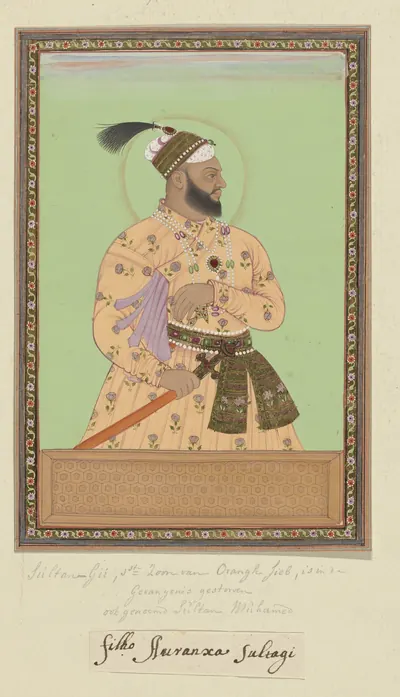 Muhammad Sultan ("Sultanji"): Deccani portrait, c. 1686, Rijksmuseum (RP-T-00-3186-10); Dutch title: "Portrait of Sultanji, the eldest son of Aurangzeb, the son-in-law of Sultan Abdullah; Aurangzeb imprisoned him and he also died in that captivity"Other · c. 1686
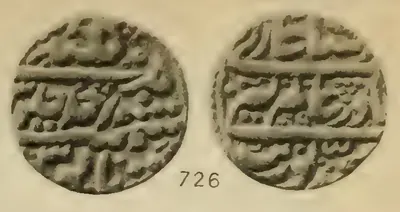 Silver rupee of Aurangzeb struck at Golkondah (Golconda), AH 1069, regnal year 1, obverse and reverse (Lane-Poole 1892, No. 726, pl. XIX)Coin · 1892
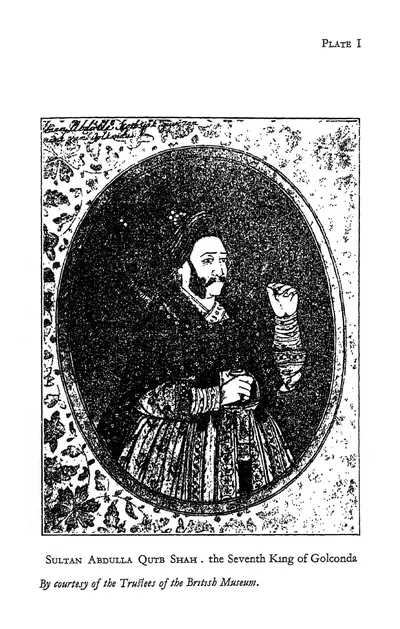 Sultan Abdulla Qutb Shah: the VIIth King of Golconda (Rocco 1929, Pl. I)Drawing · 1929
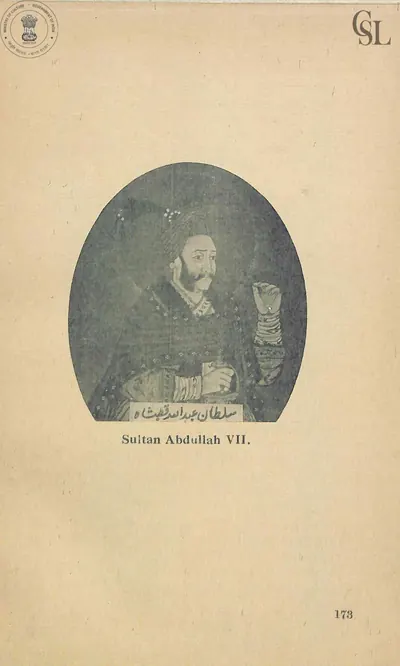 Sultan Abdullah VII (portrait reproduced by Bilgrami) (Bilgrami 1927, p. 173)Drawing · 1927
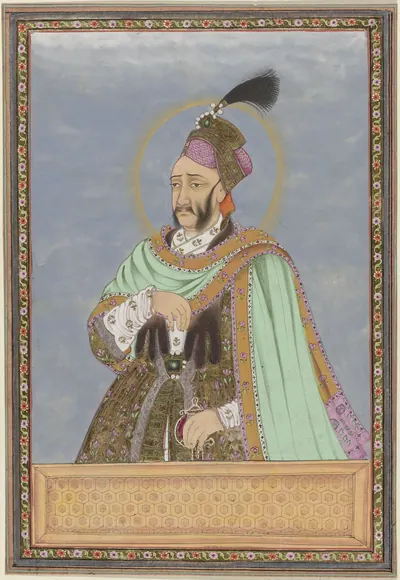 Sultan Abdullah: Deccani portrait, c. 1686, from an album in the Rijksmuseum (RP-T-00-3186-22); Dutch title: "Portrait of Sultan Abdullah, son of Sultan Muhammad Quli; after his father he ruled Golconda"Other · c. 1686
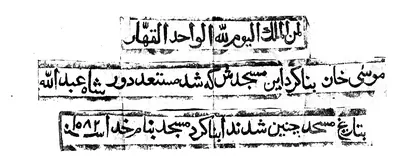 Toli Masjid, Hyderabad: Persian inscription of Musa Khan with the chronogram "Built the mosque in the name of God", 1082 AH (1671) (Epigraphia Indo-Moslemica 1917-18, Pl. XX (a))Inscription rubbing · 1921
Related
Dynasties
References
Notes (0)
Sources (12)
Spotted an error on this page? Tell us
Last updated: