Musa Burj inscription, Golconda fort (1666–67)
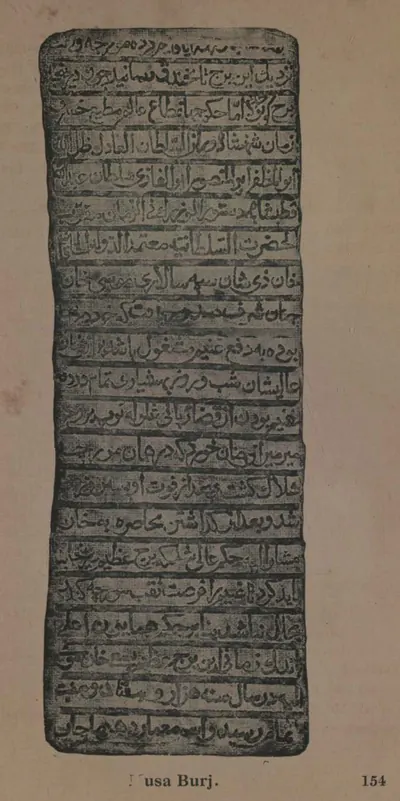
A Persian inscription on the Musa Burj bastion of Golconda fort, with a version in Telugu on another wall. It records the Mughal siege of 1656. Aurangzeb's commander Mir Miran was killed by a gunshot in his trench, and peace followed three days later. Abdullah Qutb Shah's commander Musa Khan then built the great bastion, finished in AH 1077 by the architect Dharmachar. The Telugu text, read by H. Krishna Sastri, dates the siege to Saka 1578 (23 January 1656) and the completion to Saka 1589 (1667).
The Musa Burj is a great half-round bastion of Golconda Fort.12 It is three storeys high, and built of granite blocks “which must weigh over a ton each”.12 Its inscription is one of the few Qutb Shahi records set up in two languages.12 There is a Persian text, and a version of it in Telugu on another wall of the same bastion.12
It tells, from the Golconda side, how the fort held out against the Mughal army in 1656, and how the bastion came to be built.34 For the siege itself see the Qutb Shahi page, Abdullah Qutb Shah and Mir Jumla.
Editions
Syed Ali Asgar Bilgrami found the Persian tablet “fixed on the wall of the first storey west of the flight of stairs”.1 It had apparently been moved there when the steps were repaired.1 Its top is broken, and the first line is lost.1 It measures about 3 ft by 1 ft 4 in.1
G. Yazdani had published the Persian text in Epigraphia Indo-Moslemica for 1913–14 (p. 52), without the first line.15 Bilgrami restored the line from a copy in the manuscript Tawarikh-i Farkhunda.15 He noted that “The Telugu text fully corroborates the name of Mir Miran which has been now deciphered in the first line of the Persian text”.15
The Telugu text was “Deciphered and translated” by Rao Saheb Krishna Sastri of Madras.3 Bilgrami printed his transliteration and translation.3
The Persian text
In Bilgrami’s translation, the Persian record says that the emperor gave an order “to Mir Miran”.3 Mir Miran was to “establish himself and carry the intrenchment and mines to the ditch, as at this place was a small bastion”.3 Abdullah Qutb Shah, “the just Sultan, the shadow of God”, ordered his commander-in-chief Musa Khan to hold the spot.3 Musa Khan was to drive back the enemy day and night.3 The record goes on:3
“In the meantime by the divine decree a gun shot struck the body of Mir Miran in such a manner that he expired in that very intrenchment, and three days after his death peace was concluded. When the siege had been raised the supreme orders were issued to the above named Khan that a large bastion be built at this place, so that the enemy might not get an opportunity to dig intrenchments and mines. In obedience to the auspicious, exalted order, through the efforts of the aforesaid Khan, this large bastion was completed within a short time, in the year one thousand and seventy seven (A.H.) and the architect’s name (is) Dharmachar.”3
The Telugu text
The Telugu version is 41 lines long.4 It opens with the Saka year 1578, the cyclic year Manmatha, the seventh day of the bright half of Magha, a Wednesday.4 Krishna Sastri equated this with 23 January 1656.4 It continues: “His Majesty the King Sultan Aurangzeb having come with stony army was laying siege to the blessed fort of Muhammadnagar.”4 Bilgrami says that Sultan Quli had renamed the fort Muhammadnagar.6
The Telugu agrees with the Persian on the main events.47 It says: “A cannon shot having struck Amiru Miran (he) met his death at that very battery (morcha)”.47 It adds that Musa Khan “got (the bastion) completely made by the bricklayer Dharmacharya within a few days”.47
Dates
The record carries three different dates:
- The siege. The Telugu text gives Saka 1578 (Saka is an Indian way of counting years), Magha sudi 7, which Krishna Sastri converted as 23 January 1656.47 Later it gives the year in which Aurangzeb came, in a form that the translation explains as AH 1057 (AH is the Islamic way of counting years).47 Bilgrami’s account of the campaign, from the Persian chronicles, has Aurangzeb’s son reach Hyderabad in Rabi II AH 1066 (early 1656).89 In one place it dates the siege to 1655.89
- The completion. The Persian gives AH 1077 (1666–67).37 Bilgrami notes that the Tarikh-i Farkhunda gives AH 1080.37 The Telugu gives a year that the translation explains as AH 1078, and Saka 1589, which Krishna Sastri converted as 1667.37
- The two calendars. Bilgrami’s heading for the monument gives AH 1077 and 1666.1
Musa Khan and Mir Miran
Bilgrami identified Mir Miran as Asadullah Khan Bukhari, the Mughal commander and paymaster (bakhshi).2 He noted that Musa Khan, the chamberlain who held the post, also built the Toli Masjid in AH 1082.2 Musa Khan later supported Abul Hasan’s succession.2
Bilgrami gives the cost of the bastion as Rs. 5,94,000, from the manuscript Tuzuk-i Qutbshahi.102 He says that Abdullah ordered it built “by the inclusion of the small hillock in the fortification of the fort”.102 A Mughal gun called Azhdaha Paikar still lies on the bastion; see Golconda Fort.
Footnotes
-
Syed Ali Asgar Bilgrami, Landmarks of the Deccan (1927), p. 153 (archive.org (opens in a new tab)). ↩ ↩2 ↩3 ↩4 ↩5 ↩6 ↩7 ↩8 ↩9 ↩10 ↩11 ↩12
-
Bilgrami, Landmarks of the Deccan (1927), p. 165 (archive.org (opens in a new tab)). ↩ ↩2 ↩3 ↩4 ↩5 ↩6 ↩7 ↩8 ↩9
-
Bilgrami, Landmarks of the Deccan (1927), p. 155 (archive.org (opens in a new tab)). ↩ ↩2 ↩3 ↩4 ↩5 ↩6 ↩7 ↩8 ↩9 ↩10 ↩11 ↩12
-
Bilgrami, Landmarks of the Deccan (1927), p. 157 (archive.org (opens in a new tab)). ↩ ↩2 ↩3 ↩4 ↩5 ↩6 ↩7 ↩8 ↩9 ↩10
-
Bilgrami, Landmarks of the Deccan (1927), p. 154 and plate (archive.org (opens in a new tab)). ↩ ↩2 ↩3
-
Bilgrami, Landmarks of the Deccan (1927), p. 108 (archive.org (opens in a new tab)). ↩
-
Bilgrami, Landmarks of the Deccan (1927), p. 158 (archive.org (opens in a new tab)). ↩ ↩2 ↩3 ↩4 ↩5 ↩6 ↩7 ↩8
-
Bilgrami, Landmarks of the Deccan (1927), p. 159 (archive.org (opens in a new tab)). ↩ ↩2
-
Bilgrami, Landmarks of the Deccan (1927), p. 161 (archive.org (opens in a new tab)). ↩ ↩2
-
Bilgrami, Landmarks of the Deccan (1927), p. 160 (archive.org (opens in a new tab)). ↩ ↩2
Photos
References
Notes (0)
Sources (1)
Spotted an error on this page? Tell us
Last updated: