Toli Masjid
Qutb Shahi mosque on the old road from the Purana Pul to Golconda. Musa Khan, chamberlain and general of Abdullah Qutb Shah, built it. The inscription in its prayer niche gives the chronogram year AH 1082 (1671). G. Yazdani described it in 1918 as typical of the Qutb Shahi style, with Hindu motifs such as pot-shaped bases, elephant-tusk brackets and temple niches. Campbell (1898) dated it to 1604 under Muhammad Quli, but the inscription does not support that date.
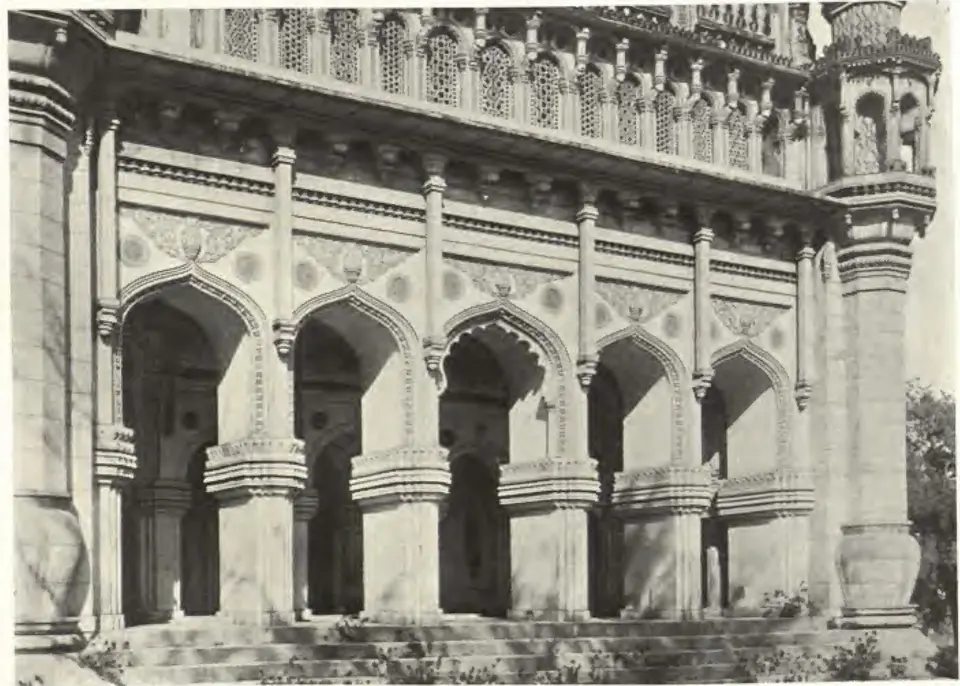
The Toli Masjid is a mosque of the Qutb Shahi period on the old road from the Purana Pul to Golconda. G. Yazdani counted the monuments along this road among “some of the most beautiful monuments of the Qutb Shahi period”.1 Shrines, mosques, baths and houses lined the route from the city to the fort.1 Syed Ali Asgar Bilgrami placed the mosque “on the road leading to the Fort from the Old Bridge”.2
Musa Khan, the chamberlain (mahaldar) of Abdullah Qutb Shah, built it.34 He was the same officer who built the Musa Burj of Golconda fort after the siege of 1656.34 See Hyderabad and the Qutb Shahis.
Date and builder
The inscription in the prayer niche is a Persian verse in Naskh characters.5 In Yazdani’s translation it says that “Musa Khan built this mosque of his, Which was completed in the reign of Shah Abdullah”.5 It ends with the chronogram (a phrase whose letters add up to a year) “Built the mosque in the name of God”.5 This gives AH 1082 (AH is the Islamic way of counting years), that is 1671.5 Bilgrami read the same words and the same year.6 See the Toli Masjid inscription.
A second inscription lies on two loose basalt tablets near a grave in the courtyard.75 It records the building of a mosque in AH 1043 (1633) in Abdullah’s reign “through the efforts of the Shaikh, the leader”.75 The calligrapher Lutfullah al-Husaini of Tabriz signed it.75 Yazdani concluded that it belonged to some other mosque, because the niche inscription gives the Toli Masjid to Musa Khan in 1082.75
Bilgrami identified the Shaikh as Shaikh Muhammad Ibn Khatun, Abdullah’s chief minister (peshwa).26 He too took the slab to relate to another mosque.26
Where the sources disagree
The works disagree on the date. A. Claude Campbell’s Glimpses of the Nizam’s Dominions (1898) says that “The Tola Musjid was built in A.D. 1604 (1013 H.) by order of the king Mahomed Kuli”.8 Campbell cites no inscription. The niche inscription, as both Yazdani and Bilgrami read it, names Musa Khan and Abdullah and gives 1082.56 Sha Rocco (1929) also counts the Toli Masjid among the mosques built in Abdullah’s reign.569
The “Damri Masjid” story
Bilgrami adds a story from the Asaf Jahi history Gulzar-i Asafiya, that the mosque was also called the “Damri Masjid”.3 In this story Musa Khan had charge of building the Mecca Masjid.3 He was allowed one damri (a very small coin) in every rupee spent.3 With that money he built this mosque “at the western side of the Karwan on the road to Muhammadnagar fort”.3 The story is a later tradition, not a record of the time.3
The building
Yazdani described the mosque in the Hyderabad Archaeological Department’s report for 1916–17.1011 It stands in a large enclosure that was once a garden.1011 Flights of steps on the east, north and south lead to a terrace six feet high, which forms the courtyard.1011 The prayer hall rises four feet higher.1011
The hall is double, “the outer apartment having five arched openings and the inner only three”.1011 Two minarets about 60 feet high stand on either side of it.1011 The lower part is of ashlar (dressed stone) masonry.1011 The upper part is of brick and lime, “probably to carry cut-plaster decorations”.1011 Bilgrami gives the same plan and the same height for the minarets.3
Campbell admired “the stucco work on which is very fine”.8 He was told that the mosque at Afzal Ganj had been modelled on it.8
Hindu motifs
For Yazdani the building was “very typical of the general character of the Qutb Shahi” style.11 He saw in it “a strong Hindu influence in motif as well as in sentiment”.11 He gave these examples:11
- the shafts of the minarets “rise from pot-shaped bases”11
- the facade is adorned “with rows of black basalt pots cut in relief”11
- elephant-tusk brackets are used throughout11
- there are niches “in the pillar and lintel style identical in form with niches in temples for the accommodation of images”11
He was less happy about the excess of ornament: “The cut-plaster decorations are always excessive, and the number of small turrets and cupolas is unnecessarily large”.1112 He said that the trellis screen between the minarets “has no architectural purpose there and shows bad taste”.1112 He later reprinted the passage in Epigraphia Indo-Moslemica.7 There he added that the Hindu motifs “have been blended in the general style of the monument with consummate skill”.7
Repairs
In 1916–17 Yazdani proposed these works:12
- a path from the Golconda road12
- repairs to the steps, the courtyard and the curtain wall behind the mosque12
- the removal of plants growing on the building12
The report for 1924–25 records a compound wall built at a cost of Rs. 4,450 to keep out stray animals.13 This brought the total spent on the mosque to Rs. 8,554.13 The report for 1926–27 mentions further special repairs.14
Footnotes
-
G. Yazdani, “Inscriptions of the Qutb Shahi Kings in Hyderabad City and Suburbs”, Epigraphia Indo-Moslemica 1917–18 (1921), p. 48 (archive.org (opens in a new tab)). ↩ ↩2
-
Syed Ali Asgar Bilgrami, Landmarks of the Deccan (1927), p. 65 (archive.org (opens in a new tab)). ↩ ↩2 ↩3
-
Bilgrami, Landmarks of the Deccan (1927), p. 67 (archive.org (opens in a new tab)). ↩ ↩2 ↩3 ↩4 ↩5 ↩6 ↩7 ↩8
-
Bilgrami, Landmarks of the Deccan (1927), p. 165 (archive.org (opens in a new tab)). ↩ ↩2
-
Yazdani, Epigraphia Indo-Moslemica 1917–18 (1921), p. 50 and pls. XIX (a), XX (a) (archive.org (opens in a new tab)). ↩ ↩2 ↩3 ↩4 ↩5 ↩6 ↩7 ↩8 ↩9 ↩10
-
Bilgrami, Landmarks of the Deccan (1927), p. 66 and plates (archive.org (opens in a new tab)). ↩ ↩2 ↩3 ↩4 ↩5
-
Yazdani, Epigraphia Indo-Moslemica 1917–18 (1921), p. 49 (archive.org (opens in a new tab)). ↩ ↩2 ↩3 ↩4 ↩5 ↩6
-
A. Claude Campbell, Glimpses of the Nizam’s Dominions (1898), p. 211 (archive.org (opens in a new tab)). ↩ ↩2 ↩3
-
Sha Rocco, Golconda and the Qutb Shahs (1929), p. 28 (archive.org (opens in a new tab)). ↩
-
Annual Report of the Archaeological Department of H.E.H. the Nizam’s Dominions, 1326 F. (1916–17) (1917), p. 3 (archive.org (opens in a new tab)). ↩ ↩2 ↩3 ↩4 ↩5 ↩6 ↩7 ↩8
-
Annual Report of the Archaeological Department, 1916–17 (1917), p. 4 and pls. II–III (archive.org (opens in a new tab)). ↩ ↩2 ↩3 ↩4 ↩5 ↩6 ↩7 ↩8 ↩9 ↩10 ↩11 ↩12 ↩13 ↩14 ↩15 ↩16 ↩17
-
Annual Report of the Archaeological Department, 1916–17 (1917), p. 5 (archive.org (opens in a new tab)). ↩ ↩2 ↩3 ↩4 ↩5 ↩6
-
Report of the Archaeological Department of H.E.H. the Nizam’s Dominions, 1334 F. (1924–25) (1926), p. 7 (archive.org (opens in a new tab)). ↩ ↩2
-
Annual Report of the Archaeological Department of H.E.H. the Nizam’s Dominions, 1336 F. (1926–27) (1929), p. 13 (archive.org (opens in a new tab)). ↩
Photos
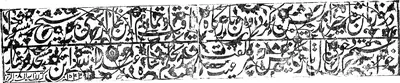 "Inscription on two loose slabs lying in the Toli Masjid, Hyderabad" (Epigraphia Indo-Moslemica 1917-18, Pl. XIX (a) (PDF p. 81))Inscription rubbing · 1921
 "Inscription slab in the court-yard of Toli Masjid" (Bilgrami 1927, p. 66)Inscription rubbing · 1927
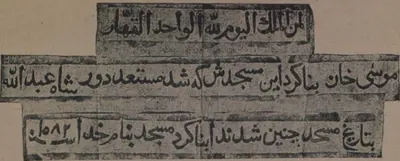 "Inscriptions of Toli Masjid (Prayer-Niche)" (Bilgrami 1927, p. 66)Inscription rubbing · 1927
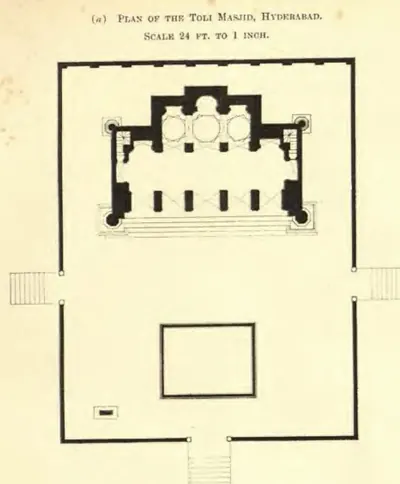 "Plan of the Toli Masjid, Hyderabad. Scale 24 ft. to 1 inch" (Annual Report of the Archaeological Department, Hyderabad, 1916-17, Pl. III (a) (PDF p. 75))Plan · 1917
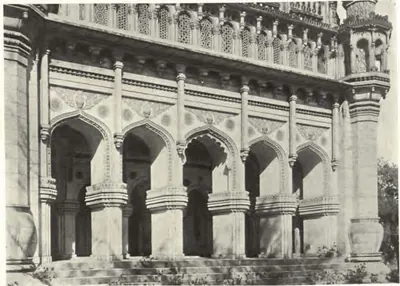 "The same [Toli Masjid], colonnade, front view" (Annual Report of the Archaeological Department, Hyderabad, 1916-17, Pl. II (c) (PDF p. 71))Historic photograph · 1917
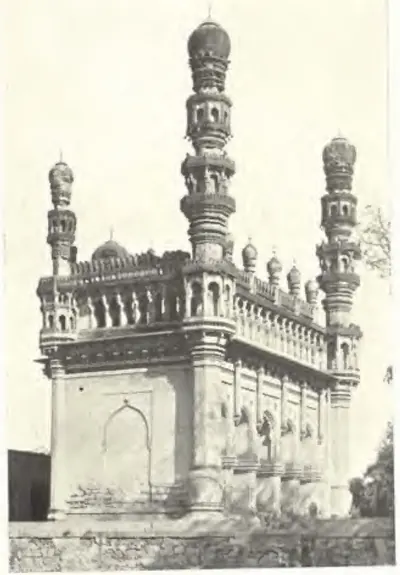 "Toli Masjid, Hydrabad, view from S. E." (Annual Report of the Archaeological Department, Hyderabad, 1916-17, Pl. II (b) (PDF p. 71 of the IGNCA scan))Historic photograph · 1917
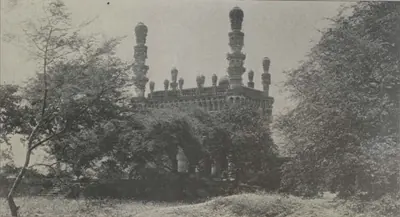 Hyderabad: "Tola Musjid, Karwan" (Campbell 1898, p. 211)Historic photograph · 1898
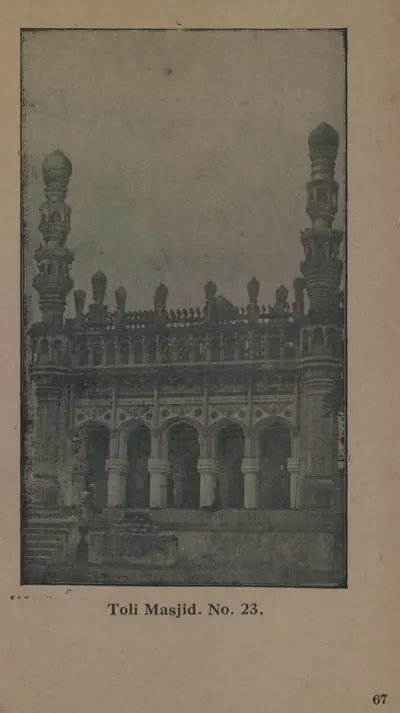 Toli Masjid, Hyderabad (No. 23) (Bilgrami 1927, p. 67)Book plate · 1927
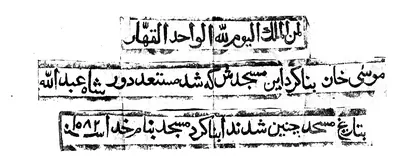 Toli Masjid, Hyderabad: Persian inscription of Musa Khan with the chronogram "Built the mosque in the name of God", 1082 AH (1671) (Epigraphia Indo-Moslemica 1917-18, Pl. XX (a))Inscription rubbing · 1921
Related
Inscriptions
References
Notes (0)
Sources (7)
Spotted an error on this page? Tell us
Last updated: