Velpuru pillar inscription of Madhavavarman
A Sanskrit inscription on a white marble pillar in the Ramalingasvamin temple at Velpuru, in the former Sattenapalle taluk of Guntur district. It names a Vishnukundin king Madhavavarman. Noticed in 1925, it is the only known stone inscription of the dynasty. Only the exposed part has been copied, because the pillar could not be removed from the temple.
The Velpuru pillar carries the only stone inscription of the Vishnukundin family so far reported. All their other records are copper plates.12 It names a king Madhavavarman.13 But no source in the library says which of the Vishnukundin Madhavavarmans he was.13
Discovery
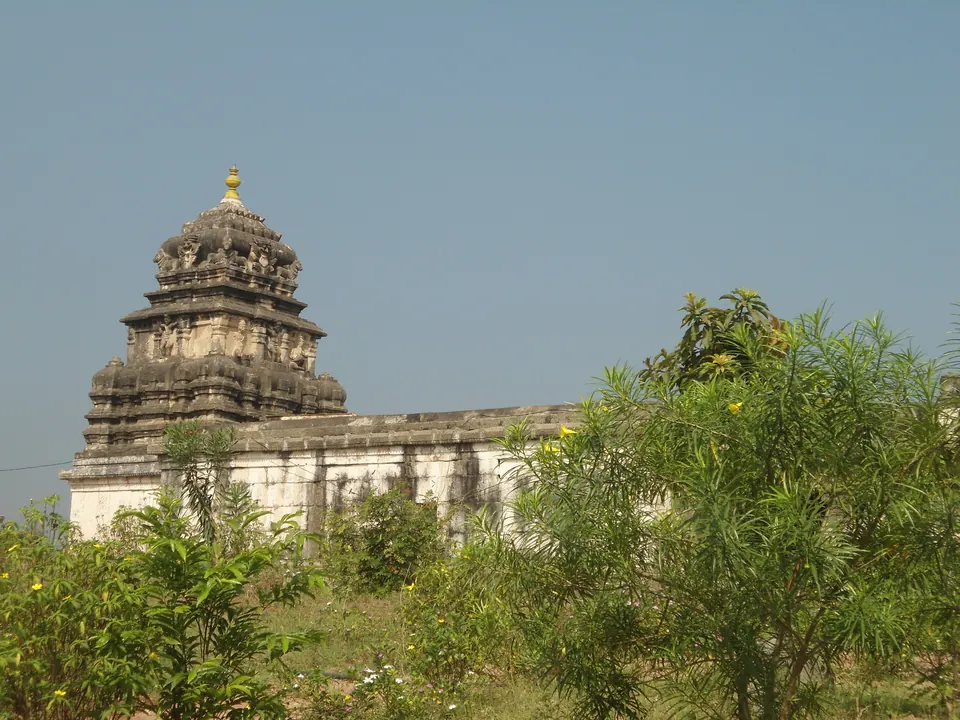
C. R. Krishnamacharlu, Senior Assistant in the epigraphy office, found the inscription. He was on a tour of the Krishna (then Kistna), Visakhapatnam (then Vizagapatam) and Guntur districts between 12 August and 2 September 1925.1 The report for 1925–26 describes the place.1 A very old temple of Ramalingasvamin stands on a small hillock north-east of Velpuru, in the Sattenapalle taluk of Guntur district.1 It “contains a number of inscriptions engraved on white marble stones of the type used in the Amaravati stūpa”.1
Behind the two door jambs of the main entrance are two white marble pillars, put up as props for the roof beams.1 “The inscription on one side of this pillar mentions King Madhavavarman of the Vishnukundin dynasty, and is the only stone record of this ancient family of kings hitherto discovered.”1 It was registered as No. 581 of 1925.3
A pillar that could not be moved
Only the part of the inscription that could be reached was copied in 1925.1 The report proposed to remove the pillar in the next field season so that the whole text could be exposed.1 That never happened. In 1936–37 the Superintendent for Epigraphy went twice to Velpuru to take out the pillar. The temple trustees and villagers objected on religious grounds, despite the help of the Revenue Department, and the work was postponed.4
The report for 1936–37 described the record as a Vishnukundin inscription of the 5th century.4 D. C. Sircar, citing the report for 1925–26, called it a Sanskrit inscription in archaic (very old) characters.3
The site
The 1925–26 report noted that the hillock was full of the large old bricks usually found on stupa mounds (the remains of Buddhist relic mounds).1 It also noted the apsidal (rounded-end) basements of one or two demolished buildings, which suggested Buddhist or post-Buddhist ruins.1 On the hill stands a slab about six feet high, called the Kotinaga stone.1 It is carved on both faces with rows of serpents (nagas).1
In 1940–41 a second Brahmi inscription was found at Velpuru, on a pillar now built into a roadside shrine of the village goddess.2 It names a king of the Aira clan who was a Haritiputra.2 The report for 1939–43 thought that pillar might have come from a stupa on the same low mound.2 On that mound stands the Ramalingeshvara temple, with the Vishnukundin inscription.2
Use by historians
K. R. Subramanian took the inscription as evidence of Vishnukundin rule round Dhanyakataka (Amaravati), south of the Krishna.56 R. S. Panchamukhi used it to carry the Vishnukundin lands as far south as Guntur district.7
Footnotes
-
Annual Report on South-Indian Epigraphy for 1925–26 (1927), Part I, paras. 7–8, p. 8 (archive.org (opens in a new tab)). ↩ ↩2 ↩3 ↩4 ↩5 ↩6 ↩7 ↩8 ↩9 ↩10 ↩11 ↩12 ↩13 ↩14 ↩15
-
Annual Reports on South Indian Epigraphy for 1939–40 to 1942–43 (1952), Part II, para. 4, p. 229 (archive.org (opens in a new tab)). ↩ ↩2 ↩3 ↩4 ↩5
-
D. C. Sircar, The Successors of the Satavahanas in Lower Deccan (1939), p. 101, note 1 (archive.org (opens in a new tab)). ↩ ↩2 ↩3 ↩4
-
Annual Report on South Indian Epigraphy for 1936–37 (1940), Part I, p. 1 (archive.org (opens in a new tab)). ↩ ↩2
-
K. R. Subramanian, Buddhist Remains in Andhra and the History of Andhra between 225 and 610 A.D. (1932), p. 109, notes (archive.org (opens in a new tab)). ↩
-
Subramanian, Buddhist Remains in Andhra (1932), p. 113, note (f) (archive.org (opens in a new tab)). ↩
-
R. S. Panchamukhi, “Tandivada Grant of Prithivi-Maharaja: 46th Year”, Epigraphia Indica XXIII (1936), p. 96 (archive.org (opens in a new tab)). ↩
Photos
References
Notes (0)
Sources (6)
Spotted an error on this page? Tell us
Last updated: