Velpuru
Village in the former Sattenapalle taluk of Guntur district. Its hilltop Ramalingasvamin temple holds a marble pillar with the only known stone inscription of the Vishnukundin dynasty. The hill is covered with old bricks of the kind found on Buddhist stupa mounds, and a second early Brahmi inscription has been found in the village.
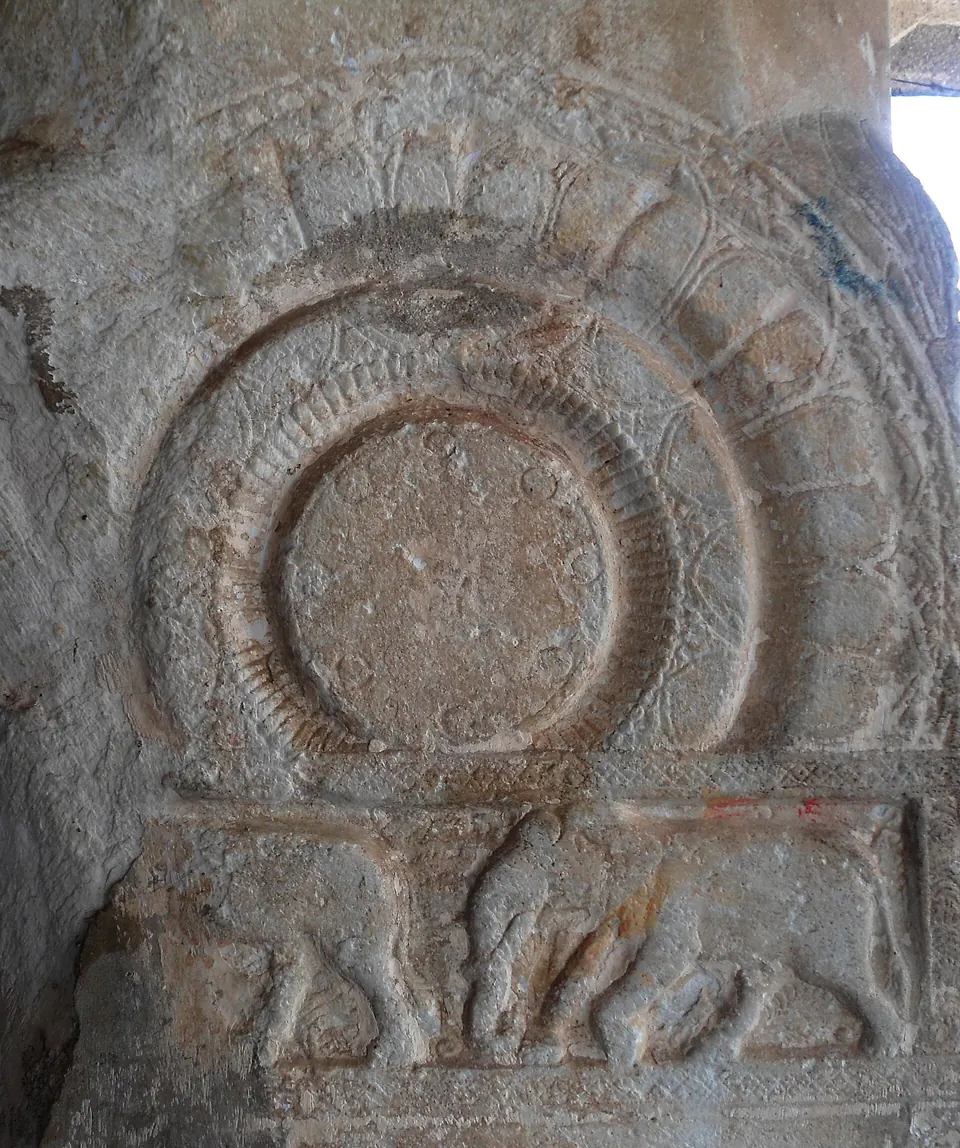
Velpuru lies in what was the Sattenapalle taluk of Guntur district. It is known for the Velpuru pillar inscription, which names the Vishnukundin king Madhavavarman.1 K. R. Subramanian placed the village about twelve miles west of Amaravati.2
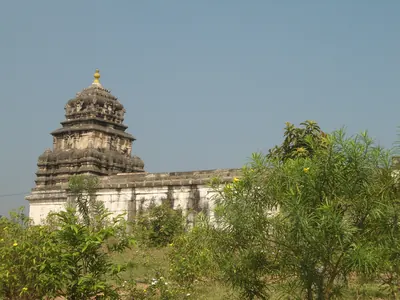
The temple hill
The epigraphy report for 1925–26 describes “a very old temple” of Ramalingasvamin on a small hillock north-east of the village.1 The temple contains several inscriptions on white marble stones of the kind used in the Amaravati stupa (relic mound).1 Two white marble pillars hold up the roof behind the main entrance, and one of them carries the Vishnukundin inscription.1
The report adds that the hillock is “full of ruins of old and broad bricks which are always found on stūpa mounds”.1 One or two demolished buildings had apsidal (rounded-end) foundations, which suggested Buddhist or post-Buddhist ruins.1 A slab about six feet high, called the Kotinaga stone, is carved on both faces with rows of serpents.1
Later finds
In 1936–37 there was an attempt to take the inscribed pillar out of the temple, so that the whole text could be read.3 It was given up because the trustees and villagers opposed it.3
P. Seshadri Sastri of Guntur reported another Brahmi inscription from Velpuru in 1940–41.4 It was on a pillar then serving in a roadside shrine of the village goddess.4 It names a Haritiputra king of the Aira clan.4 The report for 1939–43 thought this pillar might have come from a stupa on the mound beneath the Ramalingeshvara temple.4
Footnotes
-
Annual Report on South-Indian Epigraphy for 1925–26 (1927), Part I, para. 7, p. 8 (archive.org (opens in a new tab)). ↩ ↩2 ↩3 ↩4 ↩5 ↩6 ↩7
-
K. R. Subramanian, Buddhist Remains in Andhra and the History of Andhra between 225 and 610 A.D. (1932), p. 113, note (f) (archive.org (opens in a new tab)). ↩
-
Annual Report on South Indian Epigraphy for 1936–37 (1940), Part I, p. 1 (archive.org (opens in a new tab)). ↩ ↩2
-
Annual Reports on South Indian Epigraphy for 1939–40 to 1942–43 (1952), Part II, para. 4, p. 229 (archive.org (opens in a new tab)). ↩ ↩2 ↩3 ↩4
Photos
Related
Inscriptions
References
Notes (0)
Sources (4)
Spotted an error on this page? Tell us
Last updated: