Uruvupalli grant of Vishnugopavarman
A Sanskrit copper-plate grant of the Pallava crown prince Vishnugopavarman, issued from Palakkada in the 11th year of a king Simhavarman. It gives two hundred nivartanas of land in the village of Uruvupalli, in the country of Munda, to a temple at Kandukura. J. F. Fleet published it in 1876 from Sir Walter Elliot's facsimiles. Its findspot is unknown.
J. F. Fleet edited the Uruvupalli grant in 1876 from a facsimile (exact copy) in Sir Walter Elliot’s collection.1 He had “no information as yet as to where the original was found or in whose possession it is”.1 It is the only grant of the crown prince Vishnugopa.1
Description
There are four plates, numbered with numerals.1 The writing begins on the outside of the first plate and covers the outside of the fourth as well, against the usual custom.1 The seal shows what seemed to Fleet “to be a dog, but is, in native opinion, a lion”.1
C. R. Krishnamacharlu looked at Fleet’s facsimile and thought the animal more like a dog or a wolf about to pounce.2 To him its short tail ruled out a lion.2
Fleet called the letters “the Cave-alphabet”.1 Judging from their forms, he would “allot the inscription to the fifth century A.D.”1 E. Hultzsch later found its alphabet very close to that of the Pikira and Mangalur grants.3
Content
The grant opens “Victory has been achieved by the holy one!” and was issued “from the glorious and victorious locality of Palakkada”.4 The donor is the yuvamaharaja (crown prince) Vishnugopavarman.4 He names his father Skandavarman, his grandfather Viravarman and his great-grandfather Skandavarman.4 He calls himself the disciple of the feet of the venerable great king Bappa.4
He told the villagers of Uruvupalli, in the country of Munda, about a gift of land in their village.45 Two hundred nivartanas (a land measure) there had been made a possession of the gods at Kandukura.45 The land was for the temple of Vishnuhara, founded by a general.45
The boundaries named include:4
- the village of Kendukura on the west4
- the river Suprayoga on the south and east4
- the road to Kurupura and Kandukura4
- the village of Kandamuruvudu4
The grant was given “in the eleventh of the victorious years of the Great King Simhavarma”.4 It was given “in the month Paushya, in the dark fortnight, and on the tenth lunar day”.4
The places
Fleet thought that Palakkada had been the Pallava capital at the time.1 In a later article he wondered whether it might be Palghat.6 Hultzsch and V. Venkayya looked for it in the Nellore district.7
Krishnamacharlu identified Mundarashtra with the later Munda-nadu of the Nellore inscriptions, round the Kovur taluk.85 He took the temple of Vishnuhara to be one of the early temples of Kandukur.85 Sircar thought that Uruvupalli itself had not been satisfactorily identified.9
Whose eleventh year?
The grant is dated in the reign of a Simhavarman, but it does not state how he was related to the donor.4 Three scholars answered this in different ways:13710
- Fleet supposed him to be Vishnugopa’s elder brother.1
- Hultzsch took him to be Vishnugopa’s own son, the Simhavarman of the Pikira and Mangalur grants.37
- Krishnamacharlu concluded that the son formally issued a grant that his father had made.10
Sewell’s chronology took Simhavarman’s reign to begin in 436.11 It dated the grant to 446.11 Hultzsch noted that the wording of the Chendalur plates of Kumaravishnu II is almost identical with that of this grant.12
Footnotes
-
J. F. Fleet, “Sanskrit and Old-Canarese Inscriptions, No. XII”, Indian Antiquary V (1876), p. 50 (archive.org (opens in a new tab)). ↩ ↩2 ↩3 ↩4 ↩5 ↩6 ↩7 ↩8 ↩9 ↩10 ↩11
-
C. R. Krishnamacharlu, “Vilavatti Grant of Pallava Simhavarman”, Epigraphia Indica XXIV (1937–38), p. 297 (archive.org (opens in a new tab)). ↩ ↩2
-
E. Hultzsch, “Pikira Grant of Simhavarman”, Epigraphia Indica VIII (1905–06), p. 160 (archive.org (opens in a new tab)). ↩ ↩2 ↩3
-
Fleet, “Sanskrit and Old-Canarese Inscriptions, No. XII” (1876), pp. 52–53, translation (archive.org (opens in a new tab)). ↩ ↩2 ↩3 ↩4 ↩5 ↩6 ↩7 ↩8 ↩9 ↩10 ↩11 ↩12 ↩13 ↩14 ↩15
-
Krishnamacharlu, “Vilavatti Grant” (1938), p. 302, notes (archive.org (opens in a new tab)). ↩ ↩2 ↩3 ↩4 ↩5
-
Fleet, “Sanskrit and Old-Canarese Inscriptions, No. XV”, Indian Antiquary V (1876), p. 154 (archive.org (opens in a new tab)). ↩
-
Hultzsch, “Pikira Grant of Simhavarman” (1906), p. 161 (archive.org (opens in a new tab)). ↩ ↩2 ↩3
-
Krishnamacharlu, “Vilavatti Grant” (1938), p. 301 (archive.org (opens in a new tab)). ↩ ↩2
-
D. C. Sircar, The Successors of the Satavahanas in Lower Deccan (1939), p. 208 (archive.org (opens in a new tab)). ↩
-
Krishnamacharlu, “Vilavatti Grant” (1938), pp. 299–300 (archive.org (opens in a new tab)). ↩ ↩2
-
Robert Sewell and S. Krishnaswami Aiyangar, The Historical Inscriptions of Southern India (1932), p. 18 (archive.org (opens in a new tab)). ↩ ↩2
-
E. Hultzsch, “Chendalur Plates of Kumaravishnu II”, Epigraphia Indica VIII (1905–06), p. 234 (archive.org (opens in a new tab)). ↩
Photos
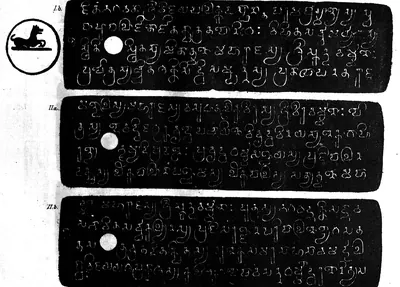 "Uruvupalli Copper-plate Grant of the Pallava Dynasty", plates I b, II a and II b, with the seal (Indian Antiquary V, 1876, plate at p. 50, printed sideways (PDF p. 66))Inscription rubbing · 1876
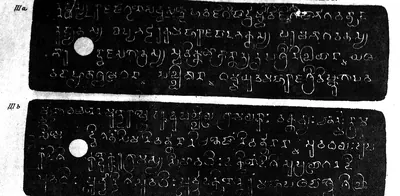 "Uruvupalli Copper-plate Grant of the Pallava Dynasty", plates III a and III b (Indian Antiquary V, 1876, plate at p. 51, printed sideways (PDF p. 67))Inscription rubbing · 1876
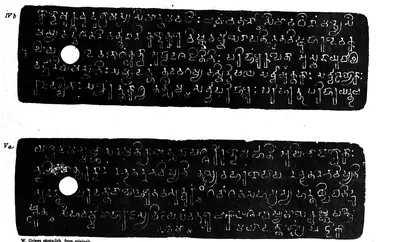 "Uruvupalli Copper-plate Grant of the Pallava Dynasty", plates IV b and V a (Indian Antiquary V, 1876, plate at p. 52, printed sideways (PDF p. 70))Inscription rubbing · 1876
References
Notes (0)
Sources (7)
Spotted an error on this page? Tell us
Last updated: