Vunna Guravayapalem plates of Paramesvaravarman I
A Sanskrit copper-plate grant of the Pallava king Paramesvaravarman I, issued from Kanchipura in his 19th year. It gives the village of Kubunuru, on the southern bank of the river Musuna in Pumi-rashtra, to the Brahman Devasarman. The plates were shown to P. Seshadri Sastri at Vunna Guravayapalem in the Podili taluk of Nellore. D. C. Sircar and Seshadri Sastri edited them from photographs. The grant is dated to 22 December 687 and gave the first date for this king that can be checked.
D. C. Sircar counted these plates among only three copper-plate grants of the Pallava kings of the Simhavishnu line before Nandivarman II.1 The other two are the Kuram plates of the same king, Paramesvaravarman I, and the Reyuru grant of his son.1 They show a king of Kanchi giving a village in the Nellore country late in the 7th century, after the Chalukyas had taken the Guntur country.2
Discovery and description
The son of the village munsiff (headman) of Vunna Guravayapalem showed the plates to P. Seshadri Sastri.3 The village is in the Podili taluk of the Nellore district.3 Sastri copied the inscription and had the seal and the plates photographed before they were returned.3
D. C. Sircar tried to obtain the originals through the state government but failed.3 So the plates were edited from photographs, taken without cutting the ring.3
There are three plates on a copper ring with a bronze seal.3 The seal shows a recumbent (lying) bull, with what seem to be a crescent and a linga (emblem of Siva) above it.3 It also shows a seated deity and a short legend that Sircar read as Sri-Nandi.3
Script and language
The letters are Telugu-Kannada of the 7th century.4 They are close to those of the Reyuru grant of Paramesvaravarman’s son, but older-looking.4 The language is Sanskrit, mostly prose, with three verses.4
Sircar noted that its simple style is like that of the early Pallava Sanskrit charters, such as the Uruvupalli, Pikira and Vilavatti grants.41 It is unlike the elaborate Kuram plates of the same king.41
Content
The grant opens with svasti and jitam bhagavata and was issued from Kanchipura. It names the king’s great-grandfather Mahendravarman I, grandfather Narasimhavarman I and father Mahendravikramavarman (Mahendravarman II).1
Paramesvaravarman was a devotee of Siva and of the Brahmans.5 He gave the village of Kubunuru, on the southern bank of the river Musuna in Pumi-rashtra, to the Brahman Devasarman.5 Devasarman was the son of Donasarman and grandson of Svamisarman, of the Maudgalya gotra (clan), and his family came from Urputuru.5 The gift was made on the winter solstice, for the increase of the king’s life and health.5
The executor was Kulavarman, son of Nagi- or Tagi-pallava and ruler of Nandakurra.56 The grant was written by Viseshavidita of the Ghanaskandha family.56
The places
Sircar took the Musuna to be the Musi, which runs between the Kandukur and Ongole taluks. He placed Kubunuru in the Podili–Kandukur region and thought Pumi-rashtra lay south of the old Mundarashtra. He identified Urputuru with Upputuru in the Bapatla taluk, and Nandakurra, tentatively, with Nandavaram in the Udayagiri taluk.2
Date
The grant was written on Sunday, the 13th day of the bright fortnight of Pausha, in the 19th year of the reign. Sircar showed that in the possible years this day fell on a Sunday only in 687, on 22 December.62 That was the day after the winter solstice.62 He concluded that Paramesvaravarman came to the throne between December 668 and December 669.62
Sircar also used the grant to narrow the dates of the king’s son Narasimhavarman II.627 He corrected P. B. Desai’s reading of the verse naming the executor of the Reyuru grant.627
Footnotes
-
Sircar and Seshadri Sastri, “Vunna Guravayapalem Plates” (EI XXXII), p. 93 (archive.org (opens in a new tab)). ↩ ↩2 ↩3 ↩4 ↩5
-
Sircar and Seshadri Sastri, “Vunna Guravayapalem Plates” (EI XXXII), p. 96 (archive.org (opens in a new tab)). ↩ ↩2 ↩3 ↩4 ↩5 ↩6 ↩7
-
D. C. Sircar and P. Seshadri Sastri, “Vunna Guravayapalem Plates of Paramesvaravarman I, Year 19”, Epigraphia Indica XXXII (1957–58), p. 91 (archive.org (opens in a new tab)). ↩ ↩2 ↩3 ↩4 ↩5 ↩6 ↩7 ↩8
-
Sircar and Seshadri Sastri, “Vunna Guravayapalem Plates” (EI XXXII), p. 92 (archive.org (opens in a new tab)). ↩ ↩2 ↩3 ↩4 ↩5
-
Sircar and Seshadri Sastri, “Vunna Guravayapalem Plates” (EI XXXII), p. 94 (archive.org (opens in a new tab)). ↩ ↩2 ↩3 ↩4 ↩5 ↩6
-
Sircar and Seshadri Sastri, “Vunna Guravayapalem Plates” (EI XXXII), p. 95 (archive.org (opens in a new tab)). ↩ ↩2 ↩3 ↩4 ↩5 ↩6 ↩7
-
P. B. Desai, “Reyuru Grant of Pallava Narasimhavarman; Year 12”, Epigraphia Indica XXIX (1951–52), p. 93 (archive.org (opens in a new tab)). ↩ ↩2
Photos
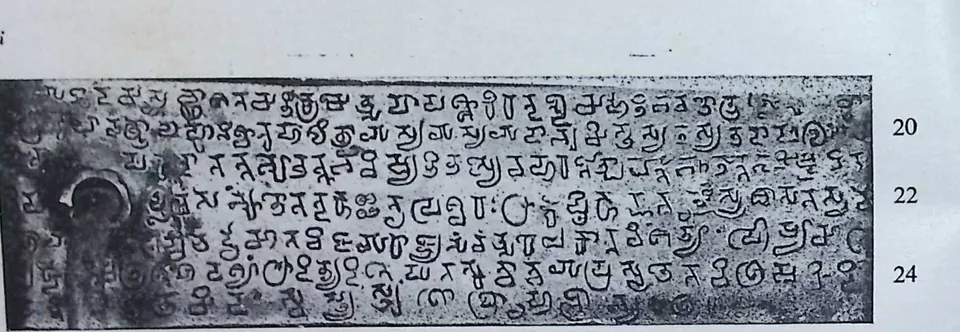
 "Vunna Guravayapalem Plates of Paramesvaravarman I, Year 19", plate iii, lines 19-24 (Epigraphia Indica XXXII, plate with No. 9 (PDF p. 149))Historic photograph · 1959
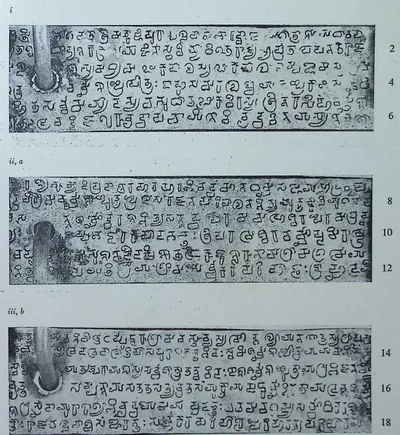 "Vunna Guravayapalem Plates of Paramesvaravarman I, Year 19", the first three inscribed plate sides, lines 1-18 (Epigraphia Indica XXXII, plate with No. 9 (PDF p. 148))Historic photograph · 1959
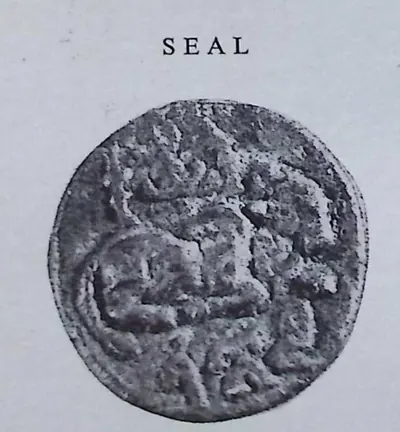 Seal of the "Vunna Guravayapalem Plates of Paramesvaravarman I, Year 19" (Epigraphia Indica XXXII, plate with No. 9 (PDF p. 149))Historic photograph · 1959
References
Notes (0)
Sources (2)
Spotted an error on this page? Tell us
Last updated: