Chicacole plates of Devendravarman, son of Gunarnava
A copper-plate grant of the Ganga king Devendravarman, son of Gunarnava, issued from Kalinganagara and dated in the 183rd year of the Ganga reckoning. It is one of six sets of plates dug up together at Srikakulam (then Chicacole). It gives the village of Poppangika as an agrahara (Brahmin village) to six Brahmin brothers living at Kalinganagara. It shows an early use of a decimal zero beside the old number symbols.
By this copper-plate grant, the Ganga king Devendravarman, son of Gunarnava, gave a village to six Brahmin brothers.12 It is dated in “the one-hundred-and-eighty-third year” of the reign.1 Its number symbols include an early decimal figure for 0.3
Discovery
E. Hultzsch edited these plates in 1895, from the originals.3 They had been found in the record room of the Principal Assistant Collector of Ganjam at Srikakulam, the modern Srikakulam.3 G. V. Ramamurti of Parlakimedi told him about the plates.3 He had “no doubt that this set of plates is the missing one of the six sets which were dug up at Chicacole some years ago and purchased by Mr. Grahame”.3
Robert Sewell’s Lists of Antiquities (1882) describes that find.4 A householder digging foundations came on a large pot.4 In it, six copper-plate grants hung by their rings from an iron bar.4 W. F. Grahame rescued them and gave them to the Madras Museum, where one set was lost or mislaid.4
J. F. Fleet edited several of the others in the Indian Antiquary.56 Among them were grants of the Ganga kings Indravarman, of the years 128 and 146, and of Devendravarman son of Anantavarman.56 V. Rangacharya noted that Srikakulam was “epigraphically … famous as the site of the six Ganga plates of Grahame”.7
The plates and the seal
There are three plates.3 Their ring had not been cut, and its ends were fixed in a small oval seal.3 The seal bears, in relief, “a recumbent bull, which faces the proper right and is surmounted by a crescent”.3 The writing was “in a state of very good preservation”.3
The language is “not very correct Sanskrit”.3 It is in prose, apart from three verses that curse anyone who breaks the grant and a verse naming the writer.3 Hultzsch found that the alphabet was like that of the Achyutapuram plates.3 It shared with them Nagari forms of two letters.3
The grant
The edict is issued “from the victorious (city of) Kalinganagara, which is the ornament of the whole earth”.2 It is issued by “the son of the glorious Gunarnava, the glorious Maharaja Devendravarman”.2 He was a worshipper of Mahesvara, and of the god Gokarnasvamin “established on the sinless peak of the Mahendra mountain”.2
The edict gives the village of Poppangika, in the Saraumatamba subdivision of the Kroshtukavartani district.12 It gives it as an agrahara (Brahmin village) to six Brahmin brothers of the Chhandoga school, who lived at Kalinganagara.12
The gift was made in the month of Magha, while the sun was moving north.1 The edict itself was written out in “the one-hundred-and-eighty-third year (in words and numerical symbols) of the reign”.1 The day was “the twentieth (solar) day … of the month of Sravana”.1
Numerals
Hultzsch pointed out that line 26 of the plates gives the number symbols for 100, 80, 3 and 20, “and, combined with the last, of the decimal figure for 0”.3
Date and identity
Neither date contains details that can be checked by calculation.1 Hultzsch wrote that “nothing can at present be said about Devendravarman, the son of Gunarnava”.1 He could say only that this king must be different from Devendravarman son of Anantavarman.1 He also noted that the name Gunarnava occurs twice among the ancestors of Chodaganga.1
Sewell counted the Ganga era from 877–78.8 He placed the grant in 1061, and identified its donor with the Ganga king Rajaraja I, son of Vajrahasta.8 On V. V. Mirashi’s starting year of 498, the year 183 falls in about 681.9
There is a second grant of Devendravarman son of Gunarnava, found in the Visakhapatnam (then Vizagapatam) taluk.1011 It is dated in the year 195 of the “Kalinganka” era.1011 According to Rangacharya’s summary, it gave land in the same village of Siddharthaka as the Achyutapuram plates.1011 The date on this page follows Mirashi’s starting year; see the Eastern Gangas and Rajaraja I.
Footnotes
-
Hultzsch, “Chicacole Plates of Devendravarman” (1895), p. 131 (archive.org (opens in a new tab)). ↩ ↩2 ↩3 ↩4 ↩5 ↩6 ↩7 ↩8 ↩9 ↩10 ↩11
-
Hultzsch, “Chicacole Plates of Devendravarman” (1895), p. 133, translation (archive.org (opens in a new tab)). ↩ ↩2 ↩3 ↩4 ↩5 ↩6
-
E. Hultzsch, “Chicacole Plates of Gunarnava’s Son Devendravarman; the Year 183”, Epigraphia Indica III (1894–95), p. 130 (archive.org (opens in a new tab)). ↩ ↩2 ↩3 ↩4 ↩5 ↩6 ↩7 ↩8 ↩9 ↩10 ↩11 ↩12 ↩13 ↩14
-
Robert Sewell, Lists of the Antiquarian Remains in the Presidency of Madras, Vol. I (1882), p. 7, Chicacole (archive.org (opens in a new tab)). ↩ ↩2 ↩3 ↩4
-
J. F. Fleet, “Sanskrit and Old-Canarese Inscriptions” (Chicacole grant of Indravarman, the year 128), Indian Antiquary XIII (1884), pp. 119–120 (archive.org (opens in a new tab)). ↩ ↩2
-
Fleet, “Sanskrit and Old-Canarese Inscriptions” (Chicacole plates of Devendravarman son of Anantavarman), Indian Antiquary XIII (1884), pp. 273–274 (archive.org (opens in a new tab)). ↩ ↩2
-
V. Rangacharya, A Topographical List of the Inscriptions of the Madras Presidency, Vol. I (1919), p. 683, Chicacole (archive.org (opens in a new tab)). ↩
-
Robert Sewell, The Historical Inscriptions of Southern India (1932), p. 76 (archive.org (opens in a new tab)). Paraphrased. ↩ ↩2
-
V. V. Mirashi, “Epoch of the Ganga Era”, Epigraphia Indica XXVI (1941–42), p. 333 (archive.org (opens in a new tab)). Paraphrased. ↩
-
Rangacharya, Topographical List, Vol. III (1919), p. 1674, Vizagapatam No. 68-A (archive.org (opens in a new tab)). ↩ ↩2 ↩3
-
Rangacharya, Topographical List, Vol. III (1919), p. 1675, continuation of No. 68-A (archive.org (opens in a new tab)). ↩ ↩2 ↩3
Photos
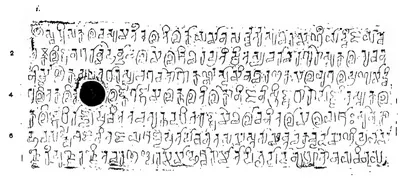 "Chicacole Plates of Devendravarman.—The Year 183", first plate (lines 1-7) (Epigraphia Indica III, plates between pp. 132 and 133, PDF p. 184)Inscription rubbing · 1895
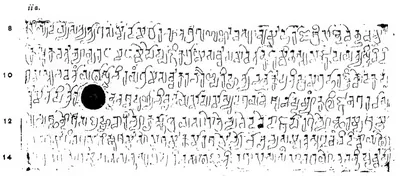 "Chicacole Plates of Devendravarman.—The Year 183", first side of the second plate (lines 8-14) (Epigraphia Indica III, plates between pp. 132 and 133, PDF p. 184)Inscription rubbing · 1895
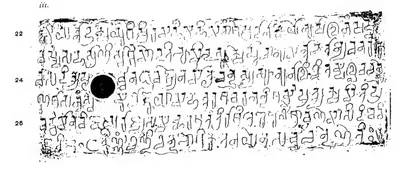 "Chicacole Plates of Devendravarman.—The Year 183", third plate (lines 22-27) (Epigraphia Indica III, plates between pp. 132 and 133, PDF p. 185)Inscription rubbing · 1895
References
Notes (0)
Sources (7)
Spotted an error on this page? Tell us
Last updated: