Penukaparu grant of Jayasimha II
A Sanskrit copper-plate grant of the Eastern Chalukya king Jayasimha II (reigned about 696–709), who calls himself Sakalalokasraya Jayasimha-Vallabha. It gives a field at the village of Penukaparu in the Karma-rashtra district to a Brahmin of Vangiparu. It is the only known grant of this king. It was examined in 1923–24, bought by the Madras Museum and edited by E. Hultzsch in 1926. Its seal shows that he, like Jayasimha I, bore the surname Sarvasiddhi.
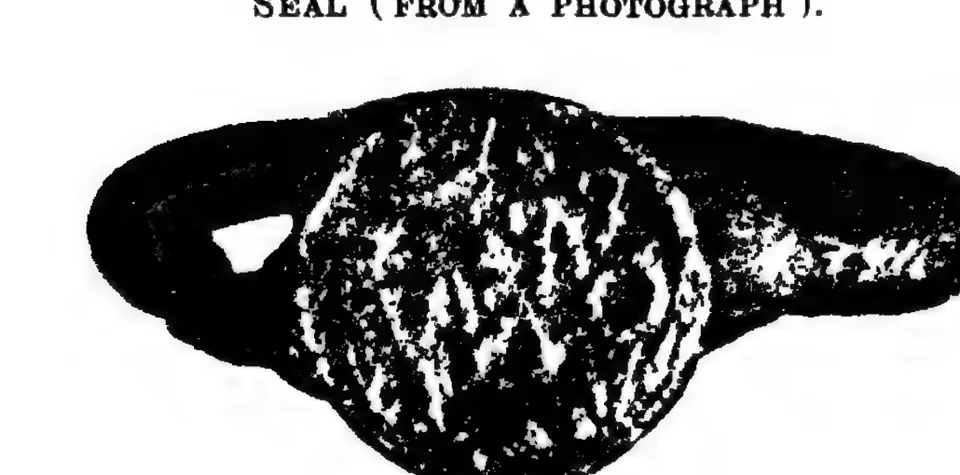
This is the only grant known of Jayasimha II, the sixth king of the Eastern Chalukyas, whom J. F. Fleet dated 696–709. The Madras epigraphical department examined it in 1923–24.12 It reported: “This is the first record of the king hitherto known to epigraphy”.12 E. Hultzsch, who edited it in 1926, also called it “the first of Jayasimha II which has hitherto come to light”.3 It carries no date except the day of the gift.3
Discovery and description
The plates belonged to K. Nagesvara Rao, editor of the Andhra Patrika, Madras.4 They were registered as No. 4 of Appendix A in the report for 1923–24.41 Neither that report nor Hultzsch’s edition says where they were found.41 The report for the next year records that the Government Museum, Madras, bought them at the epigraphist’s request.5 Hultzsch edited them from ink impressions sent by H. Krishna Sastri.4
Hultzsch quoted a description of the plates.4 There are “three copper-plates, each measuring 2½” by 7⅛”, and strung on a ring of the same metal”.4 The first and third are written only on their inner faces.4 The ring is fixed in a round seal, 1½ inches across.4
The seal bears in relief the legend Sri-Sarvvasiddhi in Chalukya characters.4 Above it are a crescent and two stars, and below it a full-blown lotus.4 The set weighs 45 tolas.4 Some lines near the edges are damaged by corrosion.43
Script and language
Hultzsch found the alphabet like that of the Chendalur plates of the king’s father, Sarvalokasraya (Mangi-yuvaraja).3 The family name is spelt Chalikya, with the Dravidian l, which is also used in the Telugu genitive Bola.3 The Telugu letter r occurs, and so does the Telugu word povu, “going”, in the boundaries.3 The language is otherwise Sanskrit prose, with four verses at the end.3
Content
The donor is the Maharaja Sakalalokasraya Jayasimha-Vallabha.3 He was the son of the Maharaja Sarvalokasraya and grandson of the Maharaja Vishnuvardhana, “who adorned the family of the Chalikyas”.3 Hultzsch identified him with Jayasimha II, “who is known to have been the eldest son and the successor of Sarvalokasraya (Mangiyuvaraja) and the grandson of Vishnuvardhana (II)”.3
Hultzsch concluded from the seal that Sarvasiddhi “must have been a surname of the donor, Jayasimha II, just as it is known to have been one of Jayasimha I”.4
The king’s order is set out twice.3 The first version breaks off, and Hultzsch thought it “was probably copied from old office records”.3 In the second, the king speaks to the ryots (cultivators) of the Karma-rashtra district.3 He tells them that a field to the north-east of the village of Penukapayu has been given.3 The gift was made on the full moon of Jyaishtha, at the time of a samkranti (the sun’s passage into a new sign), at the request of Gobbadi.3
The field had these boundaries:3
- the Nidugatta tank on the east3
- the end of the field of Pusa-Bolu on the south3
- a road on the west3
- the limit of Mashakha, perhaps a village, on the north3
A further description of boundaries follows, but Hultzsch could not tell whether it refers to the same field or another.3
The donee was Era-Dronasarman, a Brahmin of Vangiparu.3 He was of the Kaundinya gotra (clan), the Taittiriya school and the Apastamba sutra, and was the son of Devasarman and grandson of Gunjadevasarman.3
The executor (ajnapti) was Niravadya-Sakalalokasraya-sri-Prithivigamundi.3 Hultzsch noted that this officer was named after the king’s own surname, Sakalalokasraya.3 He connected gamundi with gamunda, a form of gramakuta, a village headman, and thought the officer’s real name may have been Gobbadi.3
The places
Hultzsch could not identify the village. He pointed out that it must be different from another Penukaparu, in the Gudrahara district, which Jayasimha I had granted.6 That earlier grant is the one from Pedda-Maddali, of which Fleet was “not quite satisfied as to its authenticity”.7
The donee’s village, Vangiparu, is also named in grants of Vijayaditya II (Narendra-mrigaraja) and Amma II.6 Hultzsch edited a grant of Amma II in the same volume.86 There he suggested that Vangiparru might be Vangipuram in the Bapatla taluk.86 He sent readers of this grant to that passage, on places in the Karma-rashtra district.86
Notable points
Hultzsch judged the record “a clumsy production which would remain unintelligible without comparing it with other more properly arranged documents of the same kind”.6 Its interest is historical. Fleet had known Jayasimha II only from the later grants, which give his name simply as Jayasimha and agree that he reigned for thirteen years.2
This grant gives him a surname, Sakalalokasraya, matching his father’s Sarvalokasraya.43 It also shows that he used the same seal legend, Sarvasiddhi, as Jayasimha I.43 See Mangi-yuvaraja.
Footnotes
-
Annual Report on Epigraphy, Madras, for 1923–24, Part II, para. 3, p. 98 (archive.org (opens in a new tab)). ↩ ↩2 ↩3 ↩4
-
Fleet, “The Chronology of the Eastern Chalukya Kings” (1891), p. 99 (archive.org (opens in a new tab)). ↩ ↩2 ↩3
-
Hultzsch, “Penukaparu Grant of Jayasimha II” (1926), p. 314 (archive.org (opens in a new tab)). ↩ ↩2 ↩3 ↩4 ↩5 ↩6 ↩7 ↩8 ↩9 ↩10 ↩11 ↩12 ↩13 ↩14 ↩15 ↩16 ↩17 ↩18 ↩19 ↩20 ↩21 ↩22 ↩23 ↩24 ↩25 ↩26 ↩27 ↩28
-
E. Hultzsch, “Penukaparu Grant of Jayasimha II”, Epigraphia Indica XVIII (1925–26), p. 313 and note 14 (archive.org (opens in a new tab)). ↩ ↩2 ↩3 ↩4 ↩5 ↩6 ↩7 ↩8 ↩9 ↩10 ↩11 ↩12 ↩13 ↩14 ↩15
-
Annual Report on Epigraphy, Madras, for 1924–25, Part I, para. 14, p. 4 (archive.org (opens in a new tab)). ↩
-
Hultzsch, “Penukaparu Grant of Jayasimha II” (1926), p. 315 (archive.org (opens in a new tab)). ↩ ↩2 ↩3 ↩4 ↩5 ↩6
-
J. F. Fleet, “The Chronology of the Eastern Chalukya Kings”, Indian Antiquary XX (1891), p. 97 (archive.org (opens in a new tab)). ↩
-
E. Hultzsch, “Vemalurpadu Plates of Ammaraja II”, Epigraphia Indica XVIII (1925–26), p. 228 (archive.org (opens in a new tab)). ↩ ↩2 ↩3
Photos
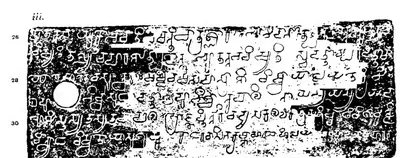 "Penukaparu grant of Jayasimha II.", plate iii (Epigraphia Indica XVIII, plate between pp. 316 and 317 (PDF p. 403))Inscription rubbing · 1926
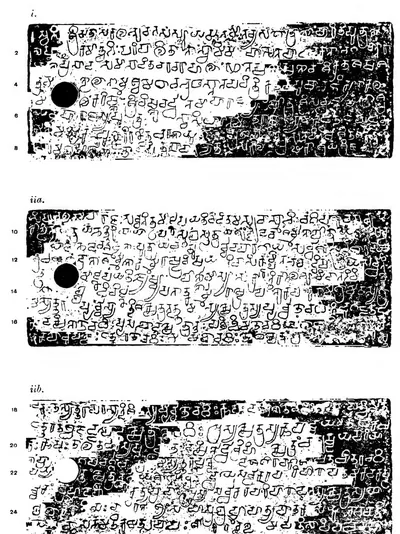 "Penukaparu grant of Jayasimha II.", plates i, ii a and ii b (Epigraphia Indica XVIII, plate between pp. 316 and 317 (PDF p. 402))Inscription rubbing · 1926
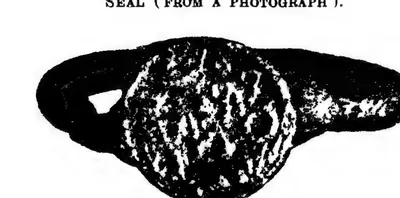 "Seal (from a photograph). Actual size.", seal of the Penukaparu grant of Jayasimha II (Epigraphia Indica XVIII, plate between pp. 316 and 317 (PDF p. 403))Historic photograph · 1926
References
Notes (0)
Sources (3)
Spotted an error on this page? Tell us
Last updated: