Madrasa-i-Aliya
A school in Hyderabad city for the sons of the nobility. It began as a private school with English teachers for the sons and relatives of the minister Sir Salar Jang, and in the 1870s became a public school for the higher classes. It had 19 pupils in 1879 and about 200 by the 1900s, and was attached to the Nizam College.
Download
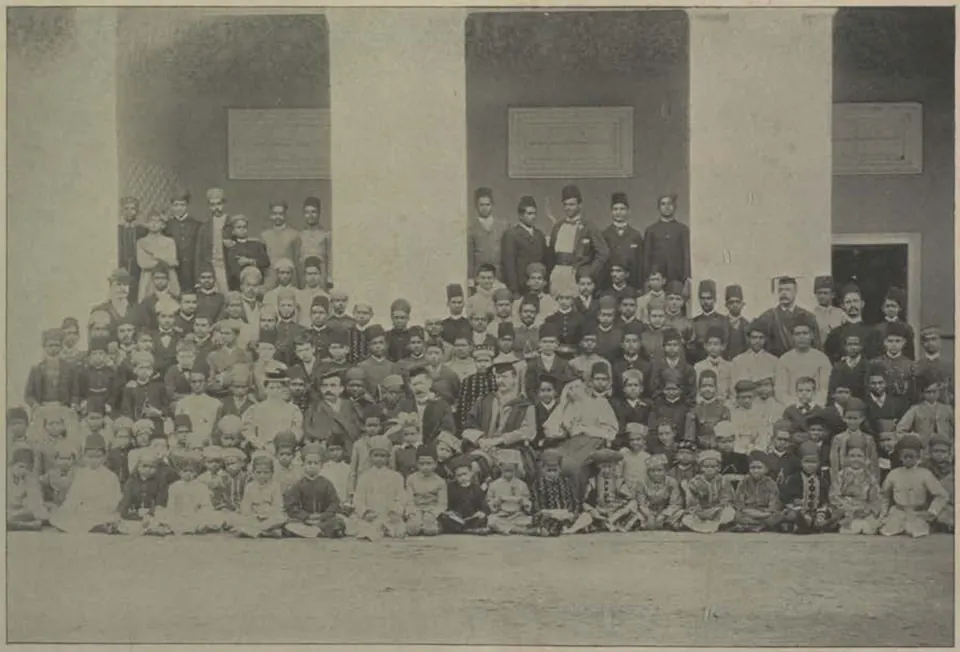
The Madrasa-i-Aliya was a school in Hyderabad city for the sons of the nobility.12 It began as a private school for the family of the minister Salar Jang.1 In the 1870s it opened to the higher classes in general.1 Later it was attached to the Nizam College.34
Beginnings
According to the Imperial Gazetteer of 1909, the school was first opened as a private school under English teachers.1 It taught the sons and relations of Sir Salar Jang.1 In the decade 1871–80 it became a public school for the higher classes.1 The gazetteer says it then had “an uninterrupted career of success”.1
It was costly at first.1 In 1879 it had only 19 pupils, and each cost the state Rs. 1,643 a year.1 By the time the gazetteer was written it had 200 pupils, at a cost of Rs. 70 to Rs. 80 each.1 Another school for the same class of boys, the Madrasa-i-Aizza, was opened privately with lower fees and many scholarships.1
Teachers from England
The school hired teachers from England.12 In 1882 E. A. Seaton, an Oxford man, came from England to be its headmaster.2 Campbell calls it “the School for Nobles”.2 W. A. Home, born at Madras, became its second English assistant in July 1885.4 Campbell calls it the school “for noblemen’s sons”.4
Joined to the Nizam College
Campbell says that in 1888 the old Hyderabad College was joined with the Madrasa-i-Aliya, and the two took the name Nizam College.4 By 1898 the Madrasa-i-Aliya was the high school attached to the Nizam College, with a kindergarten for small children.3 In 1896 it had 174 pupils with the kindergarten, against 136 the year before.3
Some of its pupils
Campbell’s book names several pupils from noble families:567
- Maharaja Kishen Pershad, who learned English at the Madrasa-i-Aliya after studying Arabic and Persian with tutors at home5
- Murli Manohar, born in 1860, who entered the school on the advice of Sir Salar Jang and later studied law6
- Raja Latchman Rao, who joined on 26 April 1886, lived in its boarding house from 1889 and passed the middle school examination in 18927
Where the sources disagree
No disagreement was found among the sources used for this page. The Imperial Gazetteer (1909) describes the school separately and does not mention its joining with the Nizam College.1
Footnotes
-
Imperial Gazetteer of India, Provincial Series: Hyderabad State (1909), p. 74 (archive.org (opens in a new tab)). ↩ ↩2 ↩3 ↩4 ↩5 ↩6 ↩7 ↩8 ↩9 ↩10 ↩11 ↩12 ↩13
-
Campbell, Glimpses of the Nizam’s Dominions (1898), p. 87, life of E. A. Seaton (archive.org (opens in a new tab)). ↩ ↩2 ↩3 ↩4
-
Campbell, Glimpses of the Nizam’s Dominions (1898), p. 65 (archive.org (opens in a new tab)). ↩ ↩2 ↩3
-
Campbell, Glimpses of the Nizam’s Dominions (1898), p. 90, life of W. A. Home (archive.org (opens in a new tab)). ↩ ↩2 ↩3 ↩4
-
A. Claude Campbell, Glimpses of the Nizam’s Dominions (1898), p. 27, life of Maharaja Kishen Pershad (archive.org (opens in a new tab)). ↩ ↩2
-
Campbell, Glimpses of the Nizam’s Dominions (1898), p. 74, life of Murli Manohar (archive.org (opens in a new tab)). ↩ ↩2
-
Campbell, Glimpses of the Nizam’s Dominions (1898), p. 324, life of Raja Latchman Rao (archive.org (opens in a new tab)). ↩ ↩2
Photos
References
Notes (0)
Sources (2)
Spotted an error on this page? Tell us
Last updated: