Nizam College
The English-medium college of Hyderabad city, affiliated to the University of Madras. The Imperial Gazetteer traces it to the Chadarghat high school, which became a college about 1880; Campbell says the Nizam College was formed in 1888 by joining the old Hyderabad College with the Madrasa-i-Aliya. In 1936 a committee proposed linking it to Osmania University.
Download
The Nizam College was the college of Hyderabad city that taught in English and sent its students to the examinations of the University of Madras.12 Before Osmania University was founded in 1918, it was one of only two places of higher learning in the state.2 Many sons of the nobility studied there and in the school attached to it.3
From the Chadarghat school
According to the Imperial Gazetteer of 1909, the college grew out of the Chadarghat high school.4 In 1877 the state closed its Anglo-vernacular high school in the city and sent the pupils to the Chadarghat school.4 About 1880 the Chadarghat high school became a second-grade college of the Madras University.4 In 1881 it was raised to a first-grade college, teaching up to the B.A.4
Some of its staff were recruited in England, the only education officers in the state who were.4 The gazetteer calls it “the Chadarghat high school, now called the Nizam College”.4
A. Claude Campbell’s Glimpses of the Nizam’s Dominions (1898) tells it differently.5 He says the old Hyderabad College was joined with the Madrasa-i-Aliya in 1888, and the two took the name Nizam College.5
The college in the 1890s
In 1898 Campbell called it a first-grade college with “an excellent staff of University men”.3 Its principal was E. A. Seaton, an Oxford graduate.3 Seaton had come from England in 1882 to be headmaster of the Madrasa-i-Aliya.6 When the Nizam College was founded, he became its vice-principal under the principal, Mr. Hodson.6 After Hodson died, Seaton took his place.6 The college was reorganised in 1895, after Hodson’s death.7
The Madrasa-i-Aliya, a high school with a kindergarten, was attached to the college.3 Campbell says that although the college was open to all, only the sons of noblemen and gentlemen were on its rolls.3 It was run like an English public school, with care for the boys’ character and games as well as their lessons.3 In 1896 the college had 55 students, against 42 the year before.3
In 1909 the gazetteer praised its boarding-house.1 But it said the hostel had too few places, and its fees were too high for poorer students from outside the city.1
Madras or Osmania?
After Osmania University began teaching in Urdu, the Nizam College still followed the courses of the University of Madras.28 In 1936 a Hyderabad committee wanted the control of the Madras University over the state’s education to end.8 It said the state should have only one place of university teaching.8 But some students could not study in Urdu.8 So it proposed that the Nizam College become an associated college of Osmania University.8 It would teach Osmania’s courses in English and keep its own Board of Governors.8
The committee did not want both institutions to teach the M.A. and M.Sc., since they were less than five miles apart.8 It repeated that the Nizam College should stay for those who could not use the Urdu courses.9 One witness, S. Hanumantha Rao, a professor at the college, thought Urdu could become its medium within a few years.10 He said boys from the Andhra and Maratha districts learned Urdu easily and did well at Osmania.10
Where the sources disagree
The two main sources tell the college’s origin differently:
- The Imperial Gazetteer (1909) says the Chadarghat high school became a college about 1880 and was “now called the Nizam College”.4
- Campbell (1898) says the Nizam College was formed in 1888, by joining the old Hyderabad College with the Madrasa-i-Aliya.5
Footnotes
-
Imperial Gazetteer: Hyderabad State (1909), p. 75 (archive.org (opens in a new tab)). ↩ ↩2 ↩3
-
Census of India 1931, Vol. XXIII: H.E.H. the Nizam’s Dominions, Part I: Report (1933), p. 216, “The Osmania University” by H. A. Ansari, Registrar (archive.org (opens in a new tab)). ↩ ↩2 ↩3
-
A. Claude Campbell, Glimpses of the Nizam’s Dominions (1898), p. 65 (archive.org (opens in a new tab)). ↩ ↩2 ↩3 ↩4 ↩5 ↩6 ↩7
-
Imperial Gazetteer of India, Provincial Series: Hyderabad State (1909), p. 74 (archive.org (opens in a new tab)). ↩ ↩2 ↩3 ↩4 ↩5 ↩6 ↩7
-
Campbell, Glimpses of the Nizam’s Dominions (1898), p. 90, life of W. A. Home (archive.org (opens in a new tab)). ↩ ↩2 ↩3
-
Campbell, Glimpses of the Nizam’s Dominions (1898), p. 87, life of E. A. Seaton (archive.org (opens in a new tab)). ↩ ↩2 ↩3
-
Campbell, Glimpses of the Nizam’s Dominions (1898), p. 89, life of H. C. Cooney (archive.org (opens in a new tab)). ↩
-
Committee for the Reorganisation of Education in the Hyderabad State: Report of the Sub-Committee (1936), p. 3 (archive.org (opens in a new tab)). Paraphrased. ↩ ↩2 ↩3 ↩4 ↩5 ↩6 ↩7
-
Report of the Sub-Committee (1936), p. 7 (archive.org (opens in a new tab)). Paraphrased. ↩
-
Report of the Sub-Committee (1936), Appendix C, summary of oral evidence, p. 54 (archive.org (opens in a new tab)). Paraphrased. ↩ ↩2
Photos
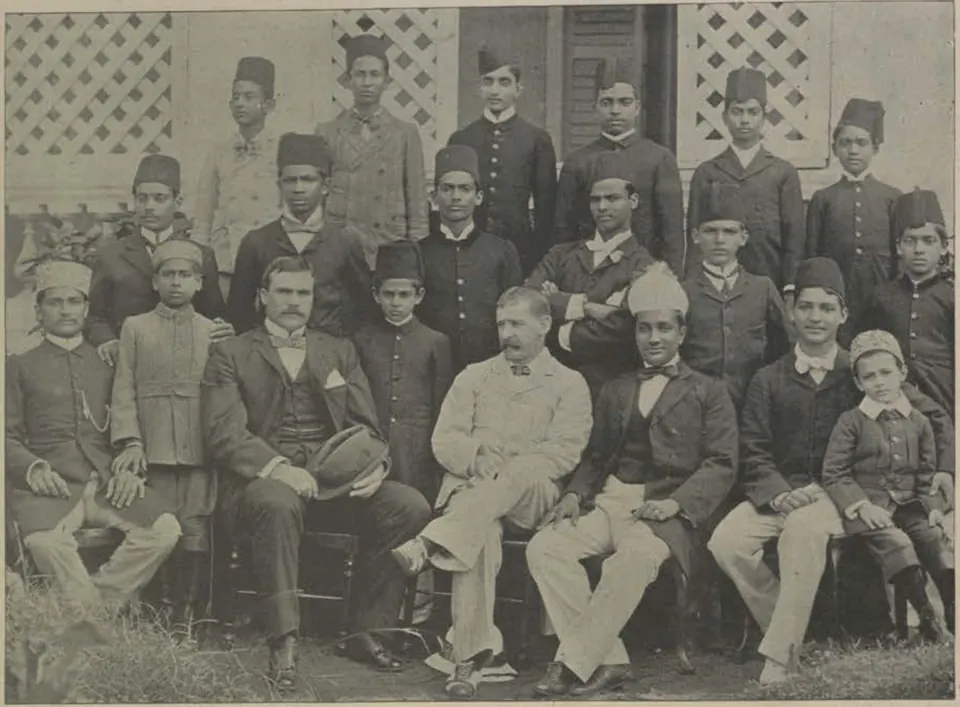
 Hyderabad: "Masters and Boarders, Nizam College" (Campbell 1898, p. 192)Historic photograph · 1898
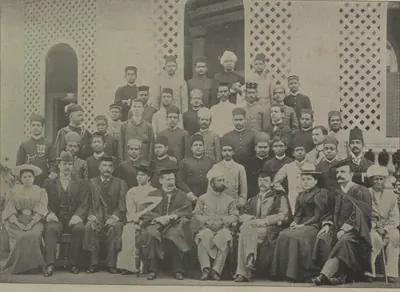 Hyderabad: "Staff and Students, Nizam College" (Campbell 1898, p. 190)Historic photograph · 1898
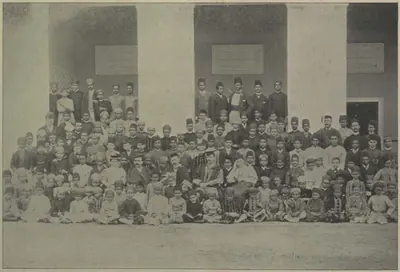 Hyderabad: "The Madrasa-i-Aliya, Nizam College" (Campbell 1898, p. 192)Historic photograph · 1898
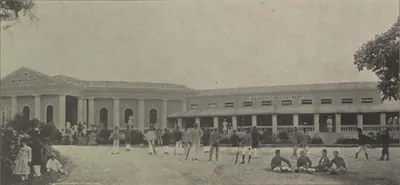 Hyderabad: "The Nizam College" (Campbell 1898, p. 190)Historic photograph · 1898
References
Notes (0)
Sources (4)
Spotted an error on this page? Tell us
Last updated: