Vivekavardhini
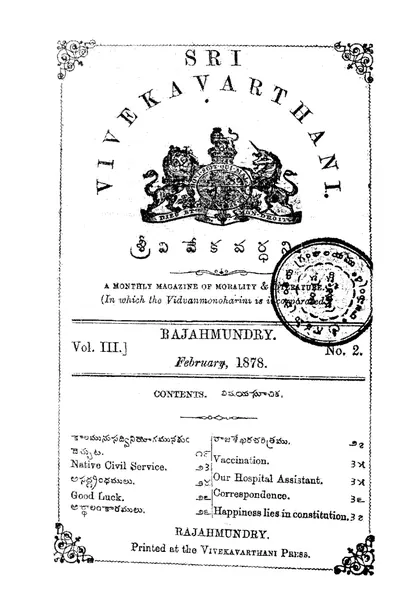
The Telugu journal of the reformer Kandukuri Veeresalingam, begun in 1874 and printed at Rajahmundry. It attacked bribery among officials, the dancing-girl parties of the rich and harmful customs, and argued for simple, clear Telugu. Basha writes that with it Telugu journalism came of age. Veeresalingam stopped it in 1890.
Download
The Vivekavardhini (“incentive to wisdom”) was a Telugu journal started by the reformer Kandukuri Veeresalingam in 1874.12 From Rajahmundry it attacked corruption and harmful customs.3 With it Veeresalingam made the journal a tool of social reform in the Telugu country.2 Its place in the history of Telugu papers is told in Telugu newspapers and journals.
Beginnings, 1874–1876
D. Anjaneyulu, in his life of Veeresalingam (1976), says the journal began while Veeresalingam was a teacher at Dhavaleswaram.1 At first it was a monthly, and soon he made it a fortnightly.14 In 1875 a friend at Narsapur, Shujayat Ali Khan, merged his own paper, the Vidvan-Manohaarini, with it.4
The first few issues were printed in Madras, at the press of the Andhra Bhasha Sanjivani.4 That journal was edited by Kokkonda Venkataratnam, who held opposite views on women’s education and the age of marriage.4 Soon Veeresalingam and some friends, each putting in a few hundred rupees, set up a press of their own at Rajahmundry.4
Aims
Anjaneyulu sets out the journal’s aims.5 The first was to improve the Telugu language by writing in an easy, simple and pure style.5 The second was to improve people’s lives by fighting harmful customs and raising moral standards.5 Social reform and true religion followed from these.5
Its motto was a verse from the Telugu Mahabharata: do not do to others what you would not want done to you.6
Fighting corruption
Veeresalingam chose local targets, though they were risky.3 One of the first evils he attacked was the parties with dancing girls held at the homes of judges and lawyers, which poor clerks had to pay for.3 He wrote in an early issue that a journal true to its mission must offend many powerful people.3
The journal also carried his quarrel with Kokkonda.6 When Kokkonda started a comic paper, the Hasya Vardhani, Veeresalingam replied in July 1876 with the Hasya Sanjivani.6 It later appeared as a supplement to the Vivekavardhini.6
Its place in Telugu journalism
S. Mahaboob Basha (2009) writes that with the Vivekavardhini (1874, Rajahmundry) Telugu journalism came of age and won respect.7 K. Sitaramaiya, writing in 1943, saw it differently.89 He named it among the older journals that did much for Telugu literature, but whose methods were by then old-fashioned.89
The East Godavari gazetteer lists it among the many periodicals of nineteenth-century Rajahmundry and Kakinada, all of which, it says, were short-lived.10 Veeresalingam stopped the journal in 1890.11 Anjaneyulu says he no longer had the time, the energy or the money to keep it alive, with so much other work pressing on him.11
Where the sources disagree
How often it appeared. Regani says Veeresalingam started a weekly called the Viveka Vardhini in 1874.2 Anjaneyulu says it began as a monthly and became a fortnightly.14
Footnotes
-
D. Anjaneyulu, Kandukuri Veeresalingam (1976), p. 15 (archive.org (opens in a new tab)). Cite-only; paraphrased. ↩ ↩2 ↩3 ↩4
-
Sarojini Regani, Highlights of the Freedom Movement in Andhra Pradesh (1956), p. 18 (archive.org (opens in a new tab)). Cite-only; paraphrased. ↩ ↩2 ↩3
-
Anjaneyulu, Kandukuri Veeresalingam (1976), p. 19 (archive.org (opens in a new tab)). Cite-only; paraphrased. ↩ ↩2 ↩3 ↩4
-
Anjaneyulu, Kandukuri Veeresalingam (1976), p. 16 (archive.org (opens in a new tab)). Cite-only; paraphrased. ↩ ↩2 ↩3 ↩4 ↩5 ↩6
-
Anjaneyulu, Kandukuri Veeresalingam (1976), p. 18 (archive.org (opens in a new tab)). Cite-only; paraphrased. ↩ ↩2 ↩3 ↩4
-
Anjaneyulu, Kandukuri Veeresalingam (1976), p. 17 (archive.org (opens in a new tab)). Cite-only; paraphrased. ↩ ↩2 ↩3 ↩4
-
S. Mahaboob Basha, “Sculpturing a ‘New Woman’ with Print Culture in Colonial Andhra: A Biography of Telugu Zenana, 1893–1907”, Kakatiya Journal of Historical Studies, Vol. IV (2009), p. 125 (archive.org (opens in a new tab)). Cite-only; paraphrased. ↩
-
K. Sitaramaiya, A Hand Book of Telugu Literature (1943), p. 85 (archive.org (opens in a new tab)). Cite-only; paraphrased. ↩ ↩2
-
Sitaramaiya, A Hand Book of Telugu Literature (1943), p. 86 (archive.org (opens in a new tab)). Cite-only; paraphrased. ↩ ↩2
-
N. Ramesan, Andhra Pradesh District Gazetteers: East Godavari (1979), p. 233 (archive.org (opens in a new tab)). Cite-only; paraphrased. ↩
-
Anjaneyulu, Kandukuri Veeresalingam (1976), p. 42 (archive.org (opens in a new tab)). Cite-only; paraphrased. ↩ ↩2
Photos
References
Notes (0)
Sources (5)
Spotted an error on this page? Tell us
Last updated: