High Court, Hyderabad
Building of the High Court of Hyderabad State on the bank of the Musi in the old city. It was built during Mir Osman Ali Khan's years of direct rule (1914–1919), at a cost of twenty lakhs of rupees, according to Mudiraj's Pictorial Hyderabad (1929). Mudiraj called it 'a noble edifice and one of the best buildings in India in its architectural beauty'. The court itself, with a Chief Justice and five puisne (junior) judges, already sat in the city in 1909.
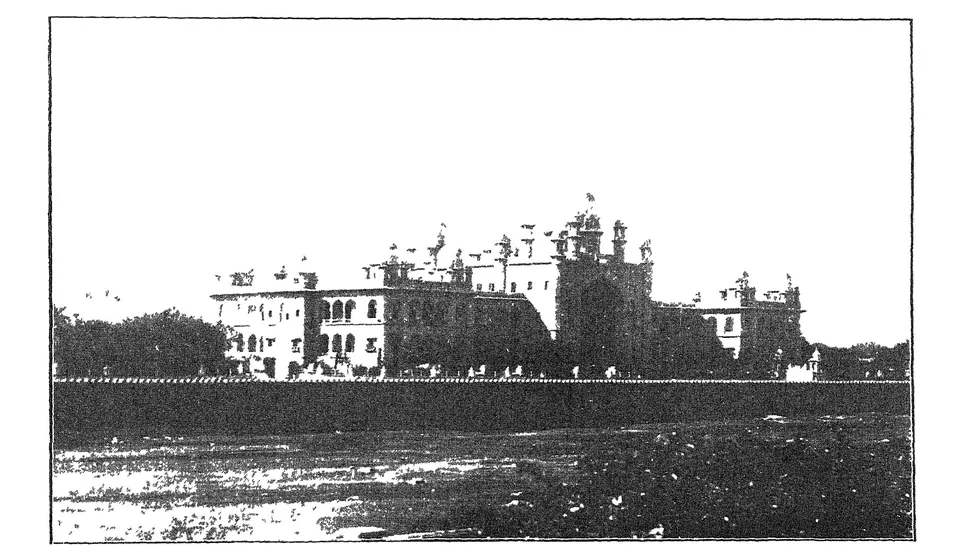
The High Court building of the Asaf Jahi state stands on the Musi in the old city of Hyderabad. K. Krishnaswamy Mudiraj’s Pictorial Hyderabad (1929) prints a photograph of it.12 Its caption is “A distant view of the New High Court Buildings from across the river Musi”.12 Another photograph is captioned “New Hyderabad High Court”.12
The court
The High Court was older than the building. Campbell (1898) says the judicial department was “under the control of the High Court, which is composed of a chief justice and five puisne judges”.3 The Imperial Gazetteer of 1909 gives the same bench.4
The gazetteer records that in 1909 “the High Court and the Small Cause and Magistrates’ Courts, the Treasury, and the Accountant-General’s and certain other offices are located in the city”.5 Most of the secretariats were in Saifabad and Chadarghat, across the river.5
Mudiraj describes the court’s powers in 1929.6 There was a High Court, but powers of revision and appeal like those of the Privy Council lay with the Nizam.6 Death sentences needed his assent.6
The building
Mudiraj says that the minister Salar Jang III resigned in 1914.7 After that Mir Osman Ali Khan governed directly until a Council of State was formed in November 1919.7
Mudiraj lists the changes of those five years.8 They included the damming of the Musi and the widening of the streets.8 They also included “a new High Court, a noble edifice and one of the best buildings in India in its architectural beauty”.8 It was built “at a cost of twenty lakhs of rupees”.8 None of the sources consulted names the architect or gives the exact years of building.
Footnotes
-
Mudiraj, Pictorial Hyderabad (1929), p. 105 (archive.org (opens in a new tab)). ↩ ↩2 ↩3
-
Mudiraj, Pictorial Hyderabad (1929), p. 15 (archive.org (opens in a new tab)). ↩ ↩2 ↩3
-
A. Claude Campbell, Glimpses of the Nizam’s Dominions (1898), p. 60 (archive.org (opens in a new tab)). ↩
-
Imperial Gazetteer of India: Hyderabad State (1909), p. 51 (archive.org (opens in a new tab)). ↩
-
Imperial Gazetteer: Hyderabad (1909), p. 119 (archive.org (opens in a new tab)). ↩ ↩2
-
K. Krishnaswamy Mudiraj, Pictorial Hyderabad, Vol. I (1929), p. 4 (archive.org (opens in a new tab)). ↩ ↩2 ↩3
-
Mudiraj, Pictorial Hyderabad (1929), p. 229 (archive.org (opens in a new tab)). ↩ ↩2
-
Mudiraj, Pictorial Hyderabad (1929), p. 230 (archive.org (opens in a new tab)). ↩ ↩2 ↩3 ↩4
Photos
References
Notes (0)
Sources (3)
Spotted an error on this page? Tell us
Last updated: