Osmania University
University at Hyderabad founded by Mir Osman Ali Khan's farman of 26 April 1917 and established by charter in 1918, the first in India to teach through an Indian language, Urdu, with English compulsory. Its translation bureau put the college textbooks into Urdu. In the 1930s the university moved to a new campus at Adikmet, where the Arts College was built at a sanctioned cost of Rs 27,13,000. In 1938 students who sang Vande Mataram in a hostel were expelled.
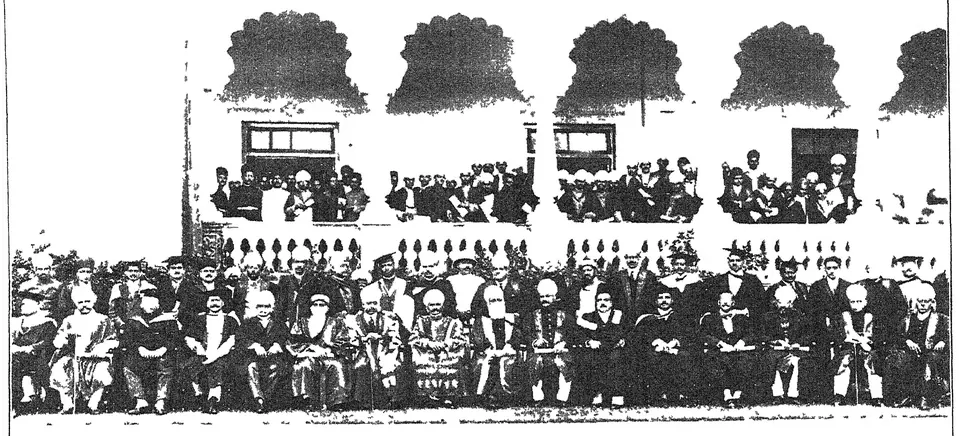
Osmania University is the university of Hyderabad. The seventh Nizam, Mir Osman Ali Khan, founded it in 1917–18.12 The census of 1931 calls it the first attempt in India to give university teaching through an Indian language, Urdu.2 English was a compulsory second language.2
Founding
The census of 1931 prints an account of the university by its Registrar.2 He says that before 1917 the state had only two places of higher learning.2 They were the Dar-ul-Uloom, a school of Islamic studies, and the Nizam College, whose examinations were set by the University of Madras.2 Early in 1917 Mr. A. Hydari, Secretary in the Education Department, sent the Nizam a memorandum proposing a new university.2 The census adds that he had since become Nawab Sir Hydar Nawaz Jung.2 The administration report for 1932–33 gives that title to Sir Akbar Hydari, the Finance Member.3 See Akbar Hydari.
Hydari wanted teaching in Urdu instead of a foreign language.2 Critics replied that most people of the state spoke other languages.4 The answer given was that Urdu was “the cultural and official language of the State”.4 To the second objection, the lack of Urdu textbooks, Hydari proposed a bureau of translation.4
The Nizam approved the plan by a farman (royal order) dated 26 April 1917.1 K. Krishnaswamy Mudiraj’s Pictorial Hyderabad (1929) prints the order.1 It made Urdu the medium of higher education but made English compulsory for all students.5 The university was named the Osmania University of Hyderabad “in commemoration of my accession to the throne”.5 The census says it was established by a charter in 1918.2
The translation bureau
The university’s first task was a Bureau of Translation, with eight translators under Maulvi Abdul Haq, a noted Urdu writer.4 Committees of scholars coined new scientific words in Urdu.4 Within five years the bureau had translated nearly all the books needed up to the B.A. examination.4 Mudiraj says the bureau had published books on history, chemistry, economics and other subjects.5
The new campus
The administration report for 1342 Fasli (1932–33) records an allotment of Rs 20 lakhs for the first works at the new site.6 These included land, roads, water pipes and a power line.6 Of this, Rs 6.97 lakhs was spent that year.6
The report for 1344 Fasli (1934–35) mentions the move of the university to its new site at Adikmet.7 Before the move, its students lived in six separate hostels scattered over the city.7 In 1936–37 the chief building work on the campus was the Arts College.8 Its sanctioned cost was Rs 27,13,000.9 By 1936–37, Rs 16,46,804 had been spent, and the ground and first floors were going up.8 By the end of 1937–38 the outlay was Rs 20,93,845, and the work was still in progress.10
In 1937–38 the university’s convocation was held in the Town Hall.11 Sir Akbar Hydari, as Chancellor, presided.11 Among those given honorary doctorates were Maharaja Kishen Pershad and Sir Tej Bahadur Sapru.11
The Vande Mataram protest of 1938
Sarojini Regani’s history of the freedom movement, written from the Congress side, describes a students’ protest in 1938.12 Hindu students in a university hostel sang the song “Vande Mataram” at their prayers before Dasara.12 The authorities closed the prayer hall and banned songs they called political.12 The students kept singing.12 On 29 November 1938, Regani writes, they were told to leave their rooms, and a strike followed.13 On 12 December the names of 350 students of the Osmania colleges were struck off the rolls.13 She says Nagpur University later admitted them.13 The university’s own view of these events is not given in the sources used here. See the Movements page.
Footnotes
-
K. Krishnaswamy Mudiraj, Pictorial Hyderabad, Vol. I (1929), p. 97 (archive.org (opens in a new tab)). ↩ ↩2 ↩3
-
Census of India 1931, Vol. XXIII: H.E.H. the Nizam’s Dominions, Part I: Report (1933), p. 216, “The Osmania University” by H. A. Ansari, Registrar (archive.org (opens in a new tab)). ↩ ↩2 ↩3 ↩4 ↩5 ↩6 ↩7 ↩8 ↩9 ↩10
-
Report on the Administration of H.E.H. the Nizam’s Dominions for 1342 Fasli (1932–33) (1935), p. 118 (archive.org (opens in a new tab)). ↩
-
Census of India 1931, Vol. XXIII, Part I (1933), p. 217 (archive.org (opens in a new tab)). ↩ ↩2 ↩3 ↩4 ↩5 ↩6
-
Mudiraj, Pictorial Hyderabad (1929), p. 99 (archive.org (opens in a new tab)). ↩ ↩2 ↩3
-
Administration Report, 1342 Fasli (1932–33) (1935), p. x (archive.org (opens in a new tab)). ↩ ↩2 ↩3
-
Report on the Administration of H.E.H. the Nizam’s Dominions, 1344 Fasli (1934–35) (1938), p. 118 (archive.org (opens in a new tab)). ↩ ↩2
-
Administration Report, 1346 Fasli (1936–37) (1939), p. 87 (archive.org (opens in a new tab)). ↩ ↩2
-
Report on the Administration of H.E.H. the Nizam’s Dominions, 1346 Fasli (1936–37) (1939), p. 86 (archive.org (opens in a new tab)). ↩
-
Report on the Administration of H.E.H. the Nizam’s Dominions, 1347 Fasli (1937–38) (1940), p. 99 (archive.org (opens in a new tab)). ↩
-
Administration Report, 1347 Fasli (1937–38) (1940), p. 177 (archive.org (opens in a new tab)). ↩ ↩2 ↩3
-
Sarojini Regani, Highlights of the Freedom Movement in Andhra Pradesh, p. 185 (archive.org (opens in a new tab)). ↩ ↩2 ↩3 ↩4
-
Regani, Highlights of the Freedom Movement, p. 186 (archive.org (opens in a new tab)). ↩ ↩2 ↩3
Photos
References
Notes (0)
Sources (7)
Spotted an error on this page? Tell us
Last updated: