Afzal-ud-daula (Asaf Jah V)
Nizam of Hyderabad from 1857 to 1869, eldest son of Nasir-ud-daula. He came to the throne on 16 May 1857, as the rising against the Company spread through northern India. With his minister Salar Jang he kept Hyderabad on the British side; the Residency was attacked on 17 July 1857 and the attack was driven off. By the treaty of 1860 Osmanabad and the Raichur Doab were given back to him, a debt of fifty lakhs was cancelled and Shorapur was added to his state; Berar stayed in British trust. He died on 26 February 1869.
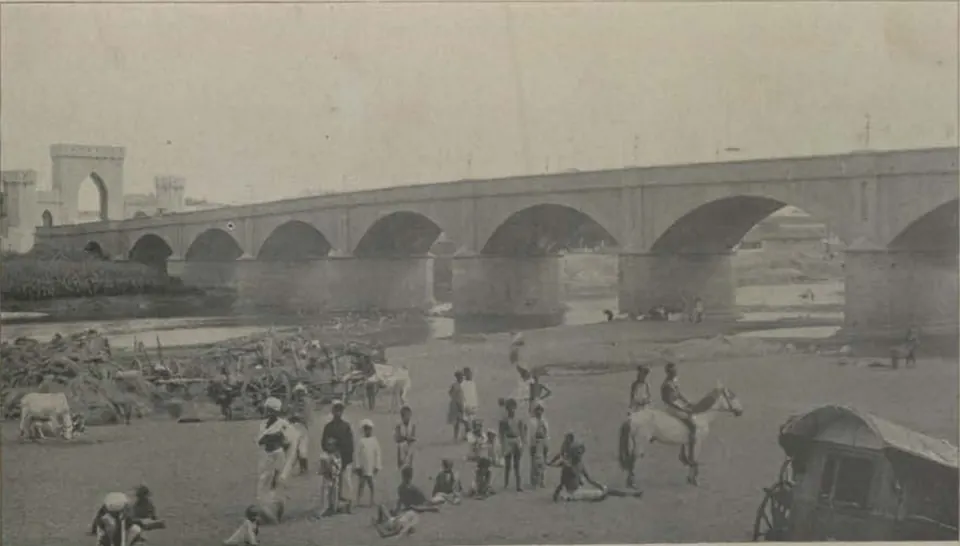
Afzal-ud-daula, the fifth Nizam in the usual reckoning of the Asaf Jahis, was the eldest son of Nasir-ud-daula, whom he succeeded on 16 May 1857.12 Bilgrami names his mother as Dilawar-un-Nissa Begum and lists her grave at the Mecca Masjid.3
1857
His accession came as the rising of 1857 spread across northern India.45 The Imperial Gazetteer says it was feared that “if Hyderabad joined the revolt, the whole of Southern India as well as Bombay would rebel”.45 Some of his advisers urged him to join it.45 But he “listened to the good counsels of his faithful minister, Salar Jang, and cast in his lot with the British”.45
Mudiraj’s Pictorial Hyderabad (1929) describes placards calling for rebellion.6 They were put up on the walls of the mosques, of the Nizam’s and the minister’s palaces, and at the Char Minar.6 It says the Nizam sent the Hyderabad Contingent to serve against the rebels in “Upper India”, in Rajputana and on the march to Kalpi.6
Mudiraj quotes the Resident, Colonel Davidson, who had the Nizam “narrowly watched”.7 Davidson reported that when messengers of the rebels came to the Nizam, he heard them out and “refused complicity”.7
On the evening of 17 July 1857 a band of Rohillas and Afghans attacked the British Residency and was driven off.8 The treaty collection of 1909 says the hopes of the disloyal had been raised “by the succession of a new Chief”.8
The Hyderabad State committee’s Freedom Struggle in Hyderabad (1956) prints the Resident’s letter to the Nizam about the attack.9 Its account, given in summary here, is that Turrebaz Khan and Maulvi Allauddin led the attackers.9 They took shelter in two houses that were shelled overnight.9 Allauddin was later transported for life, and Turrebaz Khan was shot while being recaptured.9 See the British Residency. Campbell describes a later attempt on the lives of the Resident and Salar Jang, in February 1859.10
The treaty of 1860
In February 1859 Lord Canning thanked the Nizam for his loyalty.107 The treaty of December 1860 then rewarded him:811
- the debt of fifty lakhs due from him was cancelled811
- Shorapur, taken from its rebel raja, was ceded to him811
- Dharaseo (Osmanabad) and the Raichur Doab were given back811
In return he ceded districts on the left bank of the Godavari.811 The remaining assigned districts of Berar were to be held in trust without any demand for accounts.811 The Imperial Gazetteer gives the revenue of the restored districts as 21 lakhs and that of Berar as 32 lakhs.5 It also records presents worth £10,000.5
Mudiraj describes the Nizam looking at the gifts, putting a diamond ring on his finger and hanging a jewelled sword at his side.12 In 1861 he became a Knight Grand Commander of the new Order of the Star of India.512 Mudiraj says the Resident installed him in November 1861.512
Salar Jang and the Nizam
The treaty collection says that in 1861 the Nizam decided to remove Salar Jang from office, despite the Resident’s protests.11 The British Government would not agree, and Salar Jang stayed.11 Differences arose again in 1867 but were settled.11
Campbell says the first quarrel was fed by a plot that made the Nizam believe the Resident wanted the minister removed.10 When Colonel Davidson protested, the plot was exposed and the two were reconciled.10 In 1862 the Nizam received a sanad (charter) promising that any succession in line with Muslim law and the customs of his family would be recognised.13
Death
Afzal-ud-daula died on 26 February 1869, a Friday, in the forty-third year of his age.1412 He was buried at the Mecca Masjid.1412 The Resident placed his only son, Mahbub Ali Khan, not yet three, on the throne.13
Campbell repeats a story that the Nizam never saw this son, for fear that evil would come to him.14 Three other sons had died before him.14
Footnotes
-
Campbell, Glimpses of the Nizam’s Dominions (1898), p. 125 (archive.org (opens in a new tab)). ↩
-
K. Krishnaswamy Mudiraj, Pictorial Hyderabad, Vol. I (1929), p. 69 (archive.org (opens in a new tab)). ↩
-
Syed Ali Asgar Bilgrami, Landmarks of the Deccan (1927), p. 36 (archive.org (opens in a new tab)). ↩
-
Imperial Gazetteer of India: Hyderabad State (1909), p. 17 (archive.org (opens in a new tab)). ↩ ↩2 ↩3 ↩4
-
Imperial Gazetteer: Hyderabad (1909), p. 18 (archive.org (opens in a new tab)). ↩ ↩2 ↩3 ↩4 ↩5 ↩6 ↩7 ↩8
-
Mudiraj, Pictorial Hyderabad (1929), p. 70 (archive.org (opens in a new tab)). ↩ ↩2 ↩3
-
Mudiraj, Pictorial Hyderabad (1929), p. 71 (archive.org (opens in a new tab)). ↩ ↩2 ↩3
-
C. U. Aitchison, A Collection of Treaties, Engagements and Sanads, Vol. IX (1909), p. 9 (archive.org (opens in a new tab)). ↩ ↩2 ↩3 ↩4 ↩5 ↩6 ↩7 ↩8
-
The Freedom Struggle in Hyderabad, Vol. II (1956), pp. 63–64 (archive.org (opens in a new tab)). ↩ ↩2 ↩3 ↩4
-
A. Claude Campbell, Glimpses of the Nizam’s Dominions (1898), p. 39 (archive.org (opens in a new tab)). ↩ ↩2 ↩3 ↩4
-
Aitchison, Treaties, Vol. IX (1909), p. 10 (archive.org (opens in a new tab)). ↩ ↩2 ↩3 ↩4 ↩5 ↩6 ↩7 ↩8 ↩9
-
Mudiraj, Pictorial Hyderabad (1929), p. 72 (archive.org (opens in a new tab)). ↩ ↩2 ↩3 ↩4 ↩5
-
Aitchison, Treaties, Vol. IX (1909), p. 11 (archive.org (opens in a new tab)). ↩ ↩2
-
Campbell, Glimpses of the Nizam’s Dominions (1898), p. 126 (archive.org (opens in a new tab)). ↩ ↩2 ↩3 ↩4
Photos
Related
Dynasties
References
Notes (0)
Sources (6)
Spotted an error on this page? Tell us
Last updated: