Bhima-Vallabha (Kona)
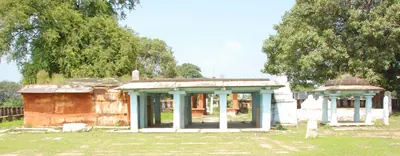
Bhima-Vallabha was a Haihaya chief of the Kona country in the Godavari delta in the 13th century, and the father of the chief Ganapatideva. His records are in the Kshiraramesvara temple at Palakollu, and E. Hultzsch dated one of them to 1318. A record calls him a son of Rajaparendu and a grandson of Gandavendara, lord of Mahishmati. A later chief of the same name, known from a record of 1364, is the last Kona chief on record.
Download
Bhima-Vallabha was a chief of the Haihayas of Kona, who ruled the Godavari delta from Palakollu in the 13th century.12 He was the father of the chief Ganapatideva.2 His family’s records show the Kona chiefs still ruling their small country while the Kakatiyas held most of the Telugu lands.3
Family
A record at Palakollu names Bhima-Vallabha as the son of Rajaparendu and grandson of Gandavendara, “the lord of Mahishmati”.2 The Annual Report on Epigraphy for 1932–33 thought that he was probably a son of Mahipalarendu, and so a grandson of the chief Vallabha, after whom he was named.2 It explained that the names Rajaparendu and Mahipalarendu mean the same thing.2 In that case, Gandavendara would be a title of Vallabha.2
The same record says that Bhima-Vallabha married Anyamamba.2 Kona Ganapatideva, in a record of Saka 1184, about 1262, is called the son of Anyama (Saka is an Indian way of counting years).2 So the report concluded that Ganapatideva was Bhima-Vallabha’s son.2 Another son, Kona Ramanatha, made a gift at Palakollu in Saka 1240, about 1318.2
His reign
E. Hultzsch knew of two inscriptions of Bhima-Vallabha in the Kshiraramesvara temple at Palakollu.1 He dated one of them to Saka 1240, about 1318.1
V. Yashoda Devi, in a thesis printed in 1993, thought that Bhima-Vallabha and Ganapati ruled together, as father and son, from about 1254 to 1300.4 She dated a record naming Bhima-Vallabha and Anyamamba to 1261.4 In her account, Ramanatha took Ganapati’s place beside his father after 1300.3 A Palakollu record of 1318 names the sons of Ramanatha, and after that year neither father nor son is heard of.3
The later Bhima-Vallabha
A Kona Bhima-Vallabharaja appears again in a record of Saka 1286, about 1364.2 The 1932–33 report thought that he was a different man, probably a grandson.2 Yashoda Devi thought he was a grandson of Ramanatha, and the last ruler of the family.35 She noted that by 1369 the Kona country had become part of the Reddi kingdom.5 Robert Sewell’s table (1932) also ends with a Kona Bhima-Vallabha in 1364–65, and says that the family then disappears from history.6 See the Reddis of Kondavidu.
Where the sources disagree
- The record of 1318. Hultzsch gave the Palakollu inscription of Saka 1240 to Bhima-Vallabha himself.1 The 1932–33 report read the gift of that year as made by his son Ramanatha.2 Yashoda Devi read the record of 1318 as naming Ramanatha’s sons.3
- His father. The Palakollu record calls his father Rajaparendu.2 The 1932–33 report and Yashoda Devi took this name to stand for Mahipalarendu, son of Vallabha, but the report called the link only probable.24
Footnotes
-
E. Hultzsch, “Pithapuram Inscription of Mallideva and Manma-Satya II; Saka-Samvat 1117”, Epigraphia Indica IV (1897), p. 87 (archive.org (opens in a new tab)). ↩ ↩2 ↩3 ↩4
-
Annual Report on South-Indian Epigraphy for 1932–33 (1936), Part II, para. 11, p. 59 (archive.org (opens in a new tab)). ↩ ↩2 ↩3 ↩4 ↩5 ↩6 ↩7 ↩8 ↩9 ↩10 ↩11 ↩12 ↩13 ↩14 ↩15
-
Yashoda Devi, History of Andhra Country (1993), p. 90 (archive.org (opens in a new tab)). Cite-only; paraphrased. ↩ ↩2 ↩3 ↩4 ↩5
-
V. Yashoda Devi, The History of Andhra Country, 1000 A.D.–1500 A.D. (1993), p. 89 (archive.org (opens in a new tab)). Cite-only; paraphrased. ↩ ↩2 ↩3
-
Yashoda Devi, History of Andhra Country (1993), p. 91 (archive.org (opens in a new tab)). Cite-only; paraphrased. ↩ ↩2
-
Robert Sewell, The Historical Inscriptions of Southern India (1932), p. 361, “Kona or Konamandala Chiefs” (archive.org (opens in a new tab)). Paraphrased. ↩
Related
Dynasties
References
Notes (0)
Sources (4)
Spotted an error on this page? Tell us
Last updated: