Ganapatideva (Kona)
Ganapatideva was a Haihaya chief of the Kona country in the Godavari delta in the late 13th century. His records at Palakollu and Draksharama run from 1262 to 1300. He was a son of the chief Bhima-Vallabha and of Anyamamba, and his queen Odayamahadevi was a daughter of the Chalukya chief Mahadeva of Nidadavolu. P. V. Parabrahma Sastry thought that the Kona chiefs of his time did not accept the rule of the Kakatiya queen Rudramadevi.
Download
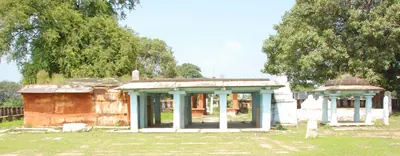
Ganapatideva was one of the last chiefs of the Haihayas of Kona, the family that ruled the Godavari delta.1 His records run from 1262 to 1300, mostly in the Kshiraramesvara temple at Palakollu.1 In his time the Kakatiyas ruled most of the Telugu country, but the Kona chiefs kept much of their freedom.2
Family
E. Hultzsch found two later kings of the family in the Palakollu inscriptions, Ganapatideva and Bhima-Vallabha.1 The Annual Report on Epigraphy for 1932–33 showed how they were related.3 A record of Saka 1184, about 1262, calls the mahamandalesvara (great provincial lord) Kona Ganapatidevaraja the son of Anyama (Saka is an Indian way of counting years).3 Another record says that Bhima-Vallabha married Anyamamba.3 So the report concluded that Ganapati was a son of Bhima-Vallabha.3 It also named his brother, Kona Ramanatha.3
Queens
Ganapatideva’s queen was Odayamahadevi.1 She was a daughter of Mahadeva of Nidudaprolu, who bore the old royal title Vishnuvardhana-maharaja.1 Hultzsch thought that Mahadeva may have descended from the Eastern Chalukyas.1 He took Nidudaprolu to be probably Nidadavolu, nine miles south-west of Rajahmundry.1 The 1932–33 report found a second queen, Lakumamba.3
V. Yashoda Devi, in a thesis printed in 1993, listed three records of Odayamahadevi at Palakollu, dated 1286, 1290 and 1306.4 Ganapati is not mentioned in her grant of 1306, so Yashoda Devi thought he had died by then.5
His reign
Yashoda Devi thought that father and son ruled together for many years.4 A record of 1262 at Draksharama names Ganapatideva maharaja and his mother Anyamadevi.4 A record of 1275 at Palakollu praises his great valour, and calls his father lord of the Kona country.4 She thought that they ruled from Palakollu and had a peaceful reign.4
The Kakatiyas
P. V. Parabrahma Sastry thought that the Kona Haihayas did not accept the Kakatiya queen Rudramadevi as their overlord.2 He noted that no Kakatiya record is found in the Vengi country between 1262 and 1278.2 Yashoda Devi likewise found no sign that Ganapati and his father obeyed either the Cholas or the Kakatiyas.5 Instead, she noted, they married into the local Chalukya families.5
Where the sources disagree
- Whose successors were they? Hultzsch thought that Ganapatideva and Bhima-Vallabha followed Mallideva and Manma-Satya II, the chiefs of the Pithapuram inscription of 1195.1 Yashoda Devi argued that they followed a later pair, Mallideva II and Bhima IV, who ruled from 1231 to 1254.64
- His mother’s family. Yashoda Devi wrote that Anyamamba was a daughter of Indusekhara of the Chalukyas.5 The 1932–33 report gave only her name.3
Footnotes
-
E. Hultzsch, “Pithapuram Inscription of Mallideva and Manma-Satya II; Saka-Samvat 1117”, Epigraphia Indica IV (1897), p. 87 and note 1 (archive.org (opens in a new tab)). ↩ ↩2 ↩3 ↩4 ↩5 ↩6 ↩7 ↩8
-
P. V. Parabrahma Sastry, The Kakatiyas of Warangal (1978), p. 127. ↩ ↩2 ↩3
-
Annual Report on South-Indian Epigraphy for 1932–33 (1936), Part II, para. 11, p. 59 (archive.org (opens in a new tab)). ↩ ↩2 ↩3 ↩4 ↩5 ↩6 ↩7
-
Yashoda Devi, History of Andhra Country (1993), p. 89 (archive.org (opens in a new tab)). Cite-only; paraphrased. ↩ ↩2 ↩3 ↩4 ↩5 ↩6
-
Yashoda Devi, History of Andhra Country (1993), p. 90 (archive.org (opens in a new tab)). Cite-only; paraphrased. ↩ ↩2 ↩3 ↩4
-
V. Yashoda Devi, The History of Andhra Country, 1000 A.D.–1500 A.D. (1993), p. 88 (archive.org (opens in a new tab)). Cite-only; paraphrased. ↩
Related
Dynasties
References
Notes (0)
Sources (4)
Spotted an error on this page? Tell us
Last updated: