Dhananjaya (Telugu Chola)
Telugu Chola ruler of Renandu in the Kadapa country, whom his editors date to about 575. As Erikal-Muturaju Dhananjaya he is named in the Kalamalla pillar inscription, one of the earliest records written wholly in Telugu. As Dhananjayavarman, youngest son of Nandivarman, he heads the line of Punyakumara in the Malepadu plates.
Dhananjayavarman was a Telugu Chola king, the youngest son of Nandivarman in the Malepadu plates.1 His editors identify him with Erikal-Muturaju Dhananjaya, who ruled Renandu according to a pillar inscription at Kalamalla.23
In the family tree
In the family tree of the Malepadu plates, Dhananjaya is the youngest of the three sons of Nandivarman.1 Nandivarman was a king of the Kasyapa-gotra (clan), born in the family of Karikala.1 Dhananjaya’s brothers were Simhavishnu and Sundarananda.1
H. Krishna Sastri translated the plates in 1912.1 His translation says that the youngest, “Dhanaṁjayavarman, on whom devolved the sovereignty in regular succession”, had a son who took the title Chola-Maharaja, Mahendravikrama.1
K. A. Nilakanta Sastri and M. Venkataramayya (1956) made him the founder of the line that came from Erigal.4 This line ruled Renandu, Hiranyarashtra and Siddhi, with capitals at Chippili and Malepadu.4
The Kalamalla inscription
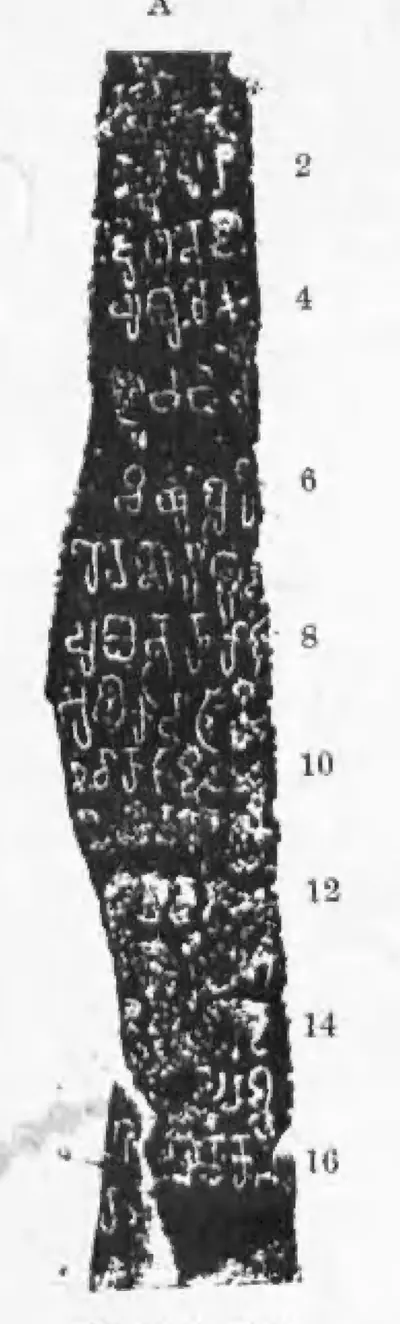
A damaged pillar at Kalamalla in the Kamalapuram country records a gift to, or by, one Revanakalu of Chirumburu.3 The gift was made while Erikal-Muturaju Dhananjaya was ruling Renandu.3
Krishna Sastri noticed it in 1912 as a record of “a certain D[h]anaṁjeyuṇḍu who was ruling Rēnāṇḍu”.2 By its letters he placed it “roughly … to the same period as the Mālēpāḍu plates”.2 He thought it “not unlikely” to refer to Dhananjayavarman, the last son of Nandivarman.2
Nilakanta Sastri and Venkataramayya edited the inscription.3 They accepted the identification without doubt.3 They dated the pillar to the last quarter of the 6th century by comparing its letters with the Biragunda stone of the Western Ganga king Avinita.3 See the Kalamalla inscription.
His title
The editors argued that Erikal or Erigal is a place name, the old seat of the family.5 They identified it with Nidugal in the Pavugada taluk of Tumkur district.5
Muturaju is a rank, not a personal name.6 In their reading it was held by a senior prince other than the king and the heir.6 Dhananjaya held it as the third of three brothers, whose elder brothers had sons of their own.6 The Malepadu plates say that the brothers’ sons and grandsons each enjoyed the fortune of a kingdom.6
The Erragudipadu stone, a few miles away and in almost the same letters, names an Erikal-Mutturaju without a personal name.7 The editors thought him plausibly, but not certainly, the same Dhananjaya.7
Another Dhananjaya
Krishna Sastri also pointed to “a certain Dhanaṁjaya Eriga” of inscriptions in the Maddagiri taluk of Tumkur.2 This man called himself a Chola ruling a district that Krishna Sastri read as Alvadi six hundred.2 B. L. Rice dated him to about the middle of the 8th century.2 Krishna Sastri thought this chief “either directly or indirectly connected” with Dhananjayavarman.2
Nilakanta Sastri and Venkataramayya read the district as Erigalvadi six hundred.54 They treated its ruler as a later chief, an Adhiraja Dhananjaya of the Chola family living about the middle of the 8th century.54 His link with the main line was unknown.54
Date
None of the records is dated.38 The figure of about 575 rests on the comparison with Avinita’s inscription.38 It also rests on a family tree counted at 25 years a generation from Nandivarman.38 Nandivarman is placed about 550, because he and his son Simhavishnu bear the names of 6th-century Pallava kings.38
Krishna Sastri allowed a little more than a century for the five rulers from Nandivarman to Punyakumara.9 He dated the Malepadu plates to the end of the 8th century, which would bring Dhananjaya well into the 8th.9
H. K. Narasimhaswami took the three brothers to have ruled one after another.10 He started from Punyakumara’s accession about 740 and placed Nandivarman’s accession about 630.10 This puts Dhananjaya at the end of the 7th century.10 The dynasty page sets out the three datings.10
Footnotes
-
H. Krishna Sastri, “Malepadu Plates of Punyakumara; the Fifth Year”, Epigraphia Indica XI (1912), p. 339 (archive.org (opens in a new tab)). ↩ ↩2 ↩3 ↩4 ↩5 ↩6
-
Krishna Sastri, “Malepadu Plates” (1912), p. 341 (archive.org (opens in a new tab)). ↩ ↩2 ↩3 ↩4 ↩5 ↩6 ↩7 ↩8
-
K. A. Nilakanta Sastri and M. Venkataramayya, “Telugu Chola Records from Anantapur and Cuddapah”, Epigraphia Indica XXVII (1956), p. 221 (archive.org (opens in a new tab)). Paraphrased. ↩ ↩2 ↩3 ↩4 ↩5 ↩6 ↩7 ↩8 ↩9 ↩10
-
Nilakanta Sastri and Venkataramayya, “Telugu Chola Records” (1956), p. 249 and note (archive.org (opens in a new tab)). Paraphrased. ↩ ↩2 ↩3 ↩4 ↩5
-
Nilakanta Sastri and Venkataramayya, “Telugu Chola Records” (1956), pp. 221–222 and note (archive.org (opens in a new tab)). Paraphrased. ↩ ↩2 ↩3 ↩4 ↩5
-
Nilakanta Sastri and Venkataramayya, “Telugu Chola Records” (1956), pp. 223–224 (archive.org (opens in a new tab)). Paraphrased. ↩ ↩2 ↩3 ↩4
-
Nilakanta Sastri and Venkataramayya, “Telugu Chola Records” (1956), p. 227 (archive.org (opens in a new tab)). Paraphrased. ↩ ↩2
-
Nilakanta Sastri and Venkataramayya, “Telugu Chola Records” (1956), pp. 250–251 (archive.org (opens in a new tab)). Paraphrased. ↩ ↩2 ↩3 ↩4
-
Krishna Sastri, “Malepadu Plates” (1912), p. 344 (archive.org (opens in a new tab)). ↩ ↩2
-
H. K. Narasimhaswami, “Dommara-Nandyala Plates of Punyakumara; 10th Year”, Epigraphia Indica XXVII (1956), p. 270 (archive.org (opens in a new tab)). Paraphrased. ↩ ↩2 ↩3 ↩4
Photos
Related
Dynasties
References
Notes (0)
Sources (2)
Spotted an error on this page? Tell us
Last updated: