Kalamalla
Village in the former Kamalapuram taluk of Kadapa district. A broken pillar in its Chennakesava temple carries a late-6th-century inscription of the Telugu Chola Dhananjaya. It is one of the earliest records written entirely in Telugu.
Location
Kalamalla lies in what was the Kamalapuram taluk of Kadapa (then Cuddapah) district.1 Its best-known inscription names a place called Chirumburu.2 The editors of the inscription identified Chirumburu with modern Chilamakuru, a few miles east-south-east of Kalamalla.2
The village falls within the old territory of Renandu.2 The editors describe Renandu as roughly the land between the Chitravati and Cheyyeru, two tributaries of the Penner.2 It covered most of Kadapa district and parts of Kolar and Chittoor.2 The Cuddapah gazetteer of 1915 places the Telugu Cholas of this region in the black-cotton country along the Penner.3
The Chennakesava temple inscriptions
Two inscriptions in the Chennakesava temple courtyard were printed as Nos. 607 and 608 in South Indian Inscriptions X (1948). No. 607 is on two faces of a broken pillar. No. 608 is on a slab by the east wall of the Anjaneya shrine in the same temple.45 It seems to concern a Brahmin of the Bharadvaja gotra (clan).45
That volume printed both without translation.4 It noted that No. 607 was too damaged to make sense of, apart from the names Dhananjaya and Renandu.4
K. A. Nilakanta Sastri and M. Venkataramayya later edited No. 607 as the inscription of Erikal-Muturaju Dhananjaya.1 They dated it to about 575 CE by the style of its letters.1 They counted it among the earliest records then known to be written entirely in Telugu.1 It seems to record a gift to or by Revanakalu of Chirumburu while Dhananjaya ruled Renandu.1
Neighbouring records
Kalamalla is one of a cluster of early Telugu Chola sites in the same taluk. A stone beside the Chennakesava temple at Erragudipadu, also in Kamalapuram taluk, bears an inscription of an Erikal-Mutturaju.2 Its letters are almost the same as those at Kalamalla.2 Chilamakuru has a record of a later Telugu Chola king, Vikramaditya II.6
Significance
Kalamalla’s broken pillar is one of the earliest known witnesses to Telugu as a written language in its own right.1 Earlier Pallava inscriptions contain Telugu words.1 But its editors stressed that this was the first complete inscription in Telugu then known.1
Footnotes
-
K. A. Nilakanta Sastri and M. Venkataramayya, “Telugu Chola Records from Anantapur and Cuddapah”, Epigraphia Indica XXVII (1956), p. 221 (archive.org (opens in a new tab)). ↩ ↩2 ↩3 ↩4 ↩5 ↩6 ↩7 ↩8
-
Nilakanta Sastri and Venkataramayya, “Telugu Chola Records”, Epigraphia Indica XXVII (1956), p. 225 (archive.org (opens in a new tab)). ↩ ↩2 ↩3 ↩4 ↩5 ↩6 ↩7
-
C. F. Brackenbury, Madras District Gazetteers: Cuddapah (1915), p. 27 (archive.org (opens in a new tab)). ↩
-
J. Ramayya Pantulu (ed.), South Indian Inscriptions X (1948), No. 607, PDF p. 340 (archive.org (opens in a new tab)). ↩ ↩2 ↩3 ↩4
-
South Indian Inscriptions X (1948), No. 608, p. 334 (archive.org (opens in a new tab)). ↩ ↩2
-
Nilakanta Sastri and Venkataramayya, “Telugu Chola Records”, Epigraphia Indica XXVII (1956), p. 249 (archive.org (opens in a new tab)). ↩
Photos
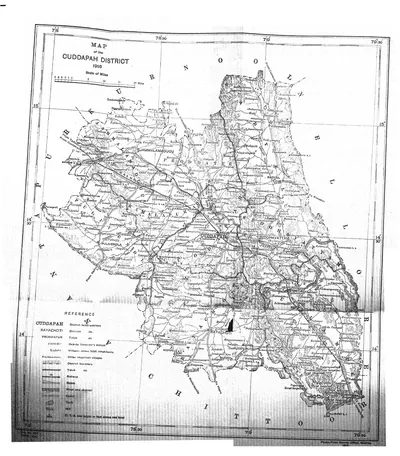 "Map of the Cuddapah District 1915" (Brackenbury 1915, folding map, PDF p. 1)Map · 1915
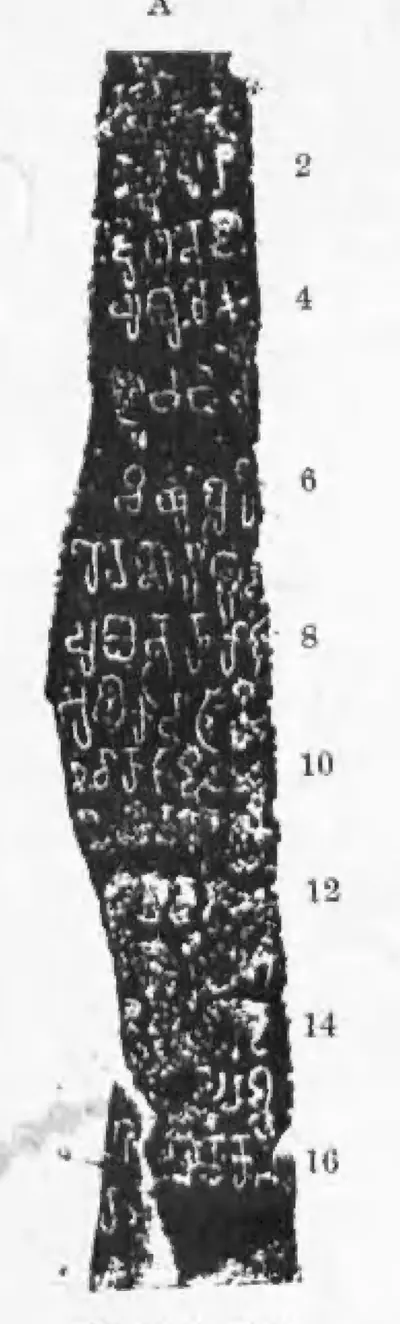 "Telugu Chola Records from Anantapur and Cuddapah (I)", A: the Kalamalla inscription of Erikal-Muturaju Dhananjaya (Epigraphia Indica XXVII, Plate (I) between pp. 228 and 229, panel A (PDF p. 316, printed sideways))Inscription rubbing · 1956
References
Notes (0)
Sources (3)
Spotted an error on this page? Tell us
Last updated: