Erragudipadu inscription of Erikal-Mutturaju
An early Telugu stone record beside the Chennakesava temple at Erragudipadu in the Kamalapuram country. Its letters are almost the same as those of the Kalamalla pillar, and its editors dated it to the last quarter of the 6th century or a little later. It records a tax-free grant of 24 measures of land to a Brahmana in the reign of an Erikal-Mutturaju. The witnesses included a Mutturaju called Navapriya and a 'Vallava Dukaraju', perhaps a Pallava crown prince.
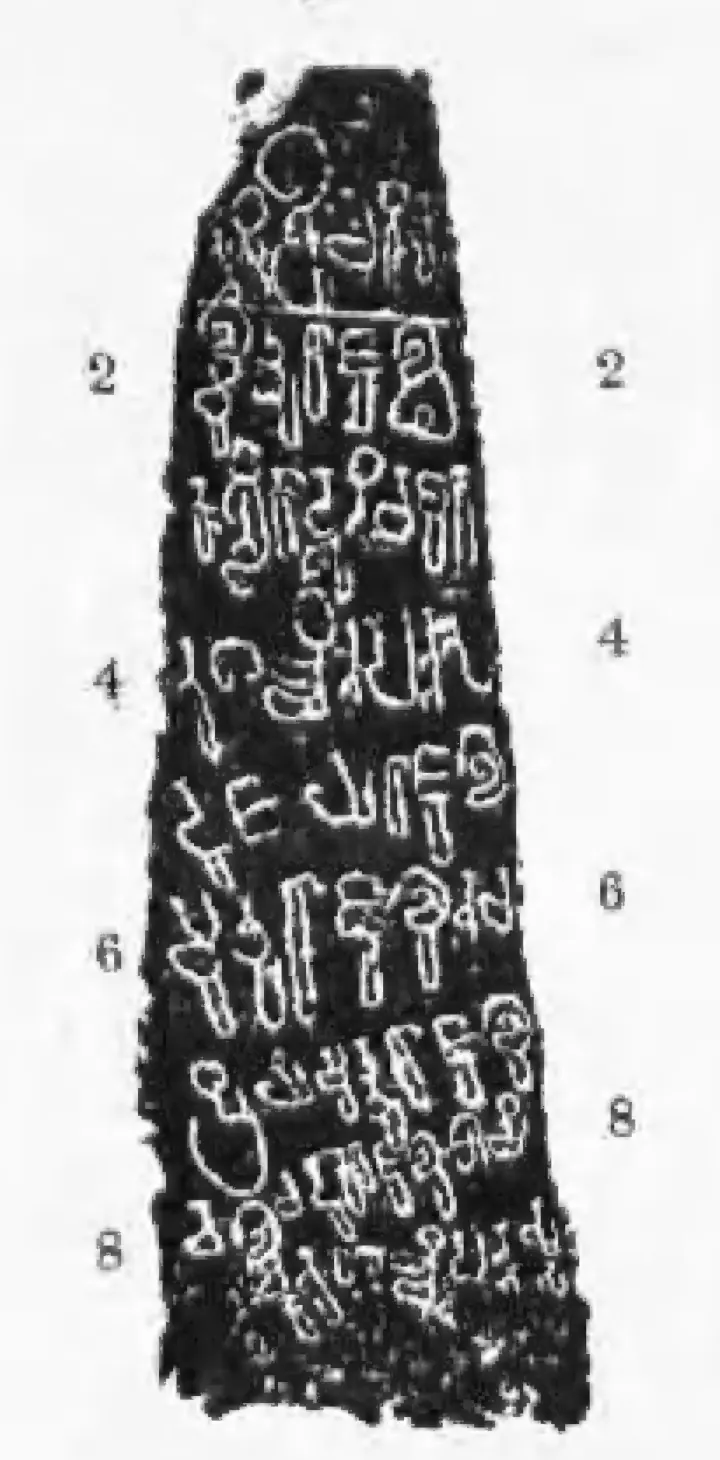
This stone at Erragudipadu records a grant of land to a Brahmana in the reign of an Erikal-Mutturaju.1 Its editors assigned it to the last quarter of the 6th century or a little later.2 With the Kalamalla pillar, it is among the earliest records written in Telugu in the Telugu Chola country.2
The stone and its letters
The inscription is cut in bold, large letters on two sides of a stone.2 The stone stands to the right of the Chennakesava temple at Erragudipadu, in the Kamalapuram taluk (sub-district) of the Kadapa (then Cuddapah) district.2 K. A. Nilakanta Sastri and M. Venkataramayya edited it in 1956.2
They found that its letters are like those of the Kalamalla pillar in almost every detail, though written in a more running hand.2 They assigned it to the last quarter of the 6th century or a little later.2 They pointed out that a letter written below another keeps its full form.2 This is a feature of the early Telugu-Kannada script.2
Contents
The record registers a grant of a pannasa of 24 marunturu of land in the kottam (territorial division) to a Brahmana.1 It was made in the reign of an Erikal-Mutturaju, at the request of, or by, one Kundikallu.1 The witnesses were Dujayarajula Mutturajulu, Navapriya Mutturajulu and Vallava Dukarajulu.1
The amount of land is written in words, as four preceded by twenty.3 The editors compared this way of writing two-digit numbers with other early records.3
The words of the grant
The editors discussed several words.3 Pannasa is often taken to mean “fifty”, but it cannot mean that here, since the land given is 24 units.3 They thought it a kind of tenure linked with a tax.3 They took it as the Telugu counterpart of the Tamil word for tax-free land.3
Kottambu means a settlement or territorial division.31 They derived it from Sanskrit goshtha, a settlement of cowherds.31 Sakshi means witness.31
They showed that the forms Dukaraju, Tugaraju and Dugaraju are Telugu forms of yuvaraja, heir-apparent.3 They compared the Eastern Chalukya prince Mangi Yuvaraja, who is also called Mangi Dogaraju.3
Who is named
The editors could not say for certain that this Erikal-Mutturaju is Dhananjaya of the Kalamalla pillar.1 But the letters and the place where the stone was found make it plausible.1 They suggested that Dujayaraju stands for Durjayaraju.1 They recalled that the Kakatiyas and other later Telugu dynasties claimed descent from a Durjaya.1
They took Navapriya Mutturaju to be Mahendravikrama, Dhananjaya’s son.1 They took Vallava Dukaraju to be a crown prince of the Pallavas of Kanchi in the time of Simhavishnu.1 But they allowed that Vallava might stand for Vallabha, a name of the Chalukyas.1 If the Pallava reading is right, the record links the Telugu Cholas with the Pallavas in the late 6th century, as subordinates or as allies.1
Significance
The editors dated the Kalamalla pillar to the same period.2 With that pillar, this is among the earliest records written in Telugu in the Telugu Chola country, in the Kamalapuram taluk of Kadapa.2 The village is not the Erragudi of the Asoka edicts.
Footnotes
-
Nilakanta Sastri and Venkataramayya, “Telugu Chola Records” (1956), p. 227 and notes (archive.org (opens in a new tab)). Paraphrased. ↩ ↩2 ↩3 ↩4 ↩5 ↩6 ↩7 ↩8 ↩9 ↩10 ↩11 ↩12 ↩13 ↩14 ↩15
-
K. A. Nilakanta Sastri and M. Venkataramayya, “Telugu Chola Records from Anantapur and Cuddapah”, Epigraphia Indica XXVII (1956), p. 225 (archive.org (opens in a new tab)). Paraphrased. ↩ ↩2 ↩3 ↩4 ↩5 ↩6 ↩7 ↩8 ↩9 ↩10 ↩11
-
Nilakanta Sastri and Venkataramayya, “Telugu Chola Records” (1956), p. 226 (archive.org (opens in a new tab)). Paraphrased. ↩ ↩2 ↩3 ↩4 ↩5 ↩6 ↩7 ↩8 ↩9 ↩10 ↩11
Photos
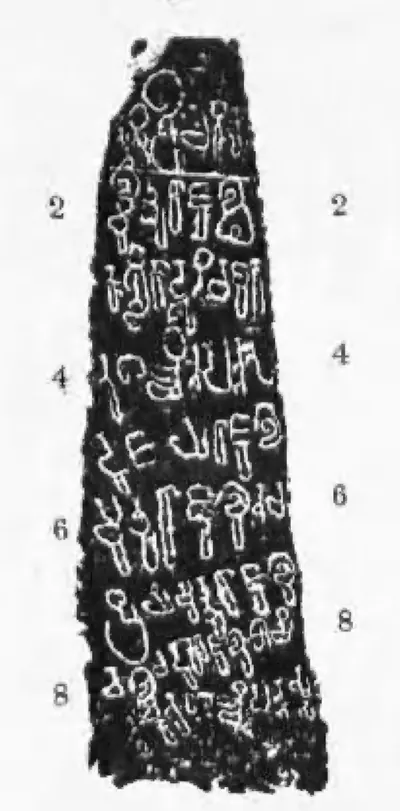 "Telugu Chola Records from Anantapur and Cuddapah (I)", B: the Erragudipadu inscription of Erikal-Mutturaju, first side (lines 1-8) (Epigraphia Indica XXVII, Plate (I) between pp. 228 and 229, panel B upper (PDF p. 316))Historic photograph · 1956
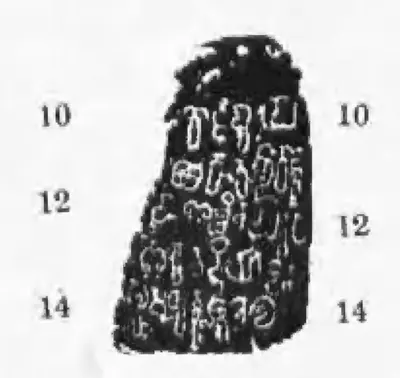 "Telugu Chola Records from Anantapur and Cuddapah (I)", B: the Erragudipadu inscription of Erikal-Mutturaju, second side (lines 10-14) (Epigraphia Indica XXVII, Plate (I) between pp. 228 and 229, panel B lower (PDF p. 316))Historic photograph · 1956
References
Notes (0)
Sources (1)
Spotted an error on this page? Tell us
Last updated: