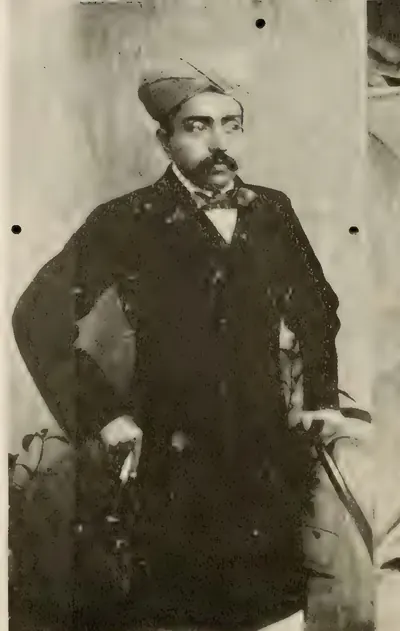
Fazl-i-Ali Khan of Banganapalle
Saiyid Fazl-i-Ali Khan, born on 9 November 1901, was the last ruling Nawab of Banganapalle. He succeeded his father, Ghulam Ali Khan, in 1922. In 1934 he had a salute of 9 guns and a seat in the Chamber of Princes. The 1961 Census handbook says that after differences with his Diwan and the British Resident he gave up his powers over law and order, and that near the end of British rule he received the title of His Highness with 11 guns. He came back to the State in June 1947, announced a State council, and signed the agreement to merge Banganapalle with the Madras Province on 18 February 1948. He died suddenly on 1 July 1948.
Download
Saiyid Fazl-i-Ali Khan was the last ruling Nawab of Banganapalle.1 He ruled from 1922 until the State joined the Madras Province in February 1948.23 He died a few months later.1 See the Banganapalle State.
Succession
The Memoranda on the Indian States (1934) give his name as “Nawab Saiyid Fazl-i-Ali Khan Bahadur”.2 They say that he was born on 9 November 1901 and that he succeeded on 22 January 1922.2 He was the eldest son of the Nawab Ghulam Ali Khan.4 See Ghulam Ali Khan III.
In 1934, the Memoranda say, he had a permanent salute of 9 guns and was a member of the Chamber of Princes (the council of the ruling princes).4 His position gave him the right to be received by the Viceroy.4 A son was born to him on 12 October 1925 and a daughter on 31 August 1927.4 The Memoranda give the State’s area as 275 square miles and its average yearly revenue as 4,58,000 rupees.2
His rule
The District Census Handbook of Kurnool (1961, printed 1964) calls him “a generous and an enlightened ruler”.1 It says that the trade and industry begun in his father’s time grew in his reign.1
But the Nawab, his Diwan (chief minister) and the British Resident disagreed about the government of the State.1 In the end, the handbook says, the Nawab was persuaded to give up his powers over law and order.1 The British Government then ran the State through its Resident at Mysore.1 In these years the State’s departments were rebuilt on the pattern of British India.1
Shortly before British rule ended, the Nawab received the title of “His Highness” with a salute of eleven guns.1
The end of the State, 1947–1948
The Nawab came back to the State on 26 June 1947.1 The handbook says that he was met with cheers and rejoicing.1 On 1 July 1947, at a durbar (court ceremony) at Banganapalle, he announced a State council and a new constitution.1 It was meant to give the people a large share in the government.1
After India became free, he signed an agreement to merge the State on 18 February 1948.31 The handbook says he was the first ruler in South India to do so.1 The White Paper on Indian States (1950) says that the government of the Madras Province took over the State on 23 February 1948.3 Banganapalle became a separate sub-taluk of the Kurnool district.1 See Kurnool.
Death
Fazl-i-Ali Khan died suddenly of heart failure on 1 July 1948, while still young.1 The Government of India recognised his only son, Mir Ghulam Ali Khan, as his successor.1
Where the sources disagree
The sources differ on the date of his succession. The Memoranda say that his father died on 22 January 1922 and that he succeeded then.24 The Census handbook dates his father’s death to July 1922.1
Footnotes
-
A. Chandra Sekhar, Census of India 1961, Andhra Pradesh: District Census Handbook, Kurnool District (1964), p. xxxii (PDF p. 53) (censusindia.gov.in (opens in a new tab)). Paraphrased (Public domain in India). ↩ ↩2 ↩3 ↩4 ↩5 ↩6 ↩7 ↩8 ↩9 ↩10 ↩11 ↩12 ↩13 ↩14 ↩15 ↩16 ↩17 ↩18 ↩19
-
Memoranda on the Indian States, 1934 (Delhi, 1934), p. 138, Madras States Agency (archive.org (opens in a new tab)). ↩ ↩2 ↩3 ↩4 ↩5
-
Ministry of States, White Paper on Indian States (revised ed., 1950), p. 44, para. 107 (archive.org (opens in a new tab)). Paraphrased (Public domain in India). ↩ ↩2 ↩3
-
Memoranda on the Indian States, 1934 (Delhi, 1934), p. 139, “Banganapalle” (archive.org (opens in a new tab)). ↩ ↩2 ↩3 ↩4 ↩5
Related
Dynasties
References
Notes (0)
Sources (3)
Spotted an error on this page? Tell us
Last updated: