Lyman Jewett
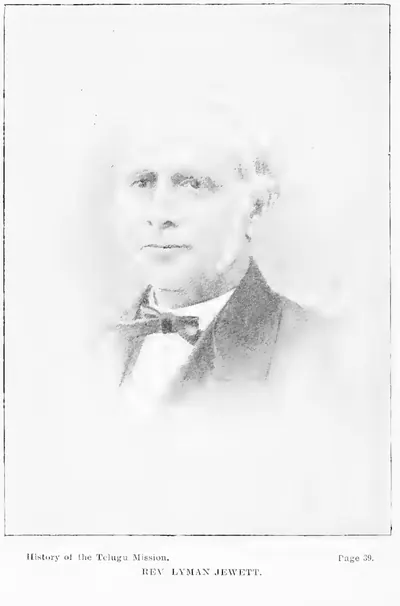
Lyman Jewett was the American Baptist missionary who kept the Telugu mission alive when its society thought of closing it. He prayed with Indian Christians on the hill above Ongole on New Year's Day 1854, refused in 1862 to give up the mission, and in 1866 baptised Yerraguntla Periah, the first Madiga convert. He later worked on Telugu Bible revision at Madras.
Download
Lyman Jewett was a missionary of the American Baptists at Nellore. He is remembered for refusing to let his society close its Telugu mission.12 See How the missions came.
The “Lone Star”
In 1853, after seventeen years with few converts, the society’s leaders proposed that Jewett close the mission and go to Burma.34 He wrote that he would rather work on among the Telugus as long as he lived.5 Hibbert-Ware tells that the board joked it must “send a man to give you a Christian burial”.6
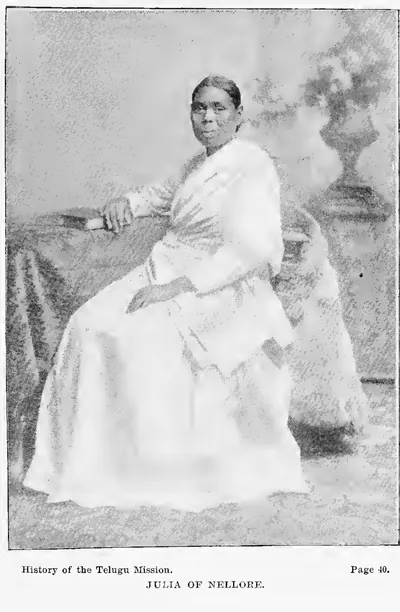
At the end of 1853 Jewett and his wife toured north to Ongole and preached in the streets for several days.5 On 1 January 1854, before sunrise, they prayed on the hill above Ongole with three Indian Christians, Christian Nursu, Julia and Ruth.57 Julia later recalled that Jewett pointed to a nearby piece of land and said it would one day hold a mission house.7
1862 and after
In 1862 the society again talked of closing the mission. Jewett told its committee that if it would not help, he would go back alone, “and, if need be, die among the Telugus”.1 He returned in 1865 with John E. Clough.8
In March 1866 Jewett baptised the first Madiga convert, Yerraguntla Periah, and his wife near Ongole.910 He called the moment one of the happiest of his life.9 Writing of the Ongole movement, he asked: “Has not God put honor on native agency?”11
From October 1878 he opened a mission station at Madras for its Telugu people, while working on the revision and translation of the Telugu Scriptures.12
Footnotes
-
Downie, The Lone Star (1893), p. 60 (archive.org (opens in a new tab)). ↩ ↩2
-
G. Hibbert-Ware, Christian Missions in the Telugu Country (1912), p. 201 (archive.org (opens in a new tab)). ↩
-
David Downie, The Lone Star: The History of the Telugu Mission of the American Baptist Missionary Union (1893), p. 45 (archive.org (opens in a new tab)). ↩
-
Downie, The Lone Star (1893), p. 46 (archive.org (opens in a new tab)). ↩
-
Downie, The Lone Star (1893), p. 48 (archive.org (opens in a new tab)). ↩ ↩2 ↩3
-
Hibbert-Ware, Christian Missions in the Telugu Country (1912), p. 202 (archive.org (opens in a new tab)). ↩
-
Downie, The Lone Star (1893), p. 49 (archive.org (opens in a new tab)). ↩ ↩2
-
Downie, The Lone Star (1893), p. 61 (archive.org (opens in a new tab)). ↩
-
Downie, The Lone Star (1893), p. 62 (archive.org (opens in a new tab)). ↩ ↩2
-
Downie, The Lone Star (1893), p. 63 (archive.org (opens in a new tab)). ↩
-
Downie, The Lone Star (1893), p. 64 (archive.org (opens in a new tab)). ↩
-
Mrs Lyman Jewett, John Rangiah, the First Telugu Foreign Missionary (1913), unnumbered p. [3] (HathiTrust (opens in a new tab)). ↩
Photos
References
Notes (0)
Sources (3)
Spotted an error on this page? Tell us
Last updated: