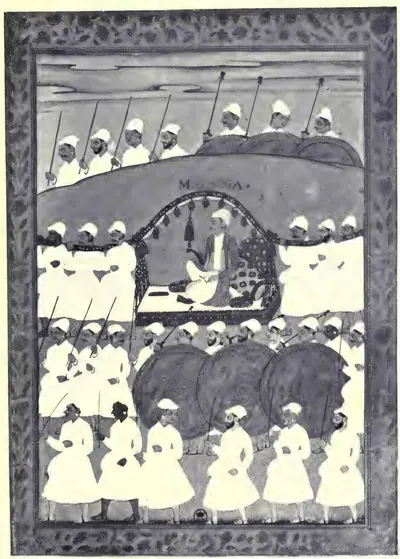
Madanna
Telugu Brahmin who became chief minister (wazir) of Abul Hasan, the last Qutb Shahi sultan of Golconda, about 1673, with the title Surya Prakash Rao. With his brother Akkanna he ran the kingdom for some twelve years. He allied it with the Marathas against the Mughals and kept an office at Bezwada. Aurangzeb made the employment of the two Brahmin brothers a charge against the king. They were murdered at Golconda in March 1686.
Madanna was the chief minister of Abul Hasan Tana Shah, the last king of the Qutb Shahi dynasty of Golconda.12 He held the post from about 1673 until his murder in 1686.12 He and his brother Akkanna were Brahmins.12 Their power at the Muslim court of Golconda was one of the charges that the Mughal emperor Aurangzeb used to justify his conquest of the kingdom.12
The Kistna district manual of 1883 says the two brothers, “both Brahmans, named Akanna and Madanna Pantulu”, managed the king’s affairs “with much ability and left an enduring reputation”.3
Origins
The Dutch writer Havart says that Madanna and Akkanna were born “of a very poor family”.4 Havart’s account was published in 1693, and Jadunath Sarkar quoted it in 1930.4 It says that in 1666 the brothers became shroffs (money-changers and accountants) “on a pay of 10 gilders per mensem under Sayyid Mustafa, a nobleman of Golkonda”.4 They rose by what seemed an act of treachery, which cost their master his office.4
Bilgrami, writing in 1927, says that they “were Brahmins of the Carnatic”.5 He says that some historians made their father the kulkarni (village accountant) of Maisaram.5 Sarkar adds that they were Vaishnavas.6 Haig, in 1907, called the second brother “Yenkanna”.7
Brahmins already held offices in the government under Abdullah Qutb Shah.8910 Jean de Thevenot travelled through the kingdom in 1666.8910 He found Brahmins collecting the road tolls and managing the nobles’ lands for them.8910 He wrote that the king trusted “the Bramens” next to his mother.8910
Chief minister
Abdullah died in 1672.1112 Madanna was then the peshkar (deputy) of Sayyid Muzaffar, a general of Persian descent.1112 He was among the courtiers who placed Abul Hasan on the throne.1112
Sarkar says that Abul Hasan resented the new minister Muzaffar’s hold on power.1 So he “bought over Madanna, the Brahman factotum of Muzaffar”, and through him won over Muzaffar’s captains.1 The post of wazir was taken from Muzaffar and “conferred on Madanna, with the title of Surya Prakash Rao”.1 This happened about 1673.1 Akkanna became commander-in-chief.1 Their nephew Yengana, “the gallant and learned” Rustam Rao, received a high command.1
Havart had often seen Madanna.46 He described him as an intelligent man who “was well versed in Persian, Hindustani and the vernaculars of the country, and lived in a kingly style”.46 He went about in a golden palanquin, while the Sultan “left everything to his care”.46
Sarkar quotes a letter of 1676 from the English at Madras.13 They complained that “Madanna has sole control, and nothing is thought of but peeling and squeezing the people”.13 The Kistna manual found orders in the old records of Fort St. George to the Company’s agent at Golconda.14 He was to give “substantial gifts” to the two brothers “to preserve their favour to the Honourable Company”.14
Bezwada and the legends
The two ministers kept their office at Vijayawada (then Bezwada), on the Krishna.315 The Kistna manual records that Streynsham Master guessed in 1679 that this was to keep the government out of the reach of the Mughals.315 Popular tradition put it down to the brothers’ devotion to the goddess Kanaka Durga.315
The manual adds that beggars still pointed out the place where “the beneficent ministers distributed food every day to a crowd of applicants of all castes”.315 A legend told of a tunnel from the caves of the hill to Hyderabad.315 By it, the brothers went to court and back in a day.315
Bilgrami describes a temple inside Golconda fort known as the Madanna temple.5 He thought it older than the Qutb Shahis, and named after the minister.5 He says the brothers had built a temple near Anantagiri.5 See Vijayawada and Golconda Fort.
Policy towards the Mughals and the Marathas
Sarkar wrote that the Qutb Shahs had long “professed lip-obedience to the Emperor of Delhi, but secretly helped Adil Shah with money”.1316 Madanna carried on this policy with one change.1316 Bijapur was in chaos, so “Madanna, therefore, built his hopes of national defence chiefly on a close alliance with the ever-victorious Maratha king”.1316
In 1677 Shivaji was given “a more than royal welcome” at Hyderabad.16 He was promised a yearly payment of one lakh of huns (gold coins) for the defence of Golconda.16 The alliance went on with his son Sambhaji.16
Aurangzeb wrote to his envoy at Golconda that the king had given “the supreme power in his State to a kafir” (unbeliever).1718 Later he charged the king with “placing the reins of authority and government in the hands of vile tyrannical infidels”.1718 He meant Madanna and Akkanna.1718
The war of 1685 and the murder
The Mughal army under Prince Shah Alam invaded in 1685.19 The Golconda forces included “10,000 fresh horsemen of Madanna’s own contingent”.19
The commander-in-chief Muhammad Ibrahim, whom Sarkar calls Madanna’s protégé, deserted to the Mughals.2021 The general Shaikh Minhaj then told the king that the minister himself would be the next to go over.2021 Madanna advised Abul Hasan not to shut himself up in Golconda, but to go to Warangal or some other distant fort.2021 The advice only made the king more suspicious, and he fled to Golconda.2021
Khafi Khan, the Mughal historian, says that “Mádaná Pant and his friends” had first turned the king against Muhammad Ibrahim.2223 Haig puts the blame on the king’s “Brahman advisers”.2223
Shah Alam offered peace terms in October 1685.2425 They required the dismissal of Madanna and Akkanna.2425 Abul Hasan delayed their dismissal.26
Sarkar says that a plot was then formed against Madanna.26 It was led by unhappy Muslim nobles under Shaikh Minhaj, and by Saruma and Jani Sahiba, widows of Abdullah Qutb Shah.26 Sarkar writes that “one night, early in March, 1686, just after Madanna had left his master’s presence, he was set upon and murdered in the streets of Golkonda by Jamshid and other slaves”.26
Akkanna was killed with him, and Rustam Rao was stabbed in his house.27 The brothers’ houses were plundered.27 The mob attacked the Hindu quarter of the fort, where “many other Brahmans lost their lives and property in that night”.27 The dowager queen sent the heads of the two ministers to Aurangzeb.27 Sha Rocco, in 1929, gives the same date.28
How the murder was told
The sources do not agree on who ordered the killing.254 Khafi Khan says that “some women of great influence in the harem, without the knowledge of Abu-l Hasan, laid a plot for the murder”.254 Sarkar notes that Bhimsen, who was in Shah Alam’s camp, agrees with him.254 Haig says that two of Abdullah’s widows had the brothers killed “without consulting the king”.7
The Mughal court history of Aurangzeb’s reign tells it differently.4 It says that Abul Hasan himself cut off Madanna’s head and sent it to Shah Alam “as a proof of his own submission”.4 Another Mughal writer, Ishwardas, adds that Madanna cried out as he died.4 He said that the king would not sit on his throne “for more than six months after this”.4
Havart says the people accused Madanna of high treason.6 He says that “under orders from the Sultan they murdered the two brothers in a most ignominious way”, dragging them through the streets.6 Madanna’s head was sent to Aurangzeb, and Akkanna’s was “trampled under the feet of an elephant”.6
Sarkar’s own judgement was harsh.629 “It is surprising,” he wrote, “that though Madanna had held the supreme place in the State for years, not a hand was raised to defend his family or punish his assassins”.629 He concluded that “the great minister fell undefended, unavenged and unhonoured”.629 The Kistna manual, two generations earlier, had found the two ministers still remembered with respect in the Krishna country.3
The nephews
Two nephews of the brothers appear in the sources.27 Rustam Rao was killed with them.27 Khafi Khan called him “a renowned master of the pen and the sword alike”.27
The Kistna manual and Sarkar make another nephew, Kancherla Gopanna, the Ramadas of Telugu devotional song.15630 He was revenue officer at Bhadrachalam.15630 The Godavari district gazetteer of 1907 instead places Ramadas about 1725, as an official of the Nizam.15630 See Kancherla Gopanna.
Footnotes
-
Jadunath Sarkar, History of Aurangzib, Vol. IV (2nd ed., 1930), p. 399 (archive.org (opens in a new tab)). ↩ ↩2 ↩3 ↩4 ↩5 ↩6 ↩7 ↩8 ↩9 ↩10
-
Sarkar, History of Aurangzib, Vol. IV (1930), pp. 406–407 (archive.org (opens in a new tab)). ↩ ↩2 ↩3 ↩4
-
Gordon Mackenzie, A Manual of the Kistna District (1883), p. 36 (archive.org (opens in a new tab)). ↩ ↩2 ↩3 ↩4 ↩5 ↩6 ↩7 ↩8
-
Sarkar, History of Aurangzib, Vol. IV (1930), p. 420, appendix “Madanna, prime minister of Golkonda” (archive.org (opens in a new tab)). ↩ ↩2 ↩3 ↩4 ↩5 ↩6 ↩7 ↩8 ↩9 ↩10 ↩11 ↩12 ↩13 ↩14
-
Bilgrami, Landmarks of the Deccan (1927), p. 109 and note (archive.org (opens in a new tab)). ↩ ↩2 ↩3 ↩4 ↩5
-
Sarkar, History of Aurangzib, Vol. IV (1930), p. 421 (archive.org (opens in a new tab)). ↩ ↩2 ↩3 ↩4 ↩5 ↩6 ↩7 ↩8 ↩9 ↩10 ↩11 ↩12 ↩13
-
Haig, Historic Landmarks of the Deccan (1907), p. 188 (archive.org (opens in a new tab)). ↩ ↩2
-
Jean de Thevenot, The Travels of Monsieur de Thevenot into the Levant, Part III (English tr., 1687), p. 94 (archive.org (opens in a new tab)). ↩ ↩2 ↩3 ↩4
-
Thevenot, Travels into the Levant, Part III (1687), p. 101 (archive.org (opens in a new tab)). ↩ ↩2 ↩3 ↩4
-
Thevenot, Travels into the Levant, Part III (1687), p. 102 (archive.org (opens in a new tab)). ↩ ↩2 ↩3 ↩4
-
Syed Ali Asgar Bilgrami, Landmarks of the Deccan (1927), p. 77 (archive.org (opens in a new tab)). ↩ ↩2 ↩3
-
Bilgrami, Landmarks of the Deccan (1927), pp. 202–203 (archive.org (opens in a new tab)). ↩ ↩2 ↩3
-
Sarkar, History of Aurangzib, Vol. IV (1930), p. 400 (archive.org (opens in a new tab)). ↩ ↩2 ↩3 ↩4 ↩5
-
Mackenzie, Kistna District (1883), p. 38 (archive.org (opens in a new tab)). ↩ ↩2
-
Mackenzie, Kistna District (1883), p. 37 (archive.org (opens in a new tab)). ↩ ↩2 ↩3 ↩4 ↩5 ↩6 ↩7 ↩8 ↩9
-
Sarkar, History of Aurangzib, Vol. IV (1930), p. 401 (archive.org (opens in a new tab)). ↩ ↩2 ↩3 ↩4 ↩5 ↩6
-
Sarkar, History of Aurangzib, Vol. IV (1930), p. 407 note (archive.org (opens in a new tab)). ↩ ↩2 ↩3
-
Khafi Khan, in Elliot and Dowson, History of India, Vol. VII (1877), p. 325 (archive.org (opens in a new tab)). ↩ ↩2 ↩3
-
Sarkar, History of Aurangzib, Vol. IV (1930), p. 410 (archive.org (opens in a new tab)). ↩ ↩2
-
Sarkar, History of Aurangzib, Vol. IV (1930), p. 412 (archive.org (opens in a new tab)). ↩ ↩2 ↩3 ↩4
-
Sarkar, History of Aurangzib, Vol. IV (1930), p. 413 (archive.org (opens in a new tab)). ↩ ↩2 ↩3 ↩4
-
Khafi Khan, Muntakhab-ul-Lubab, in H. M. Elliot and John Dowson (eds.), The History of India as Told by Its Own Historians, Vol. VII (1877), p. 319 (archive.org (opens in a new tab)). ↩ ↩2
-
T. W. Haig, Historic Landmarks of the Deccan (1907), p. 187 (archive.org (opens in a new tab)). ↩ ↩2
-
Sarkar, History of Aurangzib, Vol. IV (1930), p. 416 (archive.org (opens in a new tab)). ↩ ↩2
-
Khafi Khan, in Elliot and Dowson, History of India, Vol. VII (1877), p. 321 (archive.org (opens in a new tab)). ↩ ↩2 ↩3 ↩4 ↩5
-
Sarkar, History of Aurangzib, Vol. IV (1930), p. 417 (archive.org (opens in a new tab)). ↩ ↩2 ↩3 ↩4
-
Sarkar, History of Aurangzib, Vol. IV (1930), p. 418 (archive.org (opens in a new tab)). ↩ ↩2 ↩3 ↩4 ↩5 ↩6 ↩7
-
Sha Rocco, Golconda and the Qutb Shahs (1929), p. 35 (archive.org (opens in a new tab)). ↩
-
Sarkar, History of Aurangzib, Vol. IV (1930), p. 422 (archive.org (opens in a new tab)). ↩ ↩2 ↩3
-
F. R. Hemingway, Madras District Gazetteers: Godavari, Vol. I (1907), p. 261 (archive.org (opens in a new tab)). ↩ ↩2 ↩3
Photos
References
Notes (0)
Sources (8)
Spotted an error on this page? Tell us
Last updated: