Rajendra Choda I (Kona)
Rajendra Choda I, surnamed Vikrama-Rudra, was a Haihaya chief of Konamandala, the Godavari delta, in the early 12th century. He was a grandson of the family's founder Mummadi-Bhima I, and the father of the later chief Mallideva. He made a grant in 1128 and built a pillared hall in the Bhimanatha temple at Draksharama. After his death his two brothers ruled the Kona country together, and his own sons had to wait.
Download
Rajendra Choda I was a chief of the Haihayas of Kona, the family that ruled Konamandala, the Godavari delta, under greater kings.1 He made a grant in 1128, and is the first member of the family whose own record E. Hultzsch could list.12 He matters as the father of Mallideva, and because after his death the family began its custom of rule by two chiefs at once.13
Family
The Pithapuram inscription of 1195 gives the family tree.4 Rajendra Choda I was a son of Rajaparendu I, lord of Konamandala, and a grandson of the founder, Mummadi-Bhima I.41 The founder is said to have received the signs of royal power from the emperor Rajendra-Choda, whom Hultzsch identified with Kulottunga I.5 So Hultzsch thought that Rajendra Choda I “was evidently named after the patron of his grandfather”.1
His brothers were Mummadi-Bhima II, who was older, and Satya I, a son of another mother.41 With his queen Mallaradevi he had two sons named in the table, Beta and Mallideva.4 V. Yashoda Devi, in a thesis printed in 1993, wrote that he had five sons in all.3
Titles and the hall at Draksharama
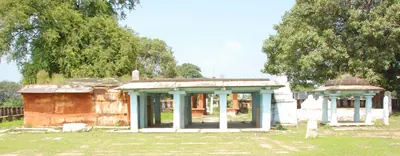
Rajendra Choda I bore the titles Vikrama-Rudra, Haihayaditya and Gandavendaduva.1 He built a mandapa (pillared hall) in the Bhimanatha temple at Draksharama.1 He named it Gandavendaduva, after one of his titles.1
The grant of 1128
The earliest of the family’s stone inscriptions at Draksharama and Palakollu records a grant made in Saka 1050, about 1128 (Saka is an Indian way of counting years).1 The donor is Choda, surnamed Vikrama-Rudra, son of Rajaparendu of the Haihaya family.1 He calls himself lord of the Kona country and “the ornament (of the city) of Mahishmati”, the old Haihaya capital.1 Hultzsch identified him with Rajendra Choda I.1 The Annual Report on Epigraphy for 1932–33 still treated this as the earliest record in Hultzsch’s list.2
Between Chalukyas and Cholas
The Western Chalukya king Vikramaditya VI died in 1126.3 Yashoda Devi thought that Rajendra Choda I then helped the Cholas fight the generals of the new Chalukya king, Somesvara III, in Vengi.3 In her account he had won some successes by 1128, like the Velanati chiefs and other small rulers of the region.3 She noted that his very name showed loyalty to the Chola house.3
After his death
After Rajendra Choda I died, his two brothers ruled together.1 Yashoda Devi noted that his own sons were set aside in favour of his brothers.3 His son Mallideva became a joint ruler only in the next generations, first with Vallabha and then with Manma-Satya II.1 See Mummadi-Bhima II and Satya I.
Where the sources disagree
- When did the family receive Konamandala? Robert Sewell’s table (1932) says that the founder received the country from the Eastern Chalukya Rajendra II about 1063.6 Yashoda Devi rejected an early date, noting that Rajendra II need not have made the gift in 1063, the year he came to the throne of Vengi.7 She placed it between 1073 and 1082, when he was already the emperor Kulottunga I.7
- How many sons? Hultzsch’s table names two sons, Beta and Mallideva.4 Yashoda Devi wrote of five sons, of whom Beta and Mallideva were the first two.3
Footnotes
-
Hultzsch, “Pithapuram Inscription of Mallideva” (1897), p. 86 (archive.org (opens in a new tab)). ↩ ↩2 ↩3 ↩4 ↩5 ↩6 ↩7 ↩8 ↩9 ↩10 ↩11 ↩12 ↩13 ↩14 ↩15
-
Annual Report on South-Indian Epigraphy for 1932–33 (1936), Part II, para. 10, p. 57 (archive.org (opens in a new tab)). ↩ ↩2
-
Yashoda Devi, History of Andhra Country (1993), p. 80 (archive.org (opens in a new tab)). Cite-only; paraphrased. ↩ ↩2 ↩3 ↩4 ↩5 ↩6 ↩7 ↩8
-
Hultzsch, “Pithapuram Inscription of Mallideva” (1897), p. 85, table “The Chiefs of Konamandala” (archive.org (opens in a new tab)). ↩ ↩2 ↩3 ↩4 ↩5
-
E. Hultzsch, “Pithapuram Inscription of Mallideva and Manma-Satya II; Saka-Samvat 1117”, Epigraphia Indica IV (1897), p. 84 (archive.org (opens in a new tab)). ↩
-
Robert Sewell, The Historical Inscriptions of Southern India (1932), p. 361, “Kona or Konamandala Chiefs” (archive.org (opens in a new tab)). Paraphrased. ↩
-
V. Yashoda Devi, The History of Andhra Country, 1000 A.D.–1500 A.D. (1993), p. 77 (archive.org (opens in a new tab)). Cite-only; paraphrased. ↩ ↩2
Related
Dynasties
References
Notes (0)
Sources (4)
Spotted an error on this page? Tell us
Last updated: