Kulottunga I
Eastern Chalukya prince of Vengi, son of Rajaraja Narendra and the Chola princess Ammangadevi. As Rajendra (Rajendra-Choda, Rajendra II) he was heir to Vengi in 1063. In 1070 he seized the Chola throne, and he reigned as Kulottunga Chola I until about 1118. He united the Eastern Chalukya and Chola crowns, and governed Vengi first through his uncle Vijayaditya VII and then through his own sons as viceroys.
Kulottunga I was born an Eastern Chalukya prince of Vengi and died a Chola emperor. As Rajendra, son of the king of Vengi, he was the rightful heir to the Eastern Chalukya throne in 1063.123 In 1070 he took the throne of the Cholas, and he reigned as Kulottunga Chola I for about half a century.123 This page deals mainly with his place in the history of Vengi.
Family and names
Kulottunga I was the son of Rajaraja Narendra and his queen Ammangadevi, the daughter of the Chola king Rajendra-Choda.45 Robert Sewell observed that he was three-quarters Chola by blood, since both his father and his grandfather had married Chola princesses.1 J. F. Fleet concluded that because of these marriages the family was from now on “plainly Cholas at heart, far more than Chalukyas”.6
His first name was Rajendra-Choda.74 The Chellur plates of his son say that he received the name Kulottunga-deva when he was anointed to the Chola kingdom.74 They also call him Raja-Narayana.74 In Bilhana’s Sanskrit poem Vikramankadevacharita he appears as Rajiga, which Fleet took to be a familiar form of Rajendra.78 His Eastern Chalukya title Saptama Vishnuvardhana, “the seventh Vishnuvardhana”, appears in an inscription of 1077 in the Guntur district.93
Kulottunga I married Madhurantaki, the daughter of Rajendradeva, a Chola king “of the race of the Sun”.47 The Tamil poem Kalingattupparani names his chief queen as Thiyagavalli.10 Fleet could not tell whether she was the same person as Madhurantaki.10
The Chellur plates say that Kulottunga and Madhurantaki had seven sons.4 The Teki plates, by contrast, speak of several queens and several sons.11 His eldest son was Chodaganga, also called Rajaraja. E. Hultzsch corrected his own earlier table from the Teki plates.12 He showed that Vira-Choda had two elder brothers, Chodaganga and Mummadi-Choda.12 He also showed that Vikrama-Choda, the son who succeeded to the Chola throne, was a younger brother of Vira-Choda.12
Vikrama-Choda, who succeeded him on the Chola throne, was a son of Kulottunga I.81213 The sources differ on his place among the sons:81213
- Fleet took him to be the eldest son8
- Hultzsch, from the Teki plates, made him a younger brother of Vira-Choda12
- Sewell called him the fourth son13
Rajasundari was a daughter of Kulottunga I in Sewell’s account, the mother of the Kalinga king Anantavarman-Chodaganga, who was crowned in 1078.14 Fleet thought it probable that she was Kulottunga’s daughter and the wife of the Ganga king Rajaraja of Kalinganagara.7 But he was not quite certain of it.7
Heir to Vengi
The Chellur plates say that Rajendra “at first occupied the throne of Vengi”.4 After that he conquered Kerala, Pandya, Kuntala and other countries before he was anointed to the Chola kingdom.4 Fleet counted forward from his father’s coronation and placed his accession in Vengi in 1063.6 Sewell recorded 1063 as the year in which Rajendra II came to the throne of Vengi, or by right should have done.1
What actually happened in Vengi between 1063 and 1070 is disputed. The Godavari district gazetteer says that his uncle Vijayaditya VII pushed him out of the succession.15 Sewell set out two views.16 In Fleet’s view Rajendra won, and later allowed his uncle to serve as viceroy.16 In Hultzsch’s view Vijayaditya ruled Vengi from 1063 to 1070 with the support of the Chola king Virarajendra.16
S. Krishnaswami Aiyangar argued in 1911 that Rajendra was probably brought up in the house of his Chola grandfather.17181920 His earliest inscriptions are found only in the country round Madras.17181920 In Aiyangar’s view he served as a Chola prince, not as ruler of Vengi.17181920 His famous early deeds were won in the north as a Chola heir-apparent.17181920 They were the capture of elephants at Vairagaram, which Aiyangar identified with Wairagarh in the Central Provinces, and the taking of Chakrakottam.17181920
The Chola throne
The sources disagree about how and when he became Chola king.
- Hultzsch (1890) thought that Kulottunga, though at first king of Vengi, seems to have inherited the Chola kingdom from his father-in-law, the Chola king Rajendradeva.21
- Fleet (1891) concluded that he gained the Chola crown “by hostile invasion and conquest”, not simply because the Chola line failed.6228 The Chellur plates say he handed Vengi to his uncle when he wanted the Chola kingdom, and his uncle then governed for fifteen years until 1077.6228 So Fleet placed the annexation in 1063, the first year of his reign.6228 He found support in Bilhana’s poem, in which Rajiga, the lord of Vengi, seizes the throne of Kanchi after the last Chola king loses his life in a rebellion.6228 But he noted that the poem puts the event at least five years too late.6228
- Sewell (1932) fixed his seizure of the Chola throne on 9 June 1070, from two records at Draksharama.2323 In his narrative Virarajendra died, and his son Adhirajendra reigned briefly.2323 Then Rajendra marched south, apparently put the young king to death and took the throne.2323 He was crowned a second time, as Chola king, in 1070.2323
- The Godavari gazetteer (1907) says that he claimed the Chola succession as grandson and adopted son of a former Chola king.15 He killed the new king and fought the Western Chalukya Vikramaditya VI before he made himself king of the Cholas and overlord of Vengi.15
The Pithapuram pillar inscription of 1202 says that Rajendra-Choda ruled the Andhra country together with the five Dravida countries.24 Hultzsch called this a new version of the fact that Kulottunga ruled Vengi and also succeeded to the Chola throne.24
Fleet noted that the Kalingattupparani treats Kulottunga throughout as purely a Chola king.5 It gives him the Chola tiger banner and the Chola solar family line, and never mentions Vengi or the Chalukya boar.5 Only a passage calling him a prince of both the Lunar and the Solar races hints at his descent.5
P. Chenchiah and M. Bhujanga Rao, historians of Telugu literature, wrote that Kulottunga “transferred the capital from Vengi to the south”.25 After that, they wrote, Vengi sank into a province ruled from the south by a deputy.25
Vengi under viceroys
After he took the Chola crown, Kulottunga governed Vengi through others.26 In the Chellur plates of Vira-Choda he says: “Being desirous of the Choda kingdom, I formerly conferred the kingdom of the country of Vengi on my paternal uncle, king Vijayaditya”.26 The uncle ruled for fifteen years.26 Then Kulottunga gave Vengi to his son Rajaraja.26 After a year Rajaraja returned to his parents, because “the kingdom is not such a pleasure as the worship of the illustrious feet of the elders”.26 Then Kulottunga sent Rajaraja’s younger brother, Vira-Choda.26
| Viceroy of Vengi | Dates given |
|---|---|
| Vijayaditya VII, his uncle | 1063–1077 (Fleet); 1063–1076 (Sewell’s table)63 |
| Rajaraja, called Mummadi-Choda in the Teki plates | 1077–1078 (Fleet, Hultzsch); installed 27 July 1076 (Sewell)271228 |
| Vira-Choda | 1078–10841214 |
| Chodaganga, called Rajaraja, the eldest son | 1084–1088/891229 |
| Vira-Choda again | 1088/89 to at least 1092–931230 |
| Vikrama-Choda | until 1118 (Godavari gazetteer)31 |
Walter Elliot, writing in 1885 from his own notes, had already summed up the Chellur grant’s account of these appointments.32 He noted that Vira-Choda was installed in Saka 1001 (Saka is an Indian way of counting years).32 The Godavari gazetteer thought that the constant changes showed that Kulottunga did not much trust his sons’ loyalty.31 Hultzsch suggested a reason why Vira-Choda’s grants are silent about Chodaganga’s governorship.12 In his view Chodaganga had lost his father’s trust.12
Kalinga
Kalinga, north of Vengi, was claimed as a vassal of the Eastern Chalukya crown.335 The ruler of northern Kalinga had failed to bring tribute for two years.335 The Kalingattupparani describes an expedition against him, led by Kulottunga’s general Karunakara of the Pallava family.335
Sewell dated a first war to about 1090, when Vira-Choda was viceroy of Vengi with orders for “conquering the north”.303435 He placed a second, successful expedition under the general Karunakara about 1111–12.303435 It was against the Kalinga king Anantavarman, himself a grandson of Kulottunga; see the Eastern Gangas.303435 The Godavari gazetteer places the conquest of Kalinga some time before 1095–96, and says that Kalinga was feudatory to Vengi.31
The end of the reign
Fleet counted 49 years from 1063 and ended the reign in 1112.36 The Pithapuram pillar inscription gives him 50 years.37 Sewell’s chronology has him reign as Chola king from 1070 to 1118.13383 It records that his son Vikrama-Chola, then viceroy of Vengi, came to the Chola throne on 29 June 1118.13383 Kulottunga may have lived a little longer in retirement.13383
Vengi was lost for a time on his death.133831 The Western Chalukya king Vikramaditya VI is found ruling the Vengi country from December 1118.133831 The local governor, Rajendra-Choda of Velanandu, went over to him.133831 The Godavari gazetteer makes Vikramaditya undisputed king of Vengi from 1120 to 1124.31
Footnotes
-
Robert Sewell and S. Krishnaswami Aiyangar, The Historical Inscriptions of Southern India (1932), p. 77 (archive.org (opens in a new tab)). ↩ ↩2 ↩3 ↩4
-
Sewell and Aiyangar, Historical Inscriptions of Southern India (1932), p. 83 (archive.org (opens in a new tab)). ↩ ↩2 ↩3 ↩4 ↩5 ↩6
-
Sewell and Aiyangar, Historical Inscriptions of Southern India (1932), p. 337 (archive.org (opens in a new tab)). ↩ ↩2 ↩3 ↩4 ↩5 ↩6 ↩7 ↩8 ↩9 ↩10 ↩11
-
Hultzsch, South-Indian Inscriptions, Vol. I (1890), p. 59, translation of the Chellur plates, verses 7–13 (archive.org (opens in a new tab)). ↩ ↩2 ↩3 ↩4 ↩5 ↩6 ↩7 ↩8
-
Fleet, “Chronology of the Eastern Chalukya Kings” (1891), p. 279 (archive.org (opens in a new tab)). ↩ ↩2 ↩3 ↩4 ↩5 ↩6 ↩7
-
Fleet, “Chronology of the Eastern Chalukya Kings” (1891), p. 277 (archive.org (opens in a new tab)). ↩ ↩2 ↩3 ↩4 ↩5 ↩6 ↩7 ↩8
-
Fleet, “Chronology of the Eastern Chalukya Kings” (1891), p. 276 (archive.org (opens in a new tab)). ↩ ↩2 ↩3 ↩4 ↩5 ↩6 ↩7
-
Fleet, “Chronology of the Eastern Chalukya Kings” (1891), p. 282 (archive.org (opens in a new tab)). ↩ ↩2 ↩3 ↩4 ↩5 ↩6 ↩7 ↩8 ↩9
-
Sewell and Aiyangar, Historical Inscriptions of Southern India (1932), p. 86 (archive.org (opens in a new tab)). ↩
-
Fleet, “Chronology of the Eastern Chalukya Kings” (1891), p. 280 (archive.org (opens in a new tab)). ↩ ↩2
-
E. Hultzsch, “Teki Plates of Rajaraja-Chodaganga”, Epigraphia Indica VI (1900–01), p. 334 (archive.org (opens in a new tab)). ↩
-
Hultzsch, “Teki Plates of Rajaraja-Chodaganga” (1901), p. 335 (archive.org (opens in a new tab)). ↩ ↩2 ↩3 ↩4 ↩5 ↩6 ↩7 ↩8 ↩9 ↩10 ↩11 ↩12
-
Sewell and Aiyangar, Historical Inscriptions of Southern India (1932), p. 96 (archive.org (opens in a new tab)). ↩ ↩2 ↩3 ↩4 ↩5 ↩6 ↩7 ↩8 ↩9
-
Sewell and Aiyangar, Historical Inscriptions of Southern India (1932), p. 87 (archive.org (opens in a new tab)). ↩ ↩2
-
F. R. Hemingway, Madras District Gazetteers: Godavari (1907), p. 21 (archive.org (opens in a new tab)). ↩ ↩2 ↩3
-
Sewell and Aiyangar, Historical Inscriptions of Southern India (1932), p. 78 (archive.org (opens in a new tab)). ↩ ↩2 ↩3
-
S. Krishnaswami Aiyangar, Ancient India (1911), p. 125 (archive.org (opens in a new tab)). ↩ ↩2 ↩3 ↩4 ↩5
-
Krishnaswami Aiyangar, Ancient India (1911), p. 128 (archive.org (opens in a new tab)). ↩ ↩2 ↩3 ↩4 ↩5
-
Krishnaswami Aiyangar, Ancient India (1911), pp. 129–130 (archive.org (opens in a new tab)). ↩ ↩2 ↩3 ↩4 ↩5
-
Krishnaswami Aiyangar, Ancient India (1911), p. 131 (archive.org (opens in a new tab)). ↩ ↩2 ↩3 ↩4 ↩5
-
E. Hultzsch, South-Indian Inscriptions, Vol. I (1890), p. 52 (archive.org (opens in a new tab)). ↩
-
Fleet, “Chronology of the Eastern Chalukya Kings” (1891), p. 281 (archive.org (opens in a new tab)). ↩ ↩2 ↩3 ↩4 ↩5
-
Sewell and Aiyangar, Historical Inscriptions of Southern India (1932), p. 82 (archive.org (opens in a new tab)). ↩ ↩2 ↩3 ↩4
-
Hultzsch, “Pithapuram Pillar Inscription” (1897), p. 228 (archive.org (opens in a new tab)). ↩ ↩2
-
P. Chenchiah and Raja M. Bhujanga Rao, A History of Telugu Literature (1928), p. 22 (archive.org (opens in a new tab)). ↩ ↩2
-
Hultzsch, South-Indian Inscriptions, Vol. I (1890), p. 60, translation of the Chellur plates, verses 14–18 (archive.org (opens in a new tab)). ↩ ↩2 ↩3 ↩4 ↩5 ↩6
-
Fleet, “Chronology of the Eastern Chalukya Kings” (1891), p. 284 (archive.org (opens in a new tab)). ↩
-
Sewell and Aiyangar, Historical Inscriptions of Southern India (1932), p. 85 (archive.org (opens in a new tab)). ↩
-
Sewell and Aiyangar, Historical Inscriptions of Southern India (1932), p. 88 (archive.org (opens in a new tab)). ↩
-
Sewell and Aiyangar, Historical Inscriptions of Southern India (1932), p. 89 (archive.org (opens in a new tab)). ↩ ↩2 ↩3 ↩4
-
Hemingway, Godavari (1907), p. 22 (archive.org (opens in a new tab)). ↩ ↩2 ↩3 ↩4 ↩5 ↩6 ↩7
-
Walter Elliot, “Note on the Family and Date of the Great Rajendra-Chola of Tanjore”, Indian Antiquary XIV (1885), pp. 203–204 (archive.org (opens in a new tab)). ↩ ↩2
-
Fleet, “Chronology of the Eastern Chalukya Kings” (1891), p. 278 (archive.org (opens in a new tab)). ↩ ↩2 ↩3
-
Sewell and Aiyangar, Historical Inscriptions of Southern India (1932), p. 90 (archive.org (opens in a new tab)). ↩ ↩2 ↩3
-
Sewell and Aiyangar, Historical Inscriptions of Southern India (1932), p. 93 (archive.org (opens in a new tab)). ↩ ↩2 ↩3
-
J. F. Fleet, “The Chronology of the Eastern Chalukya Kings”, Indian Antiquary XX (1891), p. 12, list of kings (archive.org (opens in a new tab)). ↩
-
E. Hultzsch, “Pithapuram Pillar Inscription of Mallapadeva”, Epigraphia Indica IV (1897), p. 227 (archive.org (opens in a new tab)). ↩
-
Sewell and Aiyangar, Historical Inscriptions of Southern India (1932), p. 97 (archive.org (opens in a new tab)). ↩ ↩2 ↩3 ↩4 ↩5 ↩6
Photos
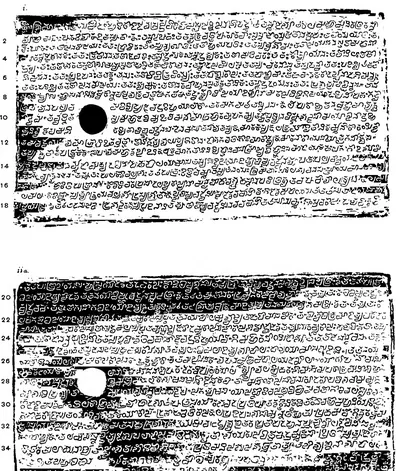 "Teki plates of Rajaraja-Chodaganga; dated in the seventeenth year (of Kulottunga I.)", plates i and ii a (Epigraphia Indica VI, Plate i, between pp. 338 and 339 (PDF p. 206))Inscription rubbing · 1901
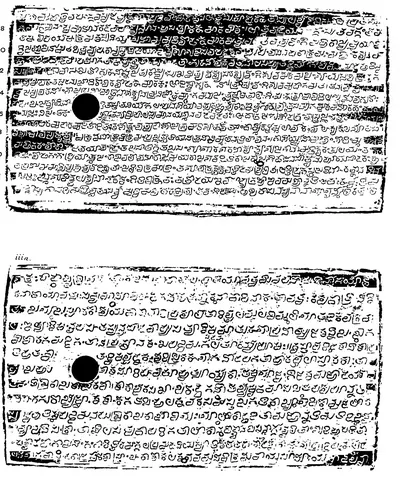 "Teki plates of Rajaraja-Chodaganga; dated in the seventeenth year (of Kulottunga I.)", plates ii b and iii a (Epigraphia Indica VI, Plate i, between pp. 338 and 339 (PDF p. 207))Inscription rubbing · 1901
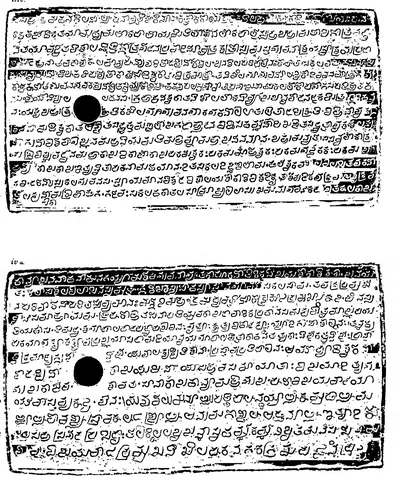 "Teki plates of Rajaraja-Chodaganga; dated in the seventeenth year (of Kulottunga I.)", plates iii b and iv a (Epigraphia Indica VI, Plate ii, between pp. 342 and 343 (PDF p. 212))Inscription rubbing · 1901
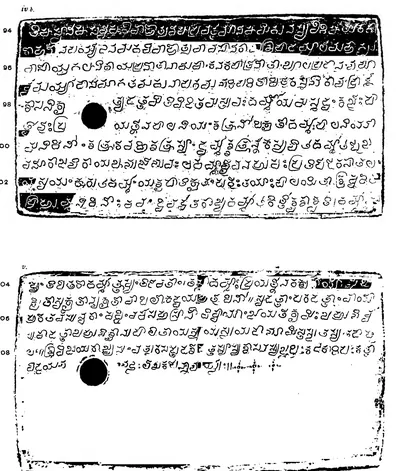 "Teki plates of Rajaraja-Chodaganga; dated in the seventeenth year (of Kulottunga I.)", plates iv b and v (Epigraphia Indica VI, Plate ii, between pp. 342 and 343 (PDF p. 213))Inscription rubbing · 1901
Related
Dynasties

Eastern Chalukyas of Vengi
c. 615–1077 CE
A branch of the Chalukyas of Badami that ruled Vengi, the coastal country between the lower Godavari and Krishna, from the early 7th century. Its founder, Kubja Vishnuvardhana, was a younger brother of Pulakesin II. The kings fought the Rashtrakutas for two centuries. After about 1000 they were bound to the Cholas by marriage, and in 1070 their heir became the Chola emperor Kulottunga I. Their copper-plate grants record the length of every reign. The first Telugu literary work, Nannaya's Mahabharata, was written at their court in Rajahmundry.
Cholas of Tanjore
c. 985–1268 CE
The imperial Chola dynasty of Tanjore (Thanjavur) and Gangaikondacholapuram in the Tamil country, overlords of much of the Telugu country from about 1000 to the 12th century. Rajaraja I restored the Eastern Chalukya Saktivarman I in Vengi about 999 and married his daughter to Saktivarman's brother Vimaladitya. Rajendra I waited on the Godavari while his general marched to the Ganges, and Virarajendra fought the Western Chalukyas at Bezwada. In 1070 the Eastern Chalukya heir became the Chola emperor Kulottunga I, whose sons governed Vengi until 1118. After a Western Chalukya occupation, Vikrama-Chola recovered the coast, but by the mid-12th century Chola rule north of the Krishna was nominal. In the south, the Telugu Choda chiefs of Nellore and Pottappi acknowledged the Chola king until the dynasty ended in the 1260s.
Velanati Chodas
c. 1076–1209 CE
A family of chiefs of Velanadu, the Chandavolu (Tsandavolu) country in the western Krishna delta. They rose as officers of the Eastern Chalukya and Chola kings and governed the Vengi country for the Chola emperors from the reign of Kulottunga I. Their records run from 1076 at Chebrolu to 1206. Gonka II claimed rule from Kalahasti to the Mahendra mountain, and Rajendra Choda II was the chief power on the coast in the 1170s. The Kakatiya Ganapatideva defeated the last of them, Prithvisvara, and had annexed Velanadu by 1209.
References
Notes (0)
Sources (9)
Spotted an error on this page? Tell us
Last updated: