Skandavarman (Salankayana)
Salankayana king of Vengi, known from two Sanskrit grants of his first regnal year, from Kanteru and Kanukollu. The Kanukollu plates, published in 1960, make him a son of Hastivarman II and a great-grandson of Hastivarman I, a cousin of Nandivarman II; before they were found he was usually placed after Nandivarman II as the last known king of the line.
Name and family
Skandavarman was the son of Hastivarman II.1 The Kanukollu plates, his own grant, trace his descent through four generations. He was the son of Hastivarman (II), the grandson of Nandivarman I and the great-grandson of Hastivarman I.12 The plates praise Hastivarman II as a king whose fame reached the four oceans. B. V. Krishna Rao inferred from the title Maharaja that he had been crowned. He took him to be the elder brother of Chandavarman, the father of Nandivarman II.12 On this reading Skandavarman and Nandivarman II were first cousins.1
Before 1960, scholars had to guess at his place in the family. K. V. Lakshmana Rao, editor of the Kanteru plates, and R. Subba Rao suggested that he was a younger son of Chandavarman and so a brother of Nandivarman II. Subba Rao noted that the two Kanteru grants were found together and that both were made to Brahmins of the Maudgalya gotra (clan).345 D. C. Sircar thought the relationship could not be known. He placed Skandavarman after Nandivarman II, because Nandivarman II was already preceded by three kings of his line.67 K. R. Subramanian made him the successor, perhaps the brother, of Nandivarman II.8
His grants
Both of Skandavarman’s known grants are in Sanskrit and are dated in the first year of his reign.9110
- The Kanukollu plates. Four plates found at Kanukollu with the grant of Nandivarman I. They were issued from Vengi on the first day of the bright fortnight of Karttika. They gave the village of Kompara, in the district of Kudrahara, as a tax-free brahmadeya to a Brahmin learned in the four Vedas who lived at a place called Rathakara. Here the king calls himself a Salankayana, a worshipper of the god Chitrarathasvamin and devoted to the feet of his father.912 Krishna Rao thought Kompara might be the village of Komarru, about ten miles east of Kanukollu, but could not be sure. He took Kudrahara to be an early form of the name Gudivada.111 See the Kanukollu plates of Skandavarman.
- The Kanteru plates. A grant found buried at Kanteru, six miles from Guntur, and edited by K. V. Lakshmana Rao. It was issued from Vengi on the full-moon day of Vaisakha. It gave the village of Chinnapura in the Kudrahara district, free of all taxes, to Sivarya of the Maudgalya gotra, who lived at Lekumari (Lekmnuri in Sircar’s summary). Lakshmana Rao saw what looked like the hump of a bull on its worn seal.12131410 See the Kanteru plates.
Krishna Rao found the letters of the Kanukollu grant close to those of the Kanteru plates. He thought it possible that the two grants were issued by the same Skandavarman.91
Administration
The Kanteru grant orders all officers, including the ayuktakas and the vishayapatis, to keep the village free of taxes. Sircar took the mention of vishayapatis to mean that the provinces of the kingdom were divided into districts (vishayas), each under its own officer.10
Date
No source gives Skandavarman reign years based on the Kanukollu genealogy. Sircar’s chart of 1939, drawn up before that grant was known, placed him tentatively about 445–470, after Nandivarman II.7 The Kanukollu plates make him a member of Nandivarman II’s own generation instead, so that placing no longer follows. Subba Rao and Subramanian also put him in the generation of Nandivarman II.158 Subramanian thought that the Pallavas invaded his kingdom from the south and that it later passed to the Vishnukundins.8 Lakshmana Rao, writing before the Kanukollu plates were found, made Skandavarman the last of the line, about 500. He supposed that the Vishnukundin Vikramendravarman defeated him.15
Footnotes
-
Krishna Rao, “Two Salankayana Charters from Kanukollu” (1960), p. 8 (archive.org (opens in a new tab)). ↩ ↩2 ↩3 ↩4 ↩5 ↩6 ↩7 ↩8 ↩9
-
Krishna Rao, “Two Salankayana Charters from Kanukollu” (1960), p. 10, translation (archive.org (opens in a new tab)). ↩ ↩2 ↩3
-
Sircar, Successors of the Satavahanas (1939), p. 70, note 1 (archive.org (opens in a new tab)). ↩
-
R. Subba Rao, “Pedavegi Copper-plates of Nandivarman II”, Journal of the Andhra Historical Research Society I, pt. 2 (1926), p. 93 (archive.org (opens in a new tab)). ↩
-
Subba Rao, “Pedavegi Copper-plates” (1926), p. 94 (archive.org (opens in a new tab)). ↩ ↩2
-
D. C. Sircar, The Successors of the Satavahanas in Lower Deccan (1939), p. 69 (archive.org (opens in a new tab)). ↩
-
Sircar, Successors of the Satavahanas (1939), p. 73, chronological chart (archive.org (opens in a new tab)). ↩ ↩2
-
K. R. Subramanian, Buddhist Remains in Andhra and the History of Andhra between 225 and 610 A.D. (1932), p. 91 (archive.org (opens in a new tab)). ↩ ↩2 ↩3
-
B. V. Krishna Rao, “Two Salankayana Charters from Kanukollu”, Epigraphia Indica XXXI (1955–56, publ. 1960), p. 7 (archive.org (opens in a new tab)). ↩ ↩2 ↩3
-
Sircar, Successors of the Satavahanas (1939), p. 96 (archive.org (opens in a new tab)). ↩ ↩2 ↩3
-
Krishna Rao, “Two Salankayana Charters from Kanukollu” (1960), p. 9 (archive.org (opens in a new tab)). ↩
-
K. V. Lakshmana Rao, “Two Copper-plate Grants of the Salankayanas of Vengi”, Journal of the Andhra Historical Research Society V, pt. 1 (1930), p. 21 (archive.org (opens in a new tab)). ↩
-
K. V. Lakshmana Rao, “Two Copper-plate Grants of the Salankayanas of Vengi”, Journal of the Andhra Historical Research Society V, pt. 1 (1930), p. 23 (archive.org (opens in a new tab)). ↩
-
K. V. Lakshmana Rao, “Two Copper-plate Grants of the Salankayanas of Vengi”, Journal of the Andhra Historical Research Society V, pt. 1 (1930), p. 31 (archive.org (opens in a new tab)). ↩
-
K. V. Lakshmana Rao, “Two Copper-plate Grants of the Salankayanas of Vengi”, Journal of the Andhra Historical Research Society V, pt. 1 (1930), pp. 26–27 (archive.org (opens in a new tab)). ↩
Photos
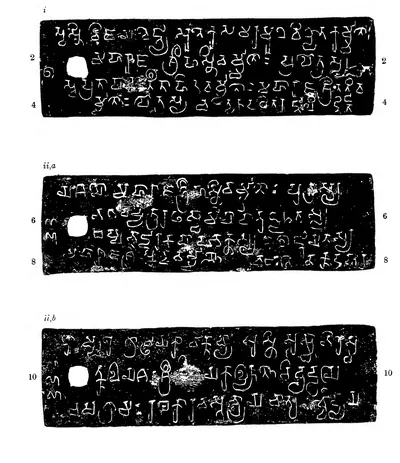 "Two Salankayana Charters from Kanukollu-Plate III. B.-Plates of Skandavarman, Year 1": plates i to ii b (Epigraphia Indica XXXI, Plate III, left half, between pp. 8 and 9 (PDF p. 32))Inscription rubbing · 1960
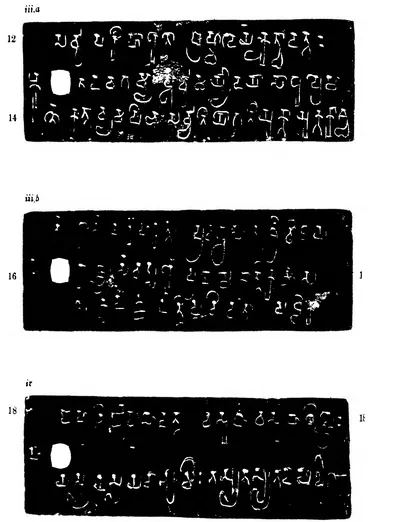 "Two Salankayana Charters from Kanukollu-Plate III. B.-Plates of Skandavarman, Year 1": plates iii a to iv (Epigraphia Indica XXXI, Plate III, right half, between pp. 8 and 9 (PDF p. 33))Inscription rubbing · 1960
Related
Dynasties
References
Notes (0)
Sources (5)
Spotted an error on this page? Tell us
Last updated: