Nandivarman I (Salankayana)
Salankayana king of Vengi, son of Hastivarman and father of Chandavarman and Hastivarman II. A Prakrit grant of his 14th year, found at Kanukollu and published in 1960, is the only record of his own. Its editor dated it to the close of the 3rd century, but D. C. Sircar placed it about the middle of the 4th.
Name and family
Nandivarman I was the son of Hastivarman.12 Two sets of plates name him as the son of Hastivarman.123 They are the Peddavegi plates of his grandson Nandivarman II and the Kanukollu plates of his grandson Skandavarman.123
In R. Subba Rao’s translation, the Peddavegi plates call him “Maharaja Nandivarma [who] performed several kinds of gifts”.1 The Kanukollu plates of Skandavarman praise him instead as a king who had overcome his enemies by his own valour.4 K. R. Subramanian, after the first of these epithets, called him Nandivarman the Charitable.5
Krishna Rao concluded that Nandivarman I had two sons, Hastivarman II and Chandavarman.2 Both are called Maharaja in the grants, which suggested to him that both were crowned. Because the eldest grandson was usually named after his grandfather, he suggested that Hastivarman II was the elder son and Chandavarman the younger.2 Hastivarman II was the father of Skandavarman, and Chandavarman the father of Nandivarman II.2
His own grant names a prince, the balaka-maharajakumara (young prince) Khandapotta (Skandapotta), for whose fame and good fortune the gift was made. Krishna Rao thought the title suggested that Khandapotta was a son of Nandivarman.6 Neither of the two family lists that name Nandivarman’s descendants includes Khandapotta.2
The Kanukollu grant
The only record of Nandivarman’s own reign is a set of eight copper plates found at Kanukollu, in the Gudivada taluk of Krishna district, together with a grant of Skandavarman.78 B. V. Krishna Rao obtained them in 1946 and published both in Epigraphia Indica in 1960.78
The grant is in Prakrit, with two Sanskrit verses at the end.69 It was issued from Vijaya-Vengipura in the 14th year of the reign. It gave the village of Pidiha as an agrahara (village granted to Brahmins) to a Brahmin of the Rathakara community, learned in the four Vedas (chatuvejja).69
The family name Salankayana does not appear in the grant, but Krishna Rao had little doubt that the king belonged to the Salankayanas of Vengi.69 See the Kanukollu plates of Nandivarman I.
The grant describes the king as favoured by the feet of his royal father.9 Krishna Rao took this to mean that Nandivarman’s father had also been a king and had probably reigned before him. For that reason he did not count Nandivarman as the first crowned king of the family.9
Date
The date of Nandivarman I is disputed.
- Krishna Rao compared the way the grants give dates. Nandivarman’s grant dates by year, season-fortnight and day, and Devavarman’s Ellore grant by month and fortnight. He thought Nandivarman’s way the older, and so made Nandivarman I a predecessor of Devavarman. He took him for a later contemporary of the Pallava king Sivaskandavarman, and placed his grant tentatively at the close of the 3rd century.9
- D. C. Sircar, as editor of the volume, thought these dates too early. On grounds of script and language he put the grant in the same age as Devavarman’s Ellore grant, about the middle of the 4th century.9
- Before the Kanukollu grant was known, Sircar’s chronology of 1939 had placed Nandivarman I about 370–395, a generation after Hastivarman.10
An older confusion
Before 1960 Nandivarman I was known only from the Peddavegi plates. In 1926 R. Subba Rao identified him with a “Vijaya Nandivarman”.11 Subba Rao believed that this king was named with a crown prince Vijaya-Buddhavarman in an unpublished Prakrit grant collected by Sir Walter Elliot.11 Sircar showed in 1939 that this grant belonged to the Pallavas and had nothing to do with the Salankayanas.3 See Evidence and disagreements.
Footnotes
-
Subba Rao, “Pedavegi Copper-plates” (1926), p. 105, translation (archive.org (opens in a new tab)). ↩ ↩2 ↩3 ↩4
-
Krishna Rao, “Two Salankayana Charters from Kanukollu” (1960), p. 8 (archive.org (opens in a new tab)). ↩ ↩2 ↩3 ↩4 ↩5 ↩6 ↩7
-
D. C. Sircar, The Successors of the Satavahanas in Lower Deccan (1939), pp. 67–68 (archive.org (opens in a new tab)). ↩ ↩2 ↩3
-
Krishna Rao, “Two Salankayana Charters from Kanukollu” (1960), p. 10, translation of the plates of Skandavarman (archive.org (opens in a new tab)). ↩
-
K. R. Subramanian, Buddhist Remains in Andhra and the History of Andhra between 225 and 610 A.D. (1932), p. 92 (archive.org (opens in a new tab)). ↩
-
Krishna Rao, “Two Salankayana Charters from Kanukollu” (1960), p. 2 (archive.org (opens in a new tab)). ↩ ↩2 ↩3 ↩4
-
B. V. Krishna Rao, “Two Salankayana Charters from Kanukollu”, Epigraphia Indica XXXI (1955–56, publ. 1960), p. 1 (archive.org (opens in a new tab)). ↩ ↩2
-
Krishna Rao, “Two Salankayana Charters from Kanukollu” (1960), p. 7 (archive.org (opens in a new tab)). ↩ ↩2
-
Krishna Rao, “Two Salankayana Charters from Kanukollu” (1960), p. 3, with D. C. Sircar’s editorial notes (archive.org (opens in a new tab)). ↩ ↩2 ↩3 ↩4 ↩5 ↩6 ↩7
-
Sircar, Successors of the Satavahanas (1939), p. 73, chronological chart (archive.org (opens in a new tab)). ↩
-
R. Subba Rao, “Pedavegi Copper-plates of Nandivarman II”, Journal of the Andhra Historical Research Society I, pt. 2 (1926), p. 94 (archive.org (opens in a new tab)). ↩ ↩2
Photos
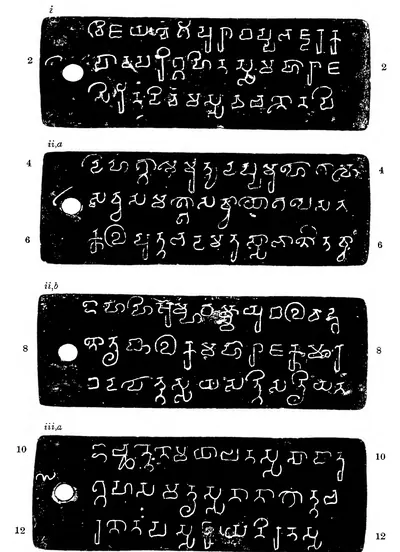 "Two Salankayana Charters from Kanukollu-Plate I. A.-Plates of Nandivarman (I), Year 14": plates i to iii a (Epigraphia Indica XXXI, Plate I, left half, between pp. 4 and 5 (PDF p. 24))Inscription rubbing · 1960
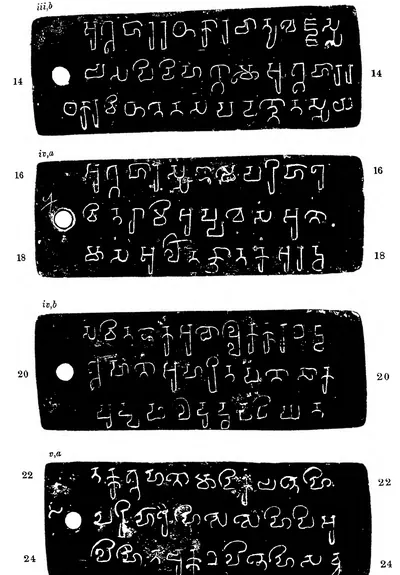 "Two Salankayana Charters from Kanukollu-Plate I. A.-Plates of Nandivarman (I), Year 14": plates iii b to v a (Epigraphia Indica XXXI, Plate I, right half, between pp. 4 and 5 (PDF p. 25))Inscription rubbing · 1960
Related
Dynasties
References
Notes (0)
Sources (4)
Spotted an error on this page? Tell us
Last updated: