Nandivarman II (Salankayana)
Salankayana king of Vengi, eldest son of Chandavarman, and the best-documented king of the dynasty. The Kolleru plates of his 7th year, the Peddavegi plates of his 10th and probably one of the Kanteru grants are his. He called himself a parama-bhagavata (devout worshipper of the Lord) and gave land to a temple of Vishnu. Most scholars date him to the first half or middle of the 5th century.
Name and family
Nandivarman II was the eldest son of Chandavarman.12 In J. F. Fleet’s translation of 1876, the Kolleru plates call him “the eldest son of the great king Chandavarma”.1
R. Subba Rao translated the Peddavegi plates into English in 1926, after their publication in 1924. These plates use the same words and trace his descent back three generations. They name him as the great-grandson of Hastivarman, the grandson of Nandivarman I and the son of Chandavarman.2
D. C. Sircar identified the kings of the two grants as one, because both grants describe their donor in this way.34 K. R. Subramanian added that both grants name the same executor, the Bhojaka of Mulakura.5 Subba Rao had already noticed this shared official.6
Older works call the king Vijaya-Nandivarman. Sircar argued that vijaya, “victorious”, was a prefix of glory, like the vijaya in “victorious Vengipura”, and that the king’s name was simply Nandivarman. In the Peddavegi plates he is called Nandivarman alone.7
Chandavarman’s brother was Hastivarman II, and through him the Kanukollu plates make Skandavarman Nandivarman’s first cousin.8 Before those plates were found, several scholars took Skandavarman for his younger brother (see below).910
His grants
Three grants are attributed to Nandivarman II, and all were issued from Vengipura.
- The Kolleru plates, year 7. These are four Sanskrit plates, made known by Sir Walter Elliot and edited by A. C. Burnell and by Fleet. They grant the village of Videnurapallika in the country of Kuduhara to 157 Brahmins of various gotras (clans). The Brahmins lived in the agrahara (Brahmin village) of Kuravaka. The grant is dated on the eighth day of the dark fortnight of Pausha in the seventh year of the reign.11112 See the Kolleru plates.
- The Peddavegi plates, year 10. These five plates were found near Pedavegi, eight miles north of Eluru (then Ellore). They give 32 nivartanas (a land measure) of land in four villages as cultivable temple land (devahala). The land was for the cowherds of Arutore, belonging to Vishnugrihasvamin, “the Lord of the three worlds”. The grant is dated on the first day of the bright fortnight of Sravana in the tenth year.1314215 See the Peddavegi plates.
- One of the Kanteru grants. This grant gave twelve nivartanas in the village of Kuruvada in the Kudrahara district to a Brahmin of the Maudgalya gotra. K. V. Lakshmana Rao’s edition names him Svamichandra, and Sircar’s summary Svamidatta. The grant is dated on a new-moon day, and its seal shows a crouching bull.161718 Sircar identified its king with Nandivarman II, because it uses the same epithets as the Kolleru and Peddavegi plates.4 One of them is parama-bhagavata, which no other Salankayana king is known to have used.4 Subramanian thought the grant might instead belong to Nandivarman I.5 See the Kanteru plates.
Religion
In all three grants the king calls himself parama-bhagavata (a devout worshipper of the Lord), as well as a devotee of the family god Chitrarathasvamin.4 The earlier king Devavarman had called himself a devotee of Mahesvara (Shiva).19 Sircar concluded that Nandivarman II was a Vaishnava who gave up the Shaivism of his family. He pointed to the Peddavegi grant of land for the god Vishnugrihasvamin. K. V. Lakshmana Rao, editor of the Kanteru plates, had argued that bhagavata could also describe a worshipper of Shiva. Sircar disagreed.1520
Subba Rao thought that the later Salankayanas were probably converts to the cult of Vishnu.21
Date
None of the grants is dated in an era, so Nandivarman’s date rests on the style of the letters and on counting generations from Hastivarman.2214
| Source | Date proposed |
|---|---|
| Burnell (1878), quoted by Fleet23 | Kolleru plates about the 4th century, on grounds of script |
| Sewell (1884)24 | Reports Burnell as putting the Kolleru grant in the 5th century |
| Bühler (1904)25 | The Salankayana plates “used to be assigned to the 4th century”; date “uncertain” |
| Dubreuil (1920)26 | Salankayana kings between about 350 and 450 |
| Lakshmana Rao (1930)27 | Nandivarman, son of Chandavarman, about 475 |
| Subba Rao (1926)14 | Reign ending about 440, allowing 25 years to each king from Hastivarman |
| Subramanian (1932)28 | Reign ending about 440 |
| Sircar (1939)429 | Grants about the middle of the 5th century; reign about 420–445 |
Fleet and Sewell report Burnell differently.23243031 Fleet has him dating the Kolleru plates to about the 4th century, and Sewell to the 5th.23243031 Burnell’s own table of the South Indian alphabets starts the Vengi alphabet at about A.D. 350, and he wrote that only two grants of the dynasty were then known.23243031
Footnotes
-
Fleet, “Sanskrit and Old-Canarese Inscriptions, No. XVIII” (1876), p. 177, translation (archive.org (opens in a new tab)). ↩ ↩2 ↩3
-
Subba Rao, “Pedavegi Copper-plates” (1926), p. 105, translation (archive.org (opens in a new tab)). ↩ ↩2 ↩3
-
Sircar, Successors of the Satavahanas (1939), p. 68 (archive.org (opens in a new tab)). ↩
-
Sircar, Successors of the Satavahanas (1939), p. 69 (archive.org (opens in a new tab)). ↩ ↩2 ↩3 ↩4 ↩5
-
K. R. Subramanian, Buddhist Remains in Andhra and the History of Andhra between 225 and 610 A.D. (1932), p. 90 (archive.org (opens in a new tab)). ↩ ↩2
-
Subba Rao, “Pedavegi Copper-plates” (1926), p. 104, note 11 (archive.org (opens in a new tab)). ↩
-
D. C. Sircar, The Successors of the Satavahanas in Lower Deccan (1939), p. 64 (archive.org (opens in a new tab)). ↩
-
B. V. Krishna Rao, “Two Salankayana Charters from Kanukollu”, Epigraphia Indica XXXI (1955–56, publ. 1960), p. 8 (archive.org (opens in a new tab)). ↩
-
Sircar, Successors of the Satavahanas (1939), p. 70, note 1 (archive.org (opens in a new tab)). ↩
-
Subba Rao, “Pedavegi Copper-plates” (1926), p. 93 (archive.org (opens in a new tab)). ↩
-
J. F. Fleet, “Sanskrit and Old-Canarese Inscriptions, No. XVIII”, Indian Antiquary V (1876), p. 175 (archive.org (opens in a new tab)). ↩
-
Burnell, Elements of South-Indian Palaeography (1878), p. 135, Appendix C and note 1 (archive.org (opens in a new tab)). ↩
-
R. Subba Rao, “Pedavegi Copper-plates of Nandivarman II”, Journal of the Andhra Historical Research Society I, pt. 2 (1926), p. 92 (archive.org (opens in a new tab)). ↩
-
Subba Rao, “Pedavegi Copper-plates” (1926), p. 95 (archive.org (opens in a new tab)). ↩ ↩2 ↩3
-
Sircar, Successors of the Satavahanas (1939), p. 84 (archive.org (opens in a new tab)). ↩ ↩2
-
K. V. Lakshmana Rao, “Two Copper-plate Grants of the Salankayanas of Vengi”, Journal of the Andhra Historical Research Society V, pt. 1 (1930), p. 23 (archive.org (opens in a new tab)). ↩
-
K. V. Lakshmana Rao, “Two Copper-plate Grants of the Salankayanas of Vengi”, Journal of the Andhra Historical Research Society V, pt. 1 (1930), p. 32 (archive.org (opens in a new tab)). ↩
-
Sircar, Successors of the Satavahanas (1939), p. 92 (archive.org (opens in a new tab)). ↩
-
E. Hultzsch, “Plates of Vijaya-Devavarman”, Epigraphia Indica IX (1907–08), p. 58 (archive.org (opens in a new tab)). ↩
-
Sircar, Successors of the Satavahanas (1939), p. 85 (archive.org (opens in a new tab)). ↩
-
Subba Rao, “Pedavegi Copper-plates” (1926), p. 97 (archive.org (opens in a new tab)). ↩
-
Sircar, Successors of the Satavahanas (1939), p. 72 (archive.org (opens in a new tab)). ↩
-
Fleet, “Sanskrit and Old-Canarese Inscriptions, No. XVIII” (1876), p. 176 (archive.org (opens in a new tab)). ↩ ↩2 ↩3 ↩4
-
Robert Sewell, Lists of Inscriptions, and Sketch of the Dynasties of Southern India (1884), p. 240 (archive.org (opens in a new tab)). ↩ ↩2 ↩3 ↩4
-
Georg Bühler, Indian Paleography (1904), p. 65 (archive.org (opens in a new tab)). ↩
-
G. Jouveau-Dubreuil, Ancient History of the Deccan (1920), p. 89 (archive.org (opens in a new tab)). ↩
-
K. V. Lakshmana Rao, “Two Copper-plate Grants of the Salankayanas of Vengi”, Journal of the Andhra Historical Research Society V, pt. 1 (1930), pp. 26–27 (archive.org (opens in a new tab)). ↩
-
Subramanian, Buddhist Remains in Andhra (1932), p. 91 (archive.org (opens in a new tab)). ↩
-
Sircar, Successors of the Satavahanas (1939), p. 73, chronological chart (archive.org (opens in a new tab)). ↩
-
A. C. Burnell, Elements of South-Indian Palaeography (2nd ed., 1878), p. 14, table (archive.org (opens in a new tab)). ↩ ↩2 ↩3
-
Burnell, Elements of South-Indian Palaeography (1878), p. 15 (archive.org (opens in a new tab)). ↩ ↩2 ↩3
Photos
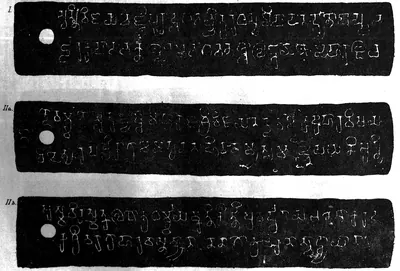 "Copper-plate grant of the kings of the Vengi country": Kollair (Kolleru) grant of the Salankayana Maharaja Vijaya-Nandivarman, plates I, IIa and IIb (Indian Antiquary V, 1876, plate at p. 176 (PDF p. 214))Inscription rubbing · 1876
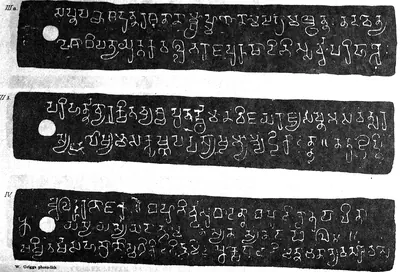 "Copper-plate grant of the kings of the Vengi country": Kollair (Kolleru) grant of the Salankayana Maharaja Vijaya-Nandivarman, plates IIIa, IIIb and IV (Indian Antiquary V, 1876, plate at p. 177 (PDF p. 215))Inscription rubbing · 1876
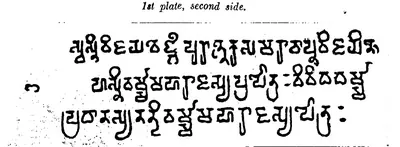 "Pedavegi Copper-plates of Nandivarman II": "1st plate, second side" (eye-copy) (Journal of the Andhra Historical Research Society I, pt. 2, Oct. 1926, p. 101 (PDF p. 122))Drawing · 1926
Related
Dynasties
References
Notes (0)
Sources (11)
Spotted an error on this page? Tell us
Last updated: