Salankayanas of Vengi
Dynasty of the country between the Krishna and the Godavari in the 4th and 5th centuries CE, ruling from Vengipura, the modern Pedavegi near Eluru. Seven copper-plate grants name seven kings in two lines descended from Hastivarman. Most scholars identify him with the 'Hastivarman of Vengi' of Samudragupta's Allahabad inscription. Their earlier grants are in Prakrit and their later ones in Sanskrit. Their seals bear a bull, and their family god was Chitrarathasvamin.
Swipe sideways to see the whole chart; tap a bar for details.
Each bar is a ruling power in its region; time runs left to right. Dashed = approximate dates. Select a bar for details.
Show as a list
Ikshvakus, Vishnukundins & early kingdoms 225–624 CE
- Telangana
- Vakatakas (c. 300–500 CE) · Ikshvakus (c. 225–352 CE) · Vishnukundins (c. 375–612 CE)
- Coastal Andhra
- Pallavas (c. 250–630 CE) · Ikshvakus (c. 225–350 CE) · Vishnukundins (c. 500–630 CE) · Salankayanas of Vengi (c. 300–470 CE) · Eastern Gangas of Kalinga (c. 537–1434 CE)
- Rayalaseema
- Pallavas (c. 300–900 CE)
Kingdoms and empires
Satavahanas
Open page- Telangana: c. 220 BCE – 225 CE (c. 445 years)
IG Hyderabad: rise c. 220 BCE, end about a century after Pulumayi II (acc. c. 138 CE); Sewell: by c. 170 BCE the Andhra king ruled Hyderabad as well as the Telugu tracts
- Coastal Andhra: c. 220 BCE – 225 CE (c. 445 years)
Sources disagree: IG Madras 220 BCE-236 CE; Sewell 'from at least 250 BCE' to c. 225 CE when the Pallava Bappa ended the line; Godavari gazetteer dates the known kings c. 110-220 CE, last inscriptions c. 218
- Rayalaseema: c. 1–225 CE (c. 224 years)
Sewell: about 1 CE the Andhra king ruled parts of Cuddapah and Kurnool; an inscription of Pulumayi II (c. 145 CE) in Adoni taluk proves Andhra rule there; Bellary gazetteer: the Andhras ruled that district in the 2nd century CE. When their rule here began is not recorded
Rulers (12)
- Simuka (c. 220 BCE – 197 BCE)
- Krishna (Kanha) (c. 197 BCE – 179 BCE)
- Sri Satakarni (c. 179 BCE – 169 BCE)
- Sivasvati (c. 85–113 CE)
- Gautamiputra Satakarni (c. 113–138 CE)
- Vasishthiputra Pulumavi (c. 138–170 CE)
… and 6 more
- Siva Sri Satakarni (c. 170–177 CE)
- Sivaskanda Satakarni (c. 177–184 CE)
- Yajna Sri Satakarni (c. 184–213 CE)
- Vijaya Satakarni (c. 213–219 CE)
- Chandra Sri Satakarni (c. 219–229 CE)
- Pulumavi III (c. 229–236 CE)
Capitals
Inscriptions
Sources (5)
Kingdoms and empires
Vakatakas
Open page- Telangana: c. 300–500 CE (c. 200 years)
Partial: the Adilabad, Nizamabad and Karimnagar country north of the Godavari, as part of the Vakataka lands of central India and the northern Deccan. Goel et al. (2022) place the Vakataka lands from the findspots of their 37 inscriptions and name only these three Telangana districts. Jouveau-Dubreuil (1920) claimed much more: almost the whole of the Hyderabad State, and up to Kurnool. A Vakataka princess married the Vishnukundin Madhavavarman (Chikkulla plates). No Vakataka inscription from Telangana is listed in Epigraphia Telanganica I; this span rests on modern histories. Dates follow the Sewell table (Vindhyasakti c. 275-300 to Harishena c. 465-500).
Rulers (8)
- Vindhyasakti (c. 275–300 CE)
- Pravarasena I (c. 300–330 CE)
- Rudrasena I (c. 330–340 CE)
- Prithvisena I (c. 340–390 CE)
- Rudrasena II (c. 390–395 CE)
- Pravarasena II (c. 395–420 CE)
… and 2 more
- Devasena (c. 445–465 CE)
- Harishena (c. 465–500 CE)
Sources (5)
Kingdoms and empires
Ikshvakus
Open page- Coastal Andhra: c. 225–350 CE (c. 125 years)
Lower Krishna valley (Vijayapuri at Nagarjunakonda, Jaggayyapeta, Uppugundur); four kings known; dated inscriptions of 273–74 and 333–34 (Sircar), with an Abhira interlude about 278–79
- Telangana: c. 225–352 CE (c. 127 years)
Partial: the lower Krishna valley on the Nalgonda side. Inscriptions of the Ikshvaku kings Chamtamula and Rudrapurushadatta at Phanigiri (Nalgonda); the editors of Epigraphia Telanganica date Rudrapurushadatta's pillar to 352 and take it as the end of Ikshvaku rule.
Rulers
Capitals
Monuments
Inscriptions
Sources (5)
Kingdoms and empires
Vishnukundins
Open page- Telangana: c. 375–612 CE (c. 237 years)
Partial: the early kingdom north of Srisailam (Nalgonda and Mahabubnagar), with its capital at Keesaragutta near Hyderabad or at Indrapura (Indrapala Gutta near Tummalagudem, Nalgonda); the capital later moved to Trivaranagara (Tiruvuru). The Tummalagudem plates of Govindavarman (37th year) and Vikramendravarman II (Saka 488, 566-67) were found in Nalgonda. The early dates (Indravarman c. 375-400) and the end in 612 follow Goel et al.
- Coastal Andhra: c. 500–630 CE (c. 130 years)
Krishna-Godavari country; later capital Lendulura (Denduluru near Vengi); grants from the Godavari delta, Tenali taluk and the Vizianagaram region, and a pillar at Velpuru south of the Krishna. Dates disputed: K. V. Lakshman Rao (in Sewell 1932) about 357-610; Panchamukhi (1936) about 500 to the Chalukya conquest of 621-631; Mirashi puts Madhavavarman I about 510-568; Sircar (1939) about 500-670 and an end later still
Rulers (7)
- Vikramahendra (c. 500–520 CE)
- Govindavarman (c. 520–535 CE)
- Madhavavarman (Vishnukundin) (c. 535–585 CE)
- Madhavavarman II (Vishnukundin) (c. 585–615 CE)
- Vikramendravarman I (c. 615–625 CE)
- Indravarman (Vishnukundin) (c. 625–655 CE)
Capitals
Inscriptions (7)
- Chikkulla plates of Vikramendravarman II
- Ipur plates (set I) of Govindavarman's son Madhavavarman
- Ipur plates (set II) of Madhavavarman II
- Khanapur plates of Madhavavarman
- Polamuru plates of Madhavavarman Janashraya
- Ramatirtham plates of Indravarman
… and 1 more
Sources (8)
Kingdoms and empires
Pallavas
Open page- Coastal Andhra: c. 250–630 CE (c. 380 years)
Krishna-Guntur, Ongole and Nellore. Prakrit grant of the crown prince Sivaskandavarman to his officer at Dhanyakataka (Amaravati), dated from about 234 (Sewell) or 250-275 (Jouveau-Dubreuil) to the first half of the 4th century (Sircar); Sanskrit grants of a Nellore-Guntur line (Omgodu, Uruvupalli, Pikira, Mangalur, Vilavatti, Chura) in the 5th and 6th centuries. Karmarashtra (Ongole-Bapatla) was Chalukya by about 630 (Kopparam plates of Pulakesin II). The Godavari gazetteer calls 200-615 a Pallava age, and IG Madras calls Vengi originally a Pallava province; Sircar found no evidence that the Pallavas held Vengi itself.
- Rayalaseema: c. 300–900 CE (c. 600 years)
Partial. Pallava frontier guards at Sriparvata (Kurnool) in the 4th century (Talagunda inscription; Sircar); Ganga kings of the Penukonda plates installed by Pallava kings (5th century); inscription of Paramesvaravarman II at Ulchala near Kurnool (728-29); Bana vassals in the Chittoor country under Nripatunga (9th century). The Cuddapah gazetteer has the Pallavas hold the eastern Cuddapah taluks for four centuries until the Chola Aditya I crippled them at the end of the 9th century. The Cuddapah gazetteer says the Pallavas of Kanchi pushed up the Penner from Nellore into north Cuddapah for a time and then ruled the eastern Cuddapah taluks for four centuries, until the Chola Aditya I crippled them at the end of the 9th century; Sewell gives a Pallava regnal-year record in Chittoor (864-65), with the Banas as Pallava vassals.
- Coastal Andhra: c. 670–750 CE (c. 80 years)
Southern Nellore only: grants of Paramesvaravarman I (Podili-Kandukur country, 687) and Narasimhavarman II (Revuru, Atmakur taluk, about 700-711), and a Tamil record of the 15th year of Nandipottarasar at Mallam (Gudur taluk), read as Pallava supremacy (Nellore gazetteer, 1942) or as Pallava rule under the Western Chalukyas (Butterworth and Venugopaul Chetty, 1905).
Rulers (18)
- Bappa (c. 225–250 CE)
- Sivaskandavarman (Pallava) (c. 250–275 CE)
- Vishnugopa of Kanchi (c. 325–350 CE)
- Kumaravishnu II (Pallava) (c. 425–450 CE)
- Skandavarman II (Pallava) (c. 450–475 CE)
- Simhavarman II (Pallava) (c. 500–525 CE)
… and 12 more
- Vishnugopavarman (c. 525–550 CE)
- Simhavishnu (c. 575–600 CE)
- Mahendravarman I (c. 600–630 CE)
- Narasimhavarman I (c. 630–668 CE)
- Mahendravarman II (c. 668–670 CE)
- Paramesvaravarman I (c. 670–690 CE)
- Narasimhavarman II (c. 690–715 CE)
- Nandivarman II Pallavamalla (c. 717–779 CE)
- Dantivarman (c. 779–830 CE)
- Nandivarman III (c. 830–854 CE)
- Nripatunga (c. 854–880 CE)
- Aparajita (c. 880–900 CE)
Capitals
Inscriptions (14)
Sources (19)
Kingdoms and empires
Salankayanas of Vengi
Open page- Coastal Andhra: c. 300–470 CE (c. 170 years)
Vengi (Pedavegi near Eluru), between the Krishna and the Godavari. Dates debated: D. C. Sircar (1939) about 320-470, from Devavarman to Skandavarman; B. V. Krishna Rao puts Nandivarman I at the close of the 3rd century, Sircar (1960) the Ellore and Kanukollu grants in the mid-4th; Subramanian about 275-450; Subba Rao has the Vishnukundins take Vengi about 450. Older works call these rulers Pallavas
Rulers
Capitals
Inscriptions
Sources (5)
Kingdoms and empires
Eastern Gangas of Kalinga
Open page- Coastal Andhra: c. 537–1434 CE (c. 897 years)
Partial: only the far north coast (the old Ganjam and Vizagapatam districts, now Srikakulam-Vizianagaram- Visakhapatnam), capital Kalinganagara (Mukhalingam). Earliest dated grant: Jirjingi, near Tekkali, Ganga year 39 (c. 537 on Mirashi's epoch of 498; Fleet put the early grants in the 7th century and Sewell used an epoch of 877-78; the Imperial Gazetteer, the 7th century). Later line in power from the end of the 9th century (Vizagapatam gazetteer): Vajrahasta III crowned 1038; Anantavarman Chodaganga 1078-1146, with records at Mukhalingam, Srikurmam, Simhachalam and Visakhapatnam. South of the Godavari only records and raids (Draksharama 1128-1274; Bendapudi). Ended 1434, when the minister Kapilesvara founded the Gajapati line
Rulers (15)
- Vajrahasta III (Eastern Ganga) (1038–1070 CE)
- Rajaraja I (Eastern Ganga) (1070–1078 CE)
- Anantavarman Chodaganga (c. 1078–1146 CE)
- Madhu-Kamarnava (c. 1146–1152 CE)
- Raghava (c. 1152–1166 CE)
- Rajaraja II (c. 1166–1192 CE)
… and 9 more
- Aniyanka-Bhima (c. 1192–1202 CE)
- Anangabhima III (c. 1219–1253 CE)
- Narasimha I (Eastern Ganga) (c. 1253–1256 CE)
- Bhanudeva I (c. 1256–1275 CE)
- Narasimha II (c. 1275–1306 CE)
- Bhanudeva II (c. 1306–1323 CE)
- Narasimha III (c. 1323–1346 CE)
- Bhanudeva III (c. 1346–1378 CE)
- Narasimha IV (c. 1378–1397 CE)
Capitals
Monuments
Inscriptions (8)
Sources (10)
Reigns
Each bar is one ruler’s reign; time runs left to right. c. = approximate date.
- Devavarman (Salankayana)c. 320–345 CE · c. 25 yrs
- Hastivarman (Salankayana)c. 345–370 CE · c. 25 yrs
- Nandivarman I (Salankayana)c. 370–395 CE · c. 25 yrs
- Chandavarman (Salankayana)c. 395–420 CE · c. 25 yrs
- Nandivarman II (Salankayana)c. 420–445 CE · c. 25 yrs
Approximate reign years after D. C. Sircar's chart of 1939, which allows about 25 years a reign and fixes Hastivarman by his supposed meeting with Samudragupta about 350; Sircar put a question mark against Devavarman. Hastivarman II and Skandavarman are not charted: the Kanukollu plates (1960) make them a second line descended from Nandivarman I, and no source gives them reign years. Sircar's 1939 date for Skandavarman, about 445–470, assumed that he followed Nandivarman II. B. V. Krishna Rao dated Nandivarman I to the close of the 3rd century; Sircar, in 1960, to about the middle of the 4th.
Family tree
The rulers and the relatives who explain the succession. Every line rests on a cited statement on a person page; the sources are listed below the tree. Select a card to open that page.
- parent and child
- marriage
- adoption
- the sources disagree (see below)
- order of succession
Generation 1
- 2Hastivarmanc. 345–370 CE
Generation 2
- 3Nandivarman Ic. 370–395 CESon of Hastivarman
- 1Devavarmanc. 320–345 CEsources disagree
Generation 3
- Hastivarman IIMaharaja; son of Nandivarman ISon of Nandivarman I
- 4Chandavarmanc. 395–420 CESon of Nandivarman I
- KhandapottaYoung prince named in Nandivarman I's grantsources disagree
Generation 4
- Skandavarman (Salankayana)Son of Hastivarman II
- 5Nandivarman IIc. 420–445 CESon of Chandavarman
- Other sons of ChandavarmanYounger brothers of Nandivarman IISons of Chandavarman
Where the sources disagree
Was Khandapotta a son of Nandivarman I?
How was Devavarman related to Hastivarman?
A younger son of Hastivarman (Subba Rao, 1926)
- Subba Rao suggested in 1926 that Devavarman was a younger son of Hastivarman, who did not rule as sovereign. →
- R. Subba Rao, "Pedavegi Copper-plates of Nandivarman II", Journal of the Andhra Historical Research Society I, pt. 2 (1926), p. 94 (archive.org (opens in a new tab)).
Earlier than Hastivarman, perhaps his father (Sircar, 1939)
- Sircar thought Devavarman ruled before Hastivarman, because the script of the Peddavegi plates looks slightly later than that of the Ellore plates. →
- D. C. Sircar, The Successors of the Satavahanas in Lower Deccan (1939), p. 69 and note (archive.org (opens in a new tab)).
- Sircar, Successors of the Satavahanas (1939), p. 73, chronological chart and note (archive.org (opens in a new tab)).
Later than Nandivarman I (Krishna Rao, 1960)
- Krishna Rao, editing the Kanukollu plates in 1960, concluded that Nandivarman I seems to have reigned before Devavarman. →
- B. V. Krishna Rao, "Two Salankayana Charters from Kanukollu", Epigraphia Indica XXXI (1955–56, publ. 1960), p. 3, with D. C. Sircar's editorial notes (archive.org (opens in a new tab)).
Sources for every line of the tree
- Hastivarman → Nandivarman I (parent and child)
- Nandivarman I was the son of Hastivarman. →
- Subba Rao, "Pedavegi Copper-plates" (1926), p. 105, translation (archive.org (opens in a new tab)).
- Krishna Rao, "Two Salankayana Charters from Kanukollu" (1960), p. 8 (archive.org (opens in a new tab)).
- Nandivarman I was the son of Hastivarman. →
- Nandivarman I → Hastivarman II and Chandavarman (parent and child)
- Chandavarman was a son of Nandivarman I. →
- R. Subba Rao, "Pedavegi Copper-plates of Nandivarman II", Journal of the Andhra Historical Research Society I, pt. 2 (1926), p. 105, translation (archive.org (opens in a new tab)).
- Krishna Rao concluded that Nandivarman I had two sons, Hastivarman II and Chandavarman. →
- Krishna Rao, "Two Salankayana Charters from Kanukollu" (1960), p. 8 (archive.org (opens in a new tab)).
- Chandavarman was a son of Nandivarman I. →
- Hastivarman II → Skandavarman (Salankayana) (parent and child)
- Skandavarman was the son of Hastivarman II. →
- Krishna Rao, "Two Salankayana Charters from Kanukollu" (1960), p. 8 (archive.org (opens in a new tab)).
- Skandavarman was the son of Hastivarman II. →
- Chandavarman → Nandivarman II and Other sons of Chandavarman (parent and child)
- Nandivarman II was the eldest son of Chandavarman. →
- Fleet, "Sanskrit and Old-Canarese Inscriptions, No. XVIII" (1876), p. 177, translation (archive.org (opens in a new tab)).
- Subba Rao, "Pedavegi Copper-plates" (1926), p. 105, translation (archive.org (opens in a new tab)).
- His eldest son was Nandivarman II. →
- J. F. Fleet, "Sanskrit and Old-Canarese Inscriptions, No. XVIII", Indian Antiquary V (1876), p. 177, translation (archive.org (opens in a new tab)).
- R. Subba Rao, "Pedavegi Copper-plates of Nandivarman II", Journal of the Andhra Historical Research Society I, pt. 2 (1926), p. 105, translation (archive.org (opens in a new tab)).
- Nandivarman II was the eldest son of Chandavarman. →
- Nandivarman I → Khandapotta (parent and child) · sources disagree
- Krishna Rao thought the title suggested that Khandapotta was a son of Nandivarman. →
- Krishna Rao, "Two Salankayana Charters from Kanukollu" (1960), p. 2 (archive.org (opens in a new tab)).
- Krishna Rao thought the title suggested that Khandapotta was a son of Nandivarman. →
- Hastivarman → Devavarman (parent and child) · sources disagree
- Subba Rao suggested in 1926 that Devavarman was a younger son of Hastivarman, who did not rule as sovereign. →
- R. Subba Rao, "Pedavegi Copper-plates of Nandivarman II", Journal of the Andhra Historical Research Society I, pt. 2 (1926), p. 94 (archive.org (opens in a new tab)).
- Subba Rao suggested in 1926 that Devavarman was a younger son of Hastivarman, who did not rule as sovereign. →
A line from one parent only means that the cited sources name no other parent.
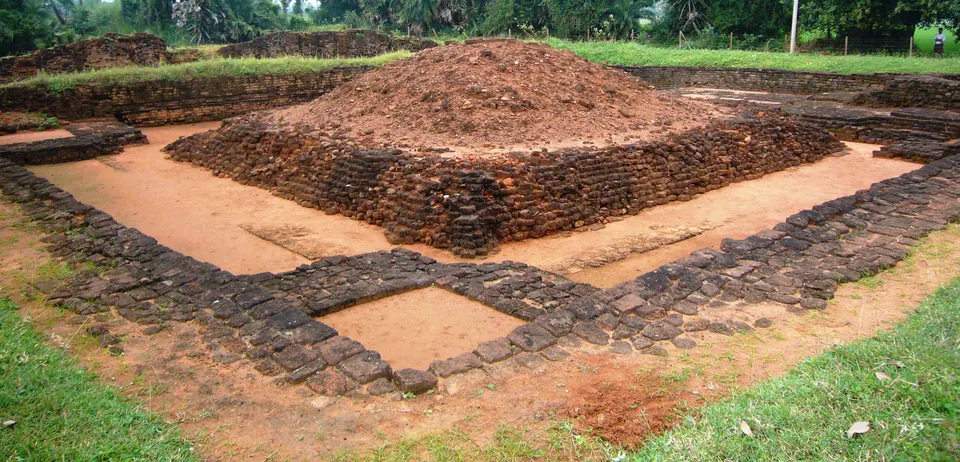
The Salankayanas ruled Vengi, the country between the lower Krishna and the Godavari, in the 4th and 5th centuries CE. Their capital was Vengipura, generally identified with the village of Pedavegi, a few miles north of Eluru (Ellore).12 They came after the Ikshvakus and the Brihatphalayanas in the Krishna valley and before the Vishnukundins.34
Almost all that is known of them comes from seven copper-plate grants: two in Prakrit and five in Sanskrit.56 They were issued from Vengipura and record gifts of land to Brahmins and to a temple.56 K. R. Subramanian observed in 1932, when fewer grants were known, that the dynasty’s history had to be rebuilt from about half a dozen copper-plate charters.7
How the dynasty was discovered
The first Salankayana grant came to notice in 1840. Walter Elliot described in the Madras Journal a set of copper plates said to have been found in the Kolleru lake.89 He showed that they belonged to a dynasty older than the Eastern Chalukyas.89
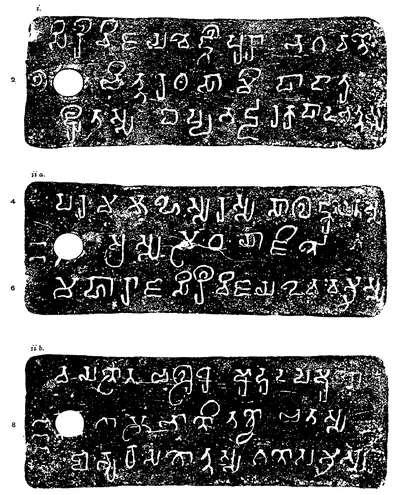
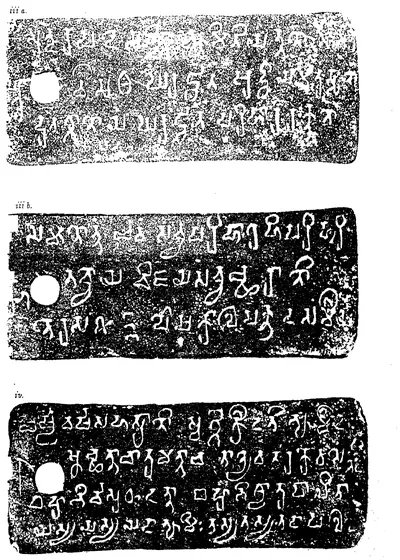
A. C. Burnell called it “a yet nameless dynasty”.10 He published the grant as a specimen of the “Vengi” alphabet.10 J. F. Fleet re-edited it in 1876 as a “copper-plate grant of the kings of the Vengi country”.81011 The grant itself names the king’s family.12 He is Vijaya-Nandivarman, “who belongs to the family of the Salankayanas”, eldest son of the great king Chandavarman.12 See the Kolleru plates.
Nineteenth-century writers usually counted these kings among the Pallavas. Robert Sewell wrote in 1884 that the Chalukya Kubja Vishnuvardhana won the east coast “by his conquest of the Salankayana kings of Vengi (Pallavas)”.13 Walter Elliot spoke of “a people of Pallava race” ruling Vengi.8 The Imperial Gazetteer of 1908 still called Vengi “apparently originally a province of the Pallavas of Conjeeveram”.14
In 1908 E. Hultzsch edited a Prakrit grant of a king Devavarman, issued from Vengipura and addressed to the villagers of Elura (Eluru). He noticed that its king used nearly the same epithets as the king of the Kolleru plates. He proposed to call the family “the Salankayana Maharajas of Vengipura”.1 See the Ellore plates of Devavarman.
The Peddavegi plates, published in Telugu in 1924 and in English by R. Subba Rao in 1926, gave four generations of kings, beginning with a Hastivarman.1516 K. V. Lakshmana Rao edited two more grants, found buried at Kanteru, six miles from Guntur. His English edition appeared in 1930, after his death.171819 See the Kanteru plates.
D. C. Sircar drew the evidence together in the 1930s.205 Finally, in 1960, B. V. Krishna Rao published two grants found at Kanukollu, one of them in Prakrit, which added a second branch of the family.2122
Origins and name
The name Salankayana is a gotra (clan) name, taken from a Vedic sage. Fleet noted in 1876 that the Salankayanas, as descendants of the sage Visvamitra, were “of lunar extraction”.11 Burnell found the name among the gotras of the Bhrigu group and thought it “of course that of the family-priest”.9 Sircar counted several gotras of this name in different groups, and could not tell which of them the kings belonged to.2324
B. V. Krishna Rao compared it with other gotra names, such as Brihatphalayana and Ananda, that had become the names of dynasties.22 He thought the Salankayanas had originally been a Brahmin family.22
Sircar also noted that two Sanskrit dictionaries give Salankayana as a name of Nandin, the bull of Shiva.23 He thought the bull on the family’s seals might be connected with its name.23 Subba Rao and Lakshmana Rao gave the same meaning from the dictionary Medini. Lakshmana Rao noted the crouching bull on the seal of a Kanteru grant.251826
Some scholars have traced the family back to the 2nd century. Sircar identified the Salankayanas with the Salakenoi whom Ptolemy, about 140 CE, placed beyond the Maisoloi (the people of Machilipatnam). He read Ptolemy’s city of Benagouron as a corruption of Vengipura.2728 Subramanian thought that neither the location of the Salakenoi nor their relation to the Salankayanas could yet be fixed.7
Krishna Rao thought that the Salankayanas had governed Vengi in the first two centuries CE, first under the Satavahanas and then under the Ikshvakus.6 In his view they became independent in the second half of the 3rd century.6 Sircar likewise thought that the family had been subordinate to the Satavahanas.29
Their relation to the Pallavas is another open question. Subba Rao listed resemblances between the two dynasties:25
- Prakrit grants followed by Sanskrit ones
- a bull on the seal
- the horse sacrifice
- kings’ names ending in -varman
- similar titles25
Subba Rao concluded that they “were closely related”, and perhaps intermarried, but independent of each other.25 Sewell’s chronology of 1932 took them to be probably descended from the Andhras (the Satavahanas), keeping some local power in Vengi.30
Territory and the capital
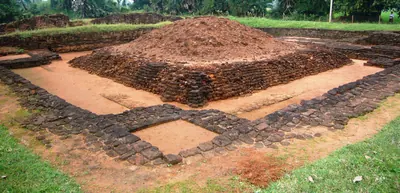
Vengipura is identified with Pedda-Vegi (Pedavegi). E. Hultzsch was shown a mound there in 1902 as the site of the temple of Chitrarathasvamin, the family god of the Salankayanas. Elura, the village addressed in Devavarman’s grant, is Eluru, seven miles away.1 See Vengi for the ruins and the later history of the site.
Subba Rao described the kingdom as made up of two districts named in the grants.2531 One was the Vengi district round the capital.2531 The other was the Gudrahara (Kudrahara or Kuduhara) district, whose chief town he placed near Machilipatnam (then Masulipatam).2531
Subba Rao concluded that the kingdom covered “the modern districts of West Godavari and Krishna”.2532 He also called it the country between the Godavari in the north and the Krishna in the south.2532 Subramanian described it in the same way.33
K. V. Lakshmana Rao drew it more narrowly.3435 He thought the kingdom “could not have been more extensive than an average modern district”.3435 In his view the Vengi district covered the taluks of Eluru, Yernagudem and Bhimavaram.3435 Kudrahara covered the taluks of Divi (Avanigadda), Bandar, Kaikalur and Gudivada.3435
The place of Kudrahara is disputed.36 Dubreuil put it round Machilipatnam, the old home of the Brihatphalayanas.36 Krishna Rao took Kudrahara and Gudrahara to be early forms of the name Gudivada.37 Subba Rao reported both views.32
Sircar thought the kingdom grew. He read the Kanteru grants as showing that the later Salankayanas held much land.3 This land had once been ruled by the Ikshvakus, the Brihatphalayanas and the Pallavas.3 He noted that a Pallava king, Simhavarman, gave a village in a district called Vengorashtra. He suggested that this was the southern fringe of the Vengi country.38 But he found no evidence that the Pallavas ever held the city of Vengi.38
Rulers
Seven kings are known, in this order according to their grants:522
- Devavarman, known from the Prakrit Ellore plates of his 13th year. He calls himself a performer of the horse sacrifice. His place in the family is unknown.3940
- Hastivarman (Hastivarman I), the first king in both long genealogies, praised for victories in many battles.4122
- Nandivarman I, his son. His Prakrit grant of his 14th year was found at Kanukollu.4222
- Hastivarman II and Chandavarman, sons of Nandivarman I. Both are called Maharaja. Neither has left a grant of his own.22
- Nandivarman II, the eldest son of Chandavarman, the issuer of the Kolleru plates of his 7th year and the Peddavegi plates of his 10th, and probably of a Kanteru grant.124143
- Skandavarman, son of Hastivarman II, known from two Sanskrit grants of his first year, from Kanukollu and Kanteru.2244
An eighth name, a crown prince Vijaya-Buddhavarman, appeared in many accounts from Dubreuil’s in 1920 onwards. Sircar showed that he was a Pallava prince (see below).4546
Administration
The grants are royal orders, so they name officials. The Kolleru and Peddavegi plates of Nandivarman II charge the desadhipatis, ayuktakas, vallabhas and royal agents (rajapurushas) with protecting the grant. Sircar inferred that the kingdom was divided into provinces (desas) under governors, with ayuktakas in charge of smaller districts.4712 The Kanteru grant of Skandavarman also names vishayapatis, heads of districts (vishayas).44
Each grant names an executor (ajnapti).484950 For Nandivarman I it was Hatthisami (Hastisvamin), and for Nandivarman II, in two grants, the Bhojaka of Mulakura.484950 The Peddavegi plates were written by Katikuri, a privy officer (rahasyadhikrita).51
The grants are addressed to the villagers through their headman, called muluda or mutuda.4052 Hultzsch thought this a Dravidian word. Sircar thought it probably meant the head of the village.4052 The epithet of Chandavarman, to whom subordinate rulers (samantas) bowed, suggested to Sircar that the kings had vassals.53
Taxes and revenue
The grants do not describe the revenue system, but their lists of exemptions show what a village normally owed. Nandivarman I’s Kanukollu grant frees the village from the entry of royal officers, from salt-digging and from the district police. It also frees it from supplying water-pots, cooked rice, cots, grass, vegetables, flowers, fruit, curds, milk, ghee and buttermilk.48
Devavarman exempted his donee “with all immunities”.40 The Kolleru village was to be “treated with immunity from all taxation” and protected by the king’s officers.12 Skandavarman’s Kanukollu grant exempted the village from all taxes, and officials were told to leave it alone.54
Land was measured in nivartanas (land measures).55 Sircar noted that ancient authorities disagree about its size.55 So the 32 nivartanas of the Peddavegi grant could be anything from about 23 to about 95 acres.55
Law and order
The grants threaten anyone who breaks them. Nandivarman I’s Kanukollu grant warns that whoever transgresses the order, or troubles the donees, will incur the king’s wrath. The Eluru, Kolleru, Peddavegi and Kanukollu grants end with the usual Sanskrit verses cursing those who take back land.4248401241 One of the exemptions in the Kanukollu grant of Nandivarman I is rendered by Krishna Rao as freedom from interference by the district police.48
Army
The sources say little about warfare. The Peddavegi and Kanukollu plates praise Hastivarman I for victories in many battles.4154 Sircar thought these might include his fight with Samudragupta.53 The Peddavegi plates also describe Chandavarman as a king “who by his prowess controlled several vassals”.41 Sircar took Devavarman’s horse sacrifice as a sign of success against the Pallavas, who had held the Andhra country.56 Krishna Rao described Kanukollu as a walled town, with a ruined mud fort.21
Economy and trade
The grants show an agrarian kingdom. Its donees held land worked by others.40 Devavarman’s donee received house sites for the men “who receive half the crop” and for his door-keepers.40 The temple land of the Peddavegi grant was to be worked by cowherds (vrajapalakas).4155
Krishna Rao thought Kanukollu had stood on a road from a port near the northern mouth of the Krishna, by way of Gudivada, to Vengipura.21 Subba Rao wrote that the Kudrahara district was “famous as a great centre of trade”. He linked it with the ports Ptolemy names on this coast, Maisolos, Kontakossyla and Koddura, from which ships sailed to Southeast Asia.31
Coins
No coins of the Salankayanas are described in the sources used for this page. Krishna Rao recorded that coins of Chandavarman had been found, without giving details.22 He was told that gold and lead coins had been picked up at Kanukollu, though the finders kept them secret or destroyed them.21
Social life
Most grants were made to Brahmins. Devavarman gave land and house sites to Ganasarman of the Babhura gotra. Nandivarman II gave a whole village to 157 Brahmins of various gotras living in the agrahara (village granted to Brahmins) of Kuravaka. Both the Kanteru grants went to Brahmins of the Maudgalya gotra.40125744
Nandivarman I’s Kanukollu grant raises a question about caste.658 It gave a village to a Brahmin learned in the four Vedas of the Rathakara (chariot-maker) community. Krishna Rao thought it showed that Rathakaras of the time enjoyed Vedic rights. He compared the Visva-Brahmanas of the Krishna and Godavari districts, artisans who call themselves Rathakaras. Sircar thought Rathakara was the name of a village, not a caste.658
Religion
Sircar noted in 1939 that all the Salankayana kings then known called themselves devotees of Chitrarathasvamin, the family god.24 K. V. Lakshmana Rao, and B. V. Krishna Rao after him, took Chitrarathasvamin to be the sun god, since Chitraratha is a name of the sun. Lakshmana Rao saw a sign of the sun on the seal of a Kanteru grant. Sircar thought Chitrarathasvamin more likely a form of Shiva.59222455
Hultzsch was shown the site of his temple at Pedda-Vegi.1 Subba Rao was shown a ruined shrine said to be his at Chinavegi.60
The family’s worship changed over time. Devavarman calls himself a devotee of Mahesvara (Shiva) and claims the horse sacrifice. The bull on the seals, and names such as Nandivarman and Skandavarman, suggested to Sircar that the family was Shaiva.4024 Nandivarman II calls himself parama-bhagavata and gave land to the god Vishnugrihasvamin. Sircar concluded that he had become a Vaishnava. Lakshmana Rao argued that bhagavata could also describe a worshipper of Shiva.5561
Sewell wrote in 1884 that “the Vengi kings were Buddhists”, and that the Chalukya conquest was a triumph of Brahmanism over Buddhism.13 The grants do not support this. Subba Rao concluded that the Salankayana kings were not Buddhists, though they may have tolerated the Buddhists among their subjects.62
Art and architecture
No building of the Salankayanas has been identified. Sewell’s list of 1882 describes ruined temples and mounds at Pedda Vegi, Chinna Vegi and Dendaluru, which Walter Elliot thought covered the old city.63 The only structure tied to the dynasty by the sources is the mound shown to Hultzsch as the site of the temple of Chitrarathasvamin.1 See Vengi.
Decline and successors
The Vishnukundins followed the Salankayanas in Vengi. They ruled from Lendulura, identified with Denduluru near Vengipura.4 Dubreuil thought that the Vishnukundins conquered the Salankayana kingdom in the 5th century with Vakataka help.45
Subba Rao suggested that Madhavavarman I or his son defeated Nandivarman II or his brother about 450.64 He recorded the tradition that Madhavavarman, married to a Vakataka princess, uprooted the Salankayanas with Vakataka help.64 Sewell’s chronology also has the Vakataka king install the Vishnukundin Madhava in Vengi in place of the Salankayanas.65
Subramanian thought that the Pallavas first invaded the kingdom from the south, and that it then passed to the Vishnukundins.66 Older works skipped the Vishnukundins. Burnell had the Vengi dynasty supplanted directly by the Chalukyas early in the 7th century.67 Sewell in 1884 had Kubja Vishnuvardhana dethrone “the Salankayana sovereign of Vengi”.68
Evidence and disagreements
Chronology
No Salankayana grant is dated in an era. Their dates rest on the style of the letters, on counting generations, and on the identification of Hastivarman with Samudragupta’s opponent.2866
| Source | Date proposed |
|---|---|
| Burnell, as quoted by Fleet (1876)69 | Kolleru plates about the 4th century |
| Sewell (1884)70 | Reports Burnell as giving the 5th century for the Kolleru plates |
| Bühler (1904)71 | The plates “used to be assigned to the 4th century”; date uncertain |
| Dubreuil (1920)45 | Devavarman, Chandavarman and Nandivarman between about 350 and 450, after Samudragupta’s invasion |
| Subba Rao (1926)644 | Hastivarman in the first half of the 4th century; Nandivarman II to about 440; Vishnukundin conquest about 450 |
| Sewell (1932)30 | About the 4th century |
| Lakshmana Rao (1930)72 | Hastivarman about 350, Devavarman about 375, Chandavarman about 450, Skandavarman about 500 |
| Subramanian (1932)3366 | About 275–450; Devavarman in the last quarter of the 3rd century, Hastivarman about 340 |
| Sircar (1939)2 | Devavarman about 320–345 to Skandavarman about 445–470 |
| Krishna Rao (1960)6 | Nandivarman I at the close of the 3rd century |
| Sircar (1960)6 | Nandivarman I and Devavarman about the middle of the 4th century |
Hastivarman and Samudragupta
The Allahabad pillar inscription of the Gupta emperor Samudragupta names “Hastivarman of Vengi” among the kings of the south.73 Sewell’s chronology of 1932 took him for a Pallava viceroy governing Vengi.74 Subba Rao in 1926, Subramanian in 1932 and Sircar in 1939 identified him with Hastivarman I of the Peddavegi plates.167538 Sircar’s main argument was that the Salankayanas were the only early dynasty known to have ruled from the city of Vengi.38 The identification also fixes the chronology, so the dates in the table above depend partly on it.28 See Hastivarman.
The Kolleru plates and the Kolleru lake
Burnell, quoting Elliot, and Elliot himself, said the Kolleru plates were found in the Kolleru lake.98 Sewell’s list of 1882 says they were “obtained at” Pedda Vegi.63 A separate question concerns Samudragupta’s campaign. Kielhorn’s identification of Kaurala, a kingdom named in the Allahabad inscription, with the country of the Kolleru lake was widely accepted. Dubreuil rejected it in 1920, but Sewell’s chronology of 1932 still has Samudragupta take the country of the Kolleru lake.7674
Buddhavarman: a prince based on a misreading
Fleet mentioned in 1876 a second, Prakrit grant in Elliot’s facsimiles. He thought it named “Vijayanandivarma and his Yuvamaharaja”, whose name he read as Vijayatungavarma or Vijayabuddhavarma.1169 Dubreuil, Lakshmana Rao and Subba Rao built a Salankayana prince Buddhavarman on this note.451619
Sircar showed in 1939 that the grant is that of the Pallava queen Charudevi.465 Fleet had published it himself in a later volume of the Indian Antiquary, and Hultzsch re-edited it in Epigraphia Indica VIII. Its king is the Pallava Skandavarman and its crown prince the Pallava Buddhavarman.465 Sewell had already noted in 1884 that this Pallava grant could not be related to the Salankayana king.77
Devavarman and Skandavarman
Neither king appears in the long genealogies of the Peddavegi plates. Scholars have placed Devavarman before Hastivarman, as his son, or after Nandivarman I.43166 Skandavarman was long taken for a younger brother or a successor of Nandivarman II.174366 In 1960 the Kanukollu plates showed him to be a son of Hastivarman II and a cousin of Nandivarman II.22 See Devavarman and Skandavarman.
The Komarti Chandavarman
Hultzsch suggested that the Chandavarman of the Komarti plates from Ganjam was the Salankayana father of Nandivarman II.7830 Sewell’s chronology of 1932 calls him a Salankayana.30 Sircar argued that he was a king of Kalinga ruling from Simhapura.7980 See Chandavarman.
Footnotes
-
Hultzsch, “Plates of Vijaya-Devavarman” (1908), p. 58 (archive.org (opens in a new tab)). ↩ ↩2 ↩3 ↩4 ↩5
-
Sircar, Successors of the Satavahanas (1939), p. 73, chronological chart (archive.org (opens in a new tab)). ↩ ↩2
-
Sircar, Successors of the Satavahanas (1939), p. 4 (archive.org (opens in a new tab)). ↩ ↩2 ↩3
-
Subba Rao, “Pedavegi Copper-plates” (1926), p. 99 (archive.org (opens in a new tab)). ↩ ↩2 ↩3
-
Sircar, Successors of the Satavahanas (1939), p. 68 (archive.org (opens in a new tab)). ↩ ↩2 ↩3 ↩4 ↩5 ↩6
-
Krishna Rao, “Two Salankayana Charters from Kanukollu” (1960), p. 3, with D. C. Sircar’s editorial notes (archive.org (opens in a new tab)). ↩ ↩2 ↩3 ↩4 ↩5 ↩6 ↩7 ↩8 ↩9
-
Subramanian, Buddhist Remains in Andhra (1932), p. 89 (archive.org (opens in a new tab)). ↩ ↩2
-
Walter Elliot, Coins of Southern India (1886), p. 39 (archive.org (opens in a new tab)). ↩ ↩2 ↩3 ↩4 ↩5
-
Burnell, Elements of South-Indian Palaeography (1878), p. 135, Appendix C, notes 1 and 3 (archive.org (opens in a new tab)). ↩ ↩2 ↩3 ↩4
-
Burnell, Elements of South-Indian Palaeography (1878), p. 16 and note 1 (archive.org (opens in a new tab)). ↩ ↩2 ↩3
-
J. F. Fleet, “Sanskrit and Old-Canarese Inscriptions, No. XVIII”, Indian Antiquary V (1876), p. 175 and notes (archive.org (opens in a new tab)). ↩ ↩2 ↩3
-
Fleet, “Sanskrit and Old-Canarese Inscriptions, No. XVIII” (1876), p. 177, translation (archive.org (opens in a new tab)). ↩ ↩2 ↩3 ↩4 ↩5 ↩6 ↩7
-
Robert Sewell, Lists of Inscriptions, and Sketch of the Dynasties of Southern India (1884), p. 148 (archive.org (opens in a new tab)). ↩ ↩2
-
Imperial Gazetteer of India: Madras, Vol. I (1908), p. 193 (archive.org (opens in a new tab)). ↩
-
R. Subba Rao, “Pedavegi Copper-plates of Nandivarman II”, Journal of the Andhra Historical Research Society I, pt. 2 (1926), p. 92 (archive.org (opens in a new tab)). ↩
-
Subba Rao, “Pedavegi Copper-plates” (1926), p. 94 (archive.org (opens in a new tab)). ↩ ↩2 ↩3 ↩4
-
Subba Rao, “Pedavegi Copper-plates” (1926), p. 93 (archive.org (opens in a new tab)). ↩ ↩2
-
K. V. Lakshmana Rao, “Two Copper-plate Grants of the Salankayanas of Vengi”, Journal of the Andhra Historical Research Society V, pt. 1 (1930), p. 21 (archive.org (opens in a new tab)). ↩ ↩2
-
Sircar, Successors of the Satavahanas (1939), p. 65 and note 1 (archive.org (opens in a new tab)). ↩ ↩2
-
Sircar, Successors of the Satavahanas (1939), p. 63 (archive.org (opens in a new tab)). ↩
-
B. V. Krishna Rao, “Two Salankayana Charters from Kanukollu”, Epigraphia Indica XXXI (1955–56, publ. 1960), p. 1 and note 1 (archive.org (opens in a new tab)). ↩ ↩2 ↩3 ↩4
-
Krishna Rao, “Two Salankayana Charters from Kanukollu” (1960), p. 8 (archive.org (opens in a new tab)). ↩ ↩2 ↩3 ↩4 ↩5 ↩6 ↩7 ↩8 ↩9 ↩10 ↩11
-
Sircar, Successors of the Satavahanas (1939), p. 82 (archive.org (opens in a new tab)). ↩ ↩2 ↩3
-
Sircar, Successors of the Satavahanas (1939), p. 83 (archive.org (opens in a new tab)). ↩ ↩2 ↩3 ↩4
-
Subba Rao, “Pedavegi Copper-plates” (1926), pp. 95–96 (archive.org (opens in a new tab)). ↩ ↩2 ↩3 ↩4 ↩5 ↩6 ↩7 ↩8 ↩9
-
K. V. Lakshmana Rao, “Two Copper-plate Grants of the Salankayanas of Vengi”, Journal of the Andhra Historical Research Society V, pt. 1 (1930), p. 24 (archive.org (opens in a new tab)). ↩
-
Sircar, Successors of the Satavahanas (1939), p. 71 (archive.org (opens in a new tab)). ↩
-
Sircar, Successors of the Satavahanas (1939), p. 72 (archive.org (opens in a new tab)). ↩ ↩2 ↩3
-
D. C. Sircar, The Successors of the Satavahanas in Lower Deccan (1939), p. 3 (archive.org (opens in a new tab)). ↩
-
Sewell and Aiyangar, Historical Inscriptions of Southern India (1932), p. 18 (archive.org (opens in a new tab)). ↩ ↩2 ↩3 ↩4
-
Subba Rao, “Pedavegi Copper-plates” (1926), p. 100 (archive.org (opens in a new tab)). ↩ ↩2 ↩3 ↩4
-
Subba Rao, “Pedavegi Copper-plates” (1926), p. 98 (archive.org (opens in a new tab)). ↩ ↩2 ↩3
-
K. R. Subramanian, Buddhist Remains in Andhra and the History of Andhra between 225 and 610 A.D. (1932), p. 88 (archive.org (opens in a new tab)). ↩ ↩2
-
K. V. Lakshmana Rao, “Two Copper-plate Grants of the Salankayanas of Vengi”, Journal of the Andhra Historical Research Society V, pt. 1 (1930), p. 28 (archive.org (opens in a new tab)). ↩ ↩2 ↩3 ↩4
-
K. V. Lakshmana Rao, “Two Copper-plate Grants of the Salankayanas of Vengi”, Journal of the Andhra Historical Research Society V, pt. 1 (1930), p. 29 (archive.org (opens in a new tab)). ↩ ↩2 ↩3 ↩4
-
Jouveau-Dubreuil, Ancient History of the Deccan (1920), pp. 84–85 (archive.org (opens in a new tab)). ↩ ↩2
-
Krishna Rao, “Two Salankayana Charters from Kanukollu” (1960), p. 9 (archive.org (opens in a new tab)). ↩
-
Sircar, Successors of the Satavahanas (1939), p. 70 and notes (archive.org (opens in a new tab)). ↩ ↩2 ↩3 ↩4
-
E. Hultzsch, “Plates of Vijaya-Devavarman”, Epigraphia Indica IX (1907–08), p. 57 (archive.org (opens in a new tab)). ↩
-
Hultzsch, “Plates of Vijaya-Devavarman” (1908), p. 59, text, translation and notes (archive.org (opens in a new tab)). ↩ ↩2 ↩3 ↩4 ↩5 ↩6 ↩7 ↩8 ↩9
-
Subba Rao, “Pedavegi Copper-plates” (1926), p. 105, translation (archive.org (opens in a new tab)). ↩ ↩2 ↩3 ↩4 ↩5 ↩6
-
Krishna Rao, “Two Salankayana Charters from Kanukollu” (1960), p. 2 (archive.org (opens in a new tab)). ↩ ↩2
-
Sircar, Successors of the Satavahanas (1939), p. 69 (archive.org (opens in a new tab)). ↩ ↩2 ↩3
-
Sircar, Successors of the Satavahanas (1939), p. 96 (archive.org (opens in a new tab)). ↩ ↩2 ↩3
-
Jouveau-Dubreuil, Ancient History of the Deccan (1920), p. 89 (archive.org (opens in a new tab)). ↩ ↩2 ↩3 ↩4
-
Sircar, Successors of the Satavahanas (1939), pp. 66–67 (archive.org (opens in a new tab)). ↩ ↩2 ↩3
-
Sircar, Successors of the Satavahanas (1939), p. 93 (archive.org (opens in a new tab)). ↩
-
Krishna Rao, “Two Salankayana Charters from Kanukollu” (1960), p. 7, translation (archive.org (opens in a new tab)). ↩ ↩2 ↩3 ↩4 ↩5
-
Sircar, Successors of the Satavahanas (1939), p. 94 (archive.org (opens in a new tab)). ↩ ↩2
-
Subba Rao, “Pedavegi Copper-plates” (1926), p. 104, note 11 (archive.org (opens in a new tab)). ↩ ↩2
-
Sircar, Successors of the Satavahanas (1939), p. 95 (archive.org (opens in a new tab)). ↩
-
Sircar, Successors of the Satavahanas (1939), p. 90 (archive.org (opens in a new tab)). ↩ ↩2
-
Sircar, Successors of the Satavahanas (1939), p. 91 (archive.org (opens in a new tab)). ↩ ↩2
-
Krishna Rao, “Two Salankayana Charters from Kanukollu” (1960), p. 10, translation (archive.org (opens in a new tab)). ↩ ↩2
-
Sircar, Successors of the Satavahanas (1939), p. 84 (archive.org (opens in a new tab)). ↩ ↩2 ↩3 ↩4 ↩5 ↩6
-
Sircar, Successors of the Satavahanas (1939), p. 86 (archive.org (opens in a new tab)). ↩
-
Sircar, Successors of the Satavahanas (1939), p. 92 (archive.org (opens in a new tab)). ↩
-
Krishna Rao, “Two Salankayana Charters from Kanukollu” (1960), p. 4 and note 1 (archive.org (opens in a new tab)). ↩ ↩2
-
K. V. Lakshmana Rao, “Two Copper-plate Grants of the Salankayanas of Vengi”, Journal of the Andhra Historical Research Society V, pt. 1 (1930), p. 23 (archive.org (opens in a new tab)). ↩
-
Subba Rao, “Pedavegi Copper-plates” (1926), p. 97 (archive.org (opens in a new tab)). ↩
-
Sircar, Successors of the Satavahanas (1939), p. 85 (archive.org (opens in a new tab)). ↩
-
Subba Rao, “Pedavegi Copper-plates” (1926), p. 101 (archive.org (opens in a new tab)). ↩
-
Robert Sewell, Lists of the Antiquarian Remains in the Presidency of Madras, Vol. I (1882), p. 36 (archive.org (opens in a new tab)). ↩ ↩2
-
Subba Rao, “Pedavegi Copper-plates” (1926), p. 95 (archive.org (opens in a new tab)). ↩ ↩2 ↩3
-
Sewell and Aiyangar, Historical Inscriptions of Southern India (1932), p. 21 (archive.org (opens in a new tab)). ↩
-
Subramanian, Buddhist Remains in Andhra (1932), p. 91 (archive.org (opens in a new tab)). ↩ ↩2 ↩3 ↩4
-
A. C. Burnell, Elements of South-Indian Palaeography (2nd ed., 1878), p. 15 (archive.org (opens in a new tab)). ↩
-
Sewell, Lists of Inscriptions, and Sketch of the Dynasties (1884), p. 151 (archive.org (opens in a new tab)). ↩
-
Fleet, “Sanskrit and Old-Canarese Inscriptions, No. XVIII” (1876), p. 176 (archive.org (opens in a new tab)). ↩ ↩2
-
Sewell, Lists of Inscriptions, and Sketch of the Dynasties (1884), p. 240 (archive.org (opens in a new tab)). ↩
-
Georg Bühler, Indian Paleography (1904), p. 65 (archive.org (opens in a new tab)). ↩
-
K. V. Lakshmana Rao, “Two Copper-plate Grants of the Salankayanas of Vengi”, Journal of the Andhra Historical Research Society V, pt. 1 (1930), pp. 26–27 (archive.org (opens in a new tab)). ↩
-
Jouveau-Dubreuil, Ancient History of the Deccan (1920), p. 61 (archive.org (opens in a new tab)). ↩
-
Robert Sewell and S. Krishnaswami Aiyangar, The Historical Inscriptions of Southern India (1932), p. 17 (archive.org (opens in a new tab)). ↩ ↩2
-
Subramanian, Buddhist Remains in Andhra (1932), p. 90 (archive.org (opens in a new tab)). ↩
-
G. Jouveau-Dubreuil, Ancient History of the Deccan (1920), p. 59, note 3 (archive.org (opens in a new tab)). ↩
-
Sewell, Lists of Inscriptions, and Sketch of the Dynasties (1884), p. 211 (archive.org (opens in a new tab)). ↩
-
Sircar, Successors of the Satavahanas (1939), p. 74 (archive.org (opens in a new tab)). ↩
-
Sircar, Successors of the Satavahanas (1939), p. 75 (archive.org (opens in a new tab)). ↩
-
Sircar, Successors of the Satavahanas (1939), pp. 76–77 (archive.org (opens in a new tab)). ↩
Photos
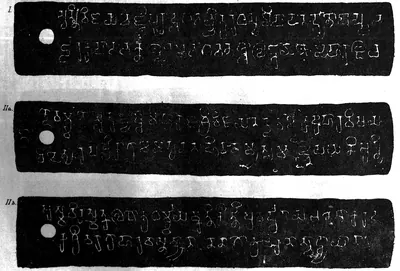 "Copper-plate grant of the kings of the Vengi country": Kollair (Kolleru) grant of the Salankayana Maharaja Vijaya-Nandivarman, plates I, IIa and IIb (Indian Antiquary V, 1876, plate at p. 176 (PDF p. 214))Inscription rubbing · 1876
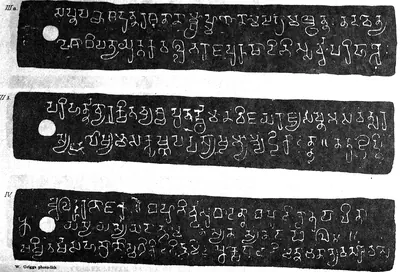 "Copper-plate grant of the kings of the Vengi country": Kollair (Kolleru) grant of the Salankayana Maharaja Vijaya-Nandivarman, plates IIIa, IIIb and IV (Indian Antiquary V, 1876, plate at p. 177 (PDF p. 215))Inscription rubbing · 1876
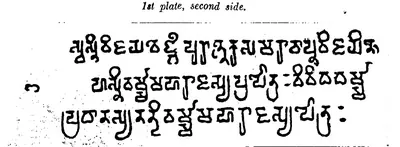 "Pedavegi Copper-plates of Nandivarman II": "1st plate, second side" (eye-copy) (Journal of the Andhra Historical Research Society I, pt. 2, Oct. 1926, p. 101 (PDF p. 122))Drawing · 1926
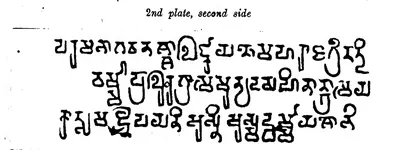 "Pedavegi Copper-plates of Nandivarman II": "2nd plate, second side" (eye-copy) (Journal of the Andhra Historical Research Society I, pt. 2, Oct. 1926, p. 102 (PDF p. 123))Drawing · 1926
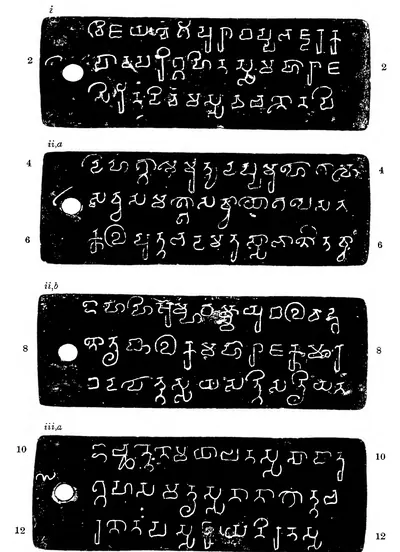 "Two Salankayana Charters from Kanukollu-Plate I. A.-Plates of Nandivarman (I), Year 14": plates i to iii a (Epigraphia Indica XXXI, Plate I, left half, between pp. 4 and 5 (PDF p. 24))Inscription rubbing · 1960
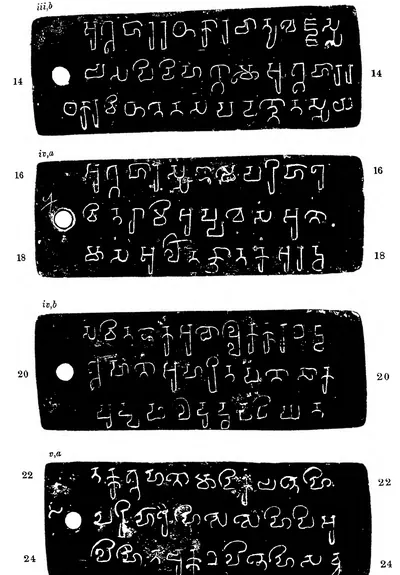 "Two Salankayana Charters from Kanukollu-Plate I. A.-Plates of Nandivarman (I), Year 14": plates iii b to v a (Epigraphia Indica XXXI, Plate I, right half, between pp. 4 and 5 (PDF p. 25))Inscription rubbing · 1960
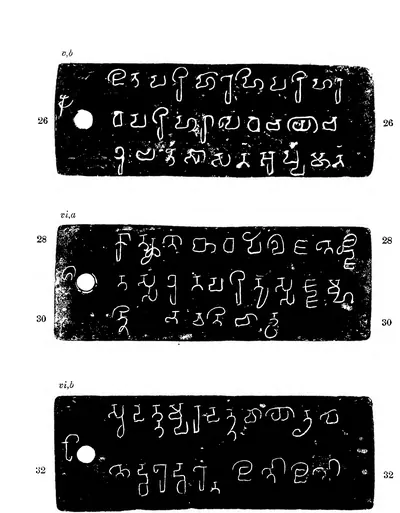 "Two Salankayana Charters from Kanukollu-Plate II. A.-Plates of Nandivarman (I), Year 14": plates v b to vi b (Epigraphia Indica XXXI, Plate II, left half, between pp. 6 and 7 (PDF p. 28))Inscription rubbing · 1960
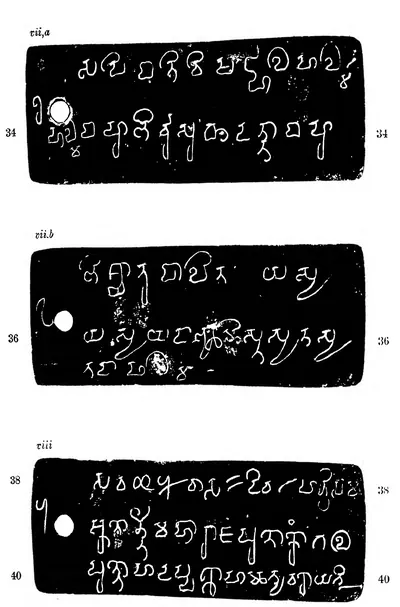 "Two Salankayana Charters from Kanukollu-Plate II. A.-Plates of Nandivarman (I), Year 14": plates vii a to viii (Epigraphia Indica XXXI, Plate II, right half, between pp. 6 and 7 (PDF p. 29))Inscription rubbing · 1960
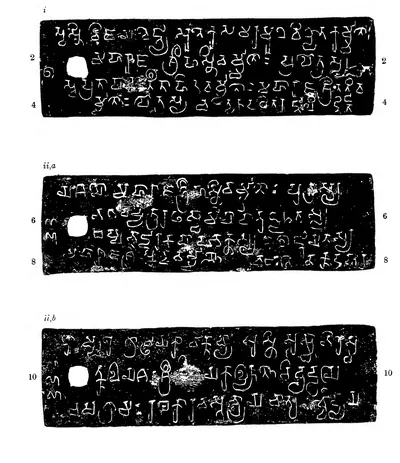 "Two Salankayana Charters from Kanukollu-Plate III. B.-Plates of Skandavarman, Year 1": plates i to ii b (Epigraphia Indica XXXI, Plate III, left half, between pp. 8 and 9 (PDF p. 32))Inscription rubbing · 1960
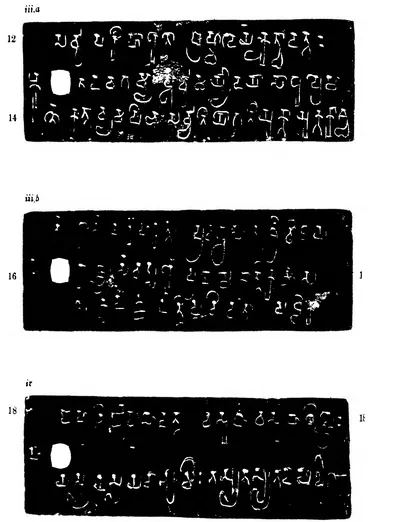 "Two Salankayana Charters from Kanukollu-Plate III. B.-Plates of Skandavarman, Year 1": plates iii a to iv (Epigraphia Indica XXXI, Plate III, right half, between pp. 8 and 9 (PDF p. 33))Inscription rubbing · 1960
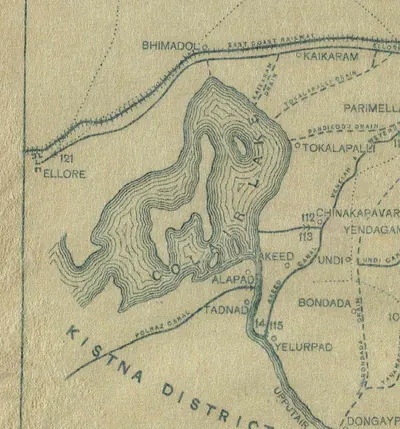 Ellore and Colair (Kolleru) Lake, detail of the "Sketch Map of the Godavari Delta showing positions of the principal irrigation & navigation works" (Walch 1896, folding map, PDF p. 17)Map · 1896
 Ellore Prakrit grant: "Plates of Vijaya-Devavarman", plates i, ii a and ii b (Epigraphia Indica IX, plate between pp. 58 and 59 (PDF p. 83))Inscription rubbing · 1908
References
Notes (0)
Sources (16)
Spotted an error on this page? Tell us
Last updated: