Udaya Choda II of Kandur
Kandur Choda chief, son of Gokarna. P. V. Parabrahma Sastry identified him with the 'king Udaya' to whom the Kakatiya Prola II gave back a kingdom after capturing Govindaraja. His records run from 1136 to 1176. The Kakatiya Rudradeva married his daughter and left him his fief (land held from a king). An inscription of 1162 at Jedcherla shows his customs officers granting coins called Gokarna-Singa rukas to the god of Kodur.
Rudradeva set up an inscription at the Thousand Pillar Temple in 1163.1 It says that Rudradeva’s father, the Kakatiya Prola II, took one Govindaraja captive and released him.1 It goes on: “and then sportively gave his kingdom to king Udaya”.1
Parabrahma Sastry identified the Udaya of this verse as Udaya Choda II, the son of Gokarna, the Kandur Choda lord of Panugallu.23 See the Kandur Chodas.
Parabrahma Sastry pieced the story together as follows.42 About 1128 Gokarna was killed by his brother Bhima. The Chalukya general Govindaraja, governor of the Kondapalli country, then took part of the Panugallu kingdom. About 1131 Prola II drove Govindaraja out and restored the kingdom to Udaya.42
Parabrahma Sastry dated Udaya Choda’s records from 1136, at Peruru, to 1176, at Nelakondapalli in the Khammam district. He described Udaya’s territory as covering nearly six taluks (sub-districts) of the Nalgonda and Mahbubnagar districts, larger than that of his ancestor Bhima II.5
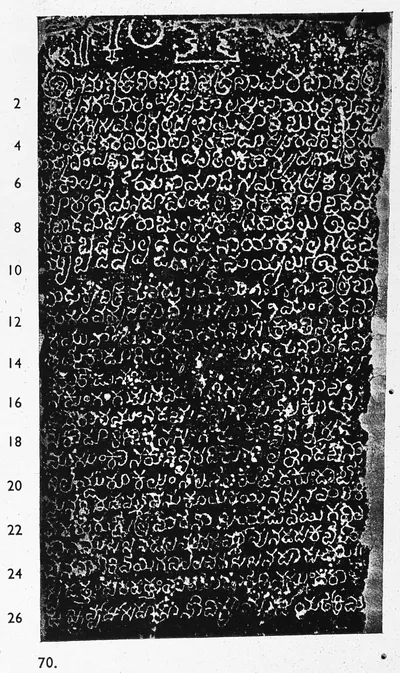
An inscription at Jedcherla in the Mahbubnagar district records a grant by two customs officials of the mahamandalesvara (great provincial lord) Kanduru-Odaya Chola-maharaja.6 They gave the god Svayambhu-Somanatha of Kodur five coins called Gokarna-Singa rukas every month, from the shop dues of Kodur.6 The editor corrected the record’s date to Saka 1084 (Saka is an Indian way of counting years), 25 December 1162.6 See the Jedcherla inscription.
Parabrahma Sastry wrote that when the Kakatiya Rudradeva defeated Bhima and annexed Kandurunadu, he made peace with the rest of the family. Rudradeva married Udaya’s daughter and allowed Udaya to hold his fief as before.7 Rudradeva’s inscription of 1163 calls him the resting-place of the goddess of fortune born from “the lineage of Kandurodaya-Choda”.8
An inscription of 1178 at Mamillapalli, in the Achampet country, names the brothers Bhima and Gokarna, sons of Udayaditya of the line of Karikala-Choda.9 It records their gifts of two villages to the god Narasimha.9 Parabrahma Sastry placed them as Udaya Choda II’s sons, Bhima IV and Gokarna II. After them, he wrote, the family became politically unimportant subordinates of the Kakatiyas.53
Footnotes
-
J. F. Fleet, “Sanskrit and Old-Canarese Inscriptions, No. CXVIII”, Indian Antiquary XI (1882), p. 17 (archive.org (opens in a new tab)). ↩ ↩2 ↩3
-
Parabrahma Sastry, The Kakatiyas of Warangal (1978), p. 80. ↩ ↩2 ↩3
-
Parabrahma Sastry, The Kakatiyas of Warangal (1978), p. 69. ↩ ↩2
-
Parabrahma Sastry, The Kakatiyas of Warangal (1978), p. 79. ↩ ↩2
-
P. V. Parabrahma Sastry, The Kakatiyas of Warangal (1978), pp. 67–68. ↩ ↩2
-
P. Sreenivasachar (ed.), A Corpus of Inscriptions in the Telingana Districts of Andhra Pradesh, Part III (1956), pp. 43–44, Mn. 12 (archive.org (opens in a new tab)). Paraphrased. ↩ ↩2 ↩3
-
Parabrahma Sastry, The Kakatiyas of Warangal (1978), p. 95. ↩
-
Fleet, “Sanskrit and Old-Canarese Inscriptions, No. CXVIII” (1882), p. 18 (archive.org (opens in a new tab)). ↩
-
Sreenivasachar, Corpus, Part III (1956), pp. 61–62, Mn. 26 (archive.org (opens in a new tab)). Paraphrased. ↩ ↩2
Photos
References
Notes (0)
Sources (3)
Spotted an error on this page? Tell us
Last updated: