Bhima Choda III of Kandur
Kandur Choda chief, second son of Tondaya II and Mailamba, for whose welfare his mother founded an agrahara at Panugallu in 1124. The Kakatiya inscription of 1163 accuses a Bhima of killing his brother Gokarna and seizing power after the death of a king Tailapa, and tells how Rudradeva burned his city and drove him into the forest. P. V. Parabrahma Sastry dated his records from 1105 to about 1157.
Bhima was the second of the three sons of Mailamba, and the brother of Udayaditya and Gokarna.1 Her inscription has lost the name of her husband.1 P. V. Parabrahma Sastry took him to be the Kandur Choda chief Tondaya II.2 See Tondaya II and the Kandur Chodas. His mother’s inscription at Panugallu, dated in Saka 1046 (1124; Saka is an Indian way of counting years), compares him with his namesake, the Pandava hero Bhima, for the strength of his arms. It records that for his welfare she gave an agrahara (village granted to Brahmans) named Choda-Bhima-Narayana-pura to 108 Brahmans.1 See the Panugallu inscription of Mailamba.
P. V. Parabrahma Sastry dated Bhima’s earliest record, at Ramalingalagudem near Nalgonda, to 1105. He took an inscription of a Bhima Choda at Kistapuram in the Nalgonda district, which he dated to 1157, as evidence that the same Bhima was still alive then.23 In his reconstruction the Chalukya prince Kumara Tailapa gave the Kandur district to Bhima and the Panugallu district to his brother Gokarna. Bhima stopped naming the Chalukya king in his records after 1126 and joined Tailapa against the loyal Gokarna, whom he killed about 1128.345
The Kakatiya Rudradeva’s inscription of 1163 at Hanamkonda tells the story from the winners’ side. In J. F. Fleet’s translation the serpent Gokarna “died instantly when he was seized by the terrible mungoose Bhima”. Though king Tailapa had died, “yet Bhima assumed a transitory position of sovereignty”. The poem calls Bhima “the slayer of the best of brothers while he was engaged in eating”. Rudradeva burned the city of Vardhamananagari, and Bhima fled into the forests “accompanied by his brother, his mother, and his wife”.6 See the Thousand Pillar Temple inscription and Rudradeva. Parabrahma Sastry concluded that, by vanquishing Bhima, Rudradeva annexed Kandurunadu to the Kakatiya kingdom.7
Footnotes
-
P. Sreenivasachar (ed.), A Corpus of Inscriptions in the Telingana Districts of H.E.H. the Nizam’s Dominions, Part II (1940), pp. 105–108, No. 36, verses 5–8 (archive.org (opens in a new tab)). Paraphrased. ↩ ↩2 ↩3
-
P. V. Parabrahma Sastry, The Kakatiyas of Warangal (1978), p. 65. ↩ ↩2
-
Parabrahma Sastry, The Kakatiyas of Warangal (1978), p. 66. ↩ ↩2
-
Parabrahma Sastry, The Kakatiyas of Warangal (1978), pp. 78–79. ↩
-
Parabrahma Sastry, The Kakatiyas of Warangal (1978), p. 83. ↩
-
J. F. Fleet, “Sanskrit and Old-Canarese Inscriptions, No. CXVIII”, Indian Antiquary XI (1882), p. 18 (archive.org (opens in a new tab)). ↩
-
Parabrahma Sastry, The Kakatiyas of Warangal (1978), p. 95. ↩
Photos
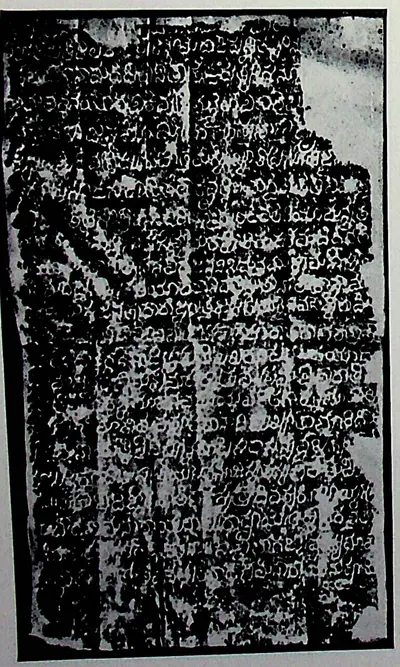 Panugal inscription of Mailamba, side I (A Corpus of Inscriptions in the Telingana Districts, Part II, Plate 35 (PDF p. 290))Inscription rubbing · 1940
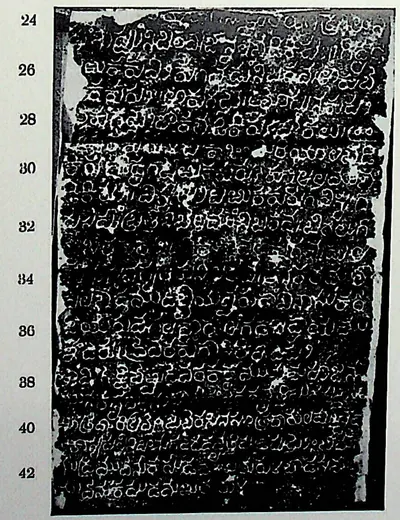 Panugal inscription of Mailamba, side II (A Corpus of Inscriptions in the Telingana Districts, Part II, Plate 35 (PDF p. 290))Inscription rubbing · 1940
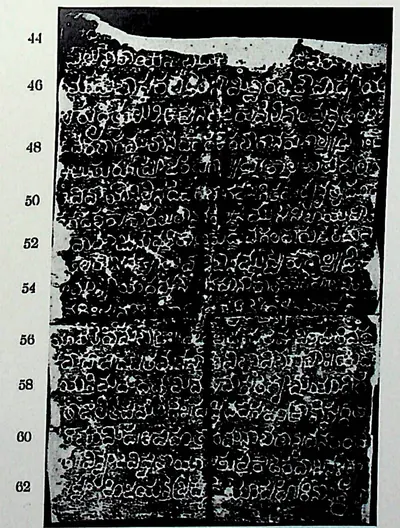 Panugal inscription of Mailamba, side III (A Corpus of Inscriptions in the Telingana Districts, Part II, Plate 35 (PDF p. 290))Inscription rubbing · 1940
References
Notes (0)
Sources (3)
Spotted an error on this page? Tell us
Last updated: