Chandavolu (Chandole)
Village in the western Krishna delta, the old Tsandavolu of the Repalle taluk. E. Hultzsch identified it with Sanadavrolu, the capital of the Velanati Chodas. Gordon Mackenzie (1883) described it as a place of great antiquity, with temple inscriptions of the 1150s–1170s, finds of gold and the foundations of extensive buildings. It appears in the ballad of the Palnadu heroes.
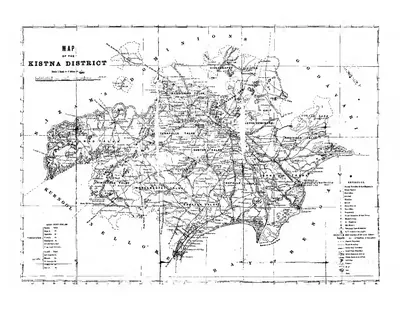
Chandavolu, written Tsandavolu in the 19th-century records, lies in the western delta of the Krishna. It was formerly in the Repalle taluk of the Kistna district.12
E. Hultzsch noted an inscription at Draksharama which says that the Velanati chief Gonka III resided at Sanadavrolu in Velanandu.1 He identified Sanadavrolu with “the modern Tsandavolu, a name which closely resembles Sanadavrolu, as the former capital of the chiefs of Velanandu”.1 Gordon Mackenzie’s Kistna District Manual (1883) calls Velnad “an old name for all the Tsandavolu country”.3 It says that the early Telugu settlers called the Tsandavolu country Velnadu, “the outer or nether land”.4 See the Velanati Chodas.
In the inscriptions
Copper plates of the Velanati chief Rajendra Choda II were issued at Dhanadapuri in Saka 1091 (Saka is an Indian way of counting years).5 H. Krishna Sastri identified Dhanadapuri with Tsandavolu.5 An inscription noted in the Annual Report on Epigraphy for 1916 names a temple of Pandisvara at Sanadavrolu.6 A dancer in its service, Sokkama, was the mother of Kamidevi, a wife of Gonka III.6
After the Kakatiya conquest Ganapatideva’s general Jaya set up an inscription here too.7 Hultzsch found it on a pillar built into the roof of the Lingodbhavasvamin temple at “Tsandavolu, the capital of the chiefs of Velanandu”.7 The Godavari District Gazetteer took this inscription as evidence that the Kakatiya king overcame the Velanandu chiefs.8
The village in the 19th century
Mackenzie described Tsandavolu as “a place of very great antiquity”.2 It had a mound outside the village that might contain Buddhist remains.2 There were four inscriptions in the temple, three of them dated in 1154, 1171 and 1176.29
Many gold coins had been found there.9 In 1874 workmen came upon masses of molten gold “as large as bricks”.9 Trenches dug by treasure-seekers had laid bare the masonry foundations of very extensive buildings.9
Robert Sewell (1882) noted that Buddhist or Jaina copper images had been found close by.10 He placed the village nine miles from the coast and fourteen miles south-west of the stupa (relic mound) of Bhattiprolu.10
In the ballad
Sewell summarised the ballad of the heroes of the Palnadu.11 In it, the king Alugu Bhupati married the daughter of a king of Chandavolu, “which is near the sea”.11 Mackenzie noted that the village “is mentioned in ancient Hindu ballads and poems”.2 See the Haihayas of Kona and Palnadu.
Footnotes
-
E. Hultzsch, “Pithapuram Pillar Inscription of Prithvisvara”, Epigraphia Indica IV (1897), p. 33 (archive.org (opens in a new tab)). ↩ ↩2 ↩3
-
Mackenzie, Kistna District Manual (1883), p. 209 (archive.org (opens in a new tab)). ↩ ↩2 ↩3 ↩4 ↩5
-
Mackenzie, Kistna District Manual (1883), p. 214 (archive.org (opens in a new tab)). ↩
-
Gordon Mackenzie, A Manual of the Kistna District (1883), p. 151 (archive.org (opens in a new tab)). ↩
-
Annual Report on Epigraphy, Madras, for 1916–17 (G.O. No. 1035, Home (Education), 10 August 1917), Part II, para. 27, p. 120 (archive.org (opens in a new tab)). ↩ ↩2
-
Annual Report on Epigraphy, Madras, for 1915–16 (G.O. No. 99, Home (Miscellaneous), 29 August 1916), Part II, para. 49, p. 134 (archive.org (opens in a new tab)). ↩ ↩2
-
E. Hultzsch, “Chebrolu Inscription of Jaya”, Epigraphia Indica V (1899), p. 150, postscript (archive.org (opens in a new tab)). ↩ ↩2
-
F. R. Hemingway, Madras District Gazetteers: Godavari, Vol. I (1907), p. 24 (archive.org (opens in a new tab)). ↩
-
Mackenzie, Kistna District Manual (1883), p. 210 (archive.org (opens in a new tab)). ↩ ↩2 ↩3 ↩4
-
Robert Sewell, Lists of the Antiquarian Remains in the Presidency of Madras, Vol. I (1882), Appendix A, p. iii, note 3 (archive.org (opens in a new tab)). ↩ ↩2
-
Sewell, Lists of Antiquarian Remains, Vol. I (1882), Appendix A, p. v (archive.org (opens in a new tab)). ↩ ↩2
Photos
References
Notes (0)
Sources (6)
Spotted an error on this page? Tell us
Last updated: