Dowleswaram
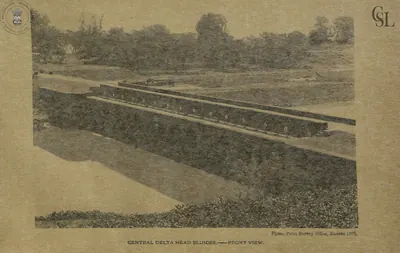
Town on the Godavari, four and a half miles below Rajahmundry, at the head of the delta. Arthur Cotton's great anicut (dam) was built across the river here in 1847–52. In 1907 it was the headquarters of two Executive Engineers and of the Public Works workshops. It is a specially holy bathing place, the last point at which the Godavari flows undivided.
Dowleswaram is a town on the Godavari, at the head of the river’s delta.123 In 1907 the Godavari gazetteer said it “is now widely known as the site of Sir Arthur Cotton’s great anicut” (a dam that feeds canals) “across the Godavari”.1
According to the gazetteer, Dowleswaram lies “four and a half miles south of Rajahmundry”.1 It had 10,304 inhabitants.1 It was the headquarters of two Executive Engineers and of the Public Works workshops.1 It had a local fund dispensary founded in 1892, and an endowed choultry (rest house for travellers).1
The Imperial Gazetteer places the head of the Godavari delta here, 40 miles in a straight line from the Bay of Bengal.23 This is just above the point where the river divides into the Gautami and Vasishta branches.23 See Rajahmundry.
The anicut
The gazetteer explains why Cotton chose a site just below Dowleswaram.4 The river was nearly four miles wide there, but it was broken by islands.4 A hill of coarse sandstone close by gave stone “of a degree of hardness exactly suited to the case”.4
Work began in April 1847 with 10,200 labourers.56 At the entrance to the town there is what looks like a town wall.56 The gazetteer adds that it “is really only the bank of the old railway constructed to bring materials from the quarry to the river for the building of the anicut”.56 The dam and its history are described on the page Dowleswaram anicut (dam). See also Arthur Cotton.
A holy bathing place
The gazetteer says that the name comes from the nearby hill of Daulagiri.16 The sage Narada is said to have founded the temple of Janardhanasvami there.16 Two footprints in the rock at the Anjaneya temple are believed to be those of Rama and Sita.6 So the place is called “the holy place of Rama’s feet”.6
Dowleswaram is “the last place at which the waters of the Godavari flow down united and undiminished”.6 For this reason it is one of the holiest bathing places on the river.6 Great crowds come to bathe there at the pushkaram festival.6 The town also had a small European church and cemetery, and brass-workers and wood-carvers.6
Footnotes
-
Hemingway, Godavari (1907), p. 240, s.v. Dowlaishweram (archive.org (opens in a new tab)). ↩ ↩2 ↩3 ↩4 ↩5 ↩6 ↩7 ↩8
-
Imperial Gazetteer of India: Madras, Vol. I (1908), p. 164, s.v. Godavari Canals (archive.org (opens in a new tab)). ↩ ↩2 ↩3
-
Imperial Gazetteer: Madras, Vol. I (1908), p. 165 (archive.org (opens in a new tab)). ↩ ↩2 ↩3
-
F. R. Hemingway, Madras District Gazetteers: Godavari, Vol. I (1907), p. 80 (archive.org (opens in a new tab)). ↩ ↩2 ↩3
-
Hemingway, Godavari (1907), p. 82 (archive.org (opens in a new tab)). ↩ ↩2 ↩3
-
Hemingway, Godavari (1907), p. 241 (archive.org (opens in a new tab)). ↩ ↩2 ↩3 ↩4 ↩5 ↩6 ↩7 ↩8 ↩9 ↩10 ↩11
Photos
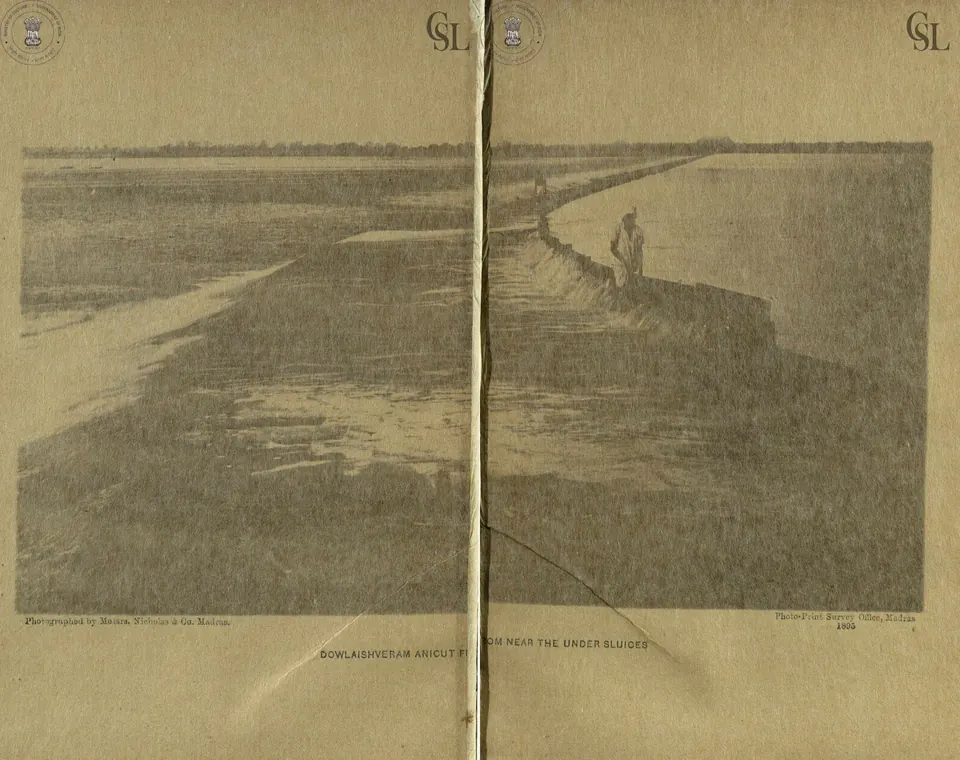
 "Dowlaishveram Anicut from near the under sluices" (photograph by Messrs. Nicholas & Co., two halves joined) (Walch 1896, PDF pp. 81-82)Historic photograph · 1896
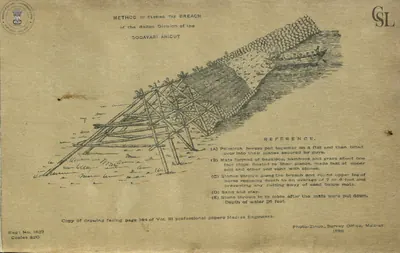 Godavari anicut: "Method of closing the breach of the Ralli division of the Godavari anicut" (Walch 1896, PDF p. 68)Drawing · 1896
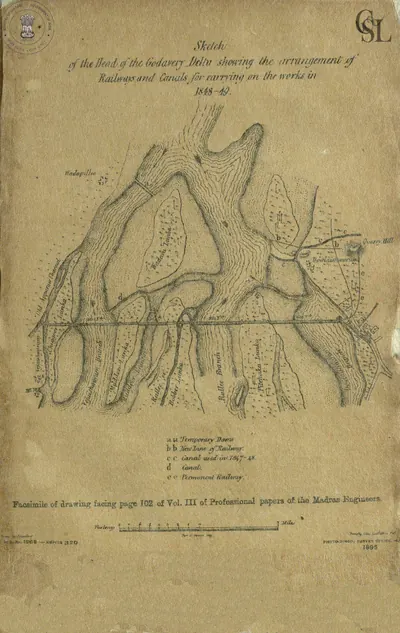 Godavari delta: "Sketch of the Head of the Godavery Delta showing the arrangement of" railways and canals for carrying on the works in 1848-49 (Walch 1896, facsimile, PDF p. 58)Map · 1896
Related
Monuments
References
Notes (0)
Sources (2)
Spotted an error on this page? Tell us
Last updated: